Icon Oncology Group has confirmed that an intruder reached patient information held on a supplier’s system, in an incident touching Australia’s largest cancer care provider. A forum seller now claims to be offering tens of thousands of the documents, and UK healthcare should take note of where the weak point sat.
What happened
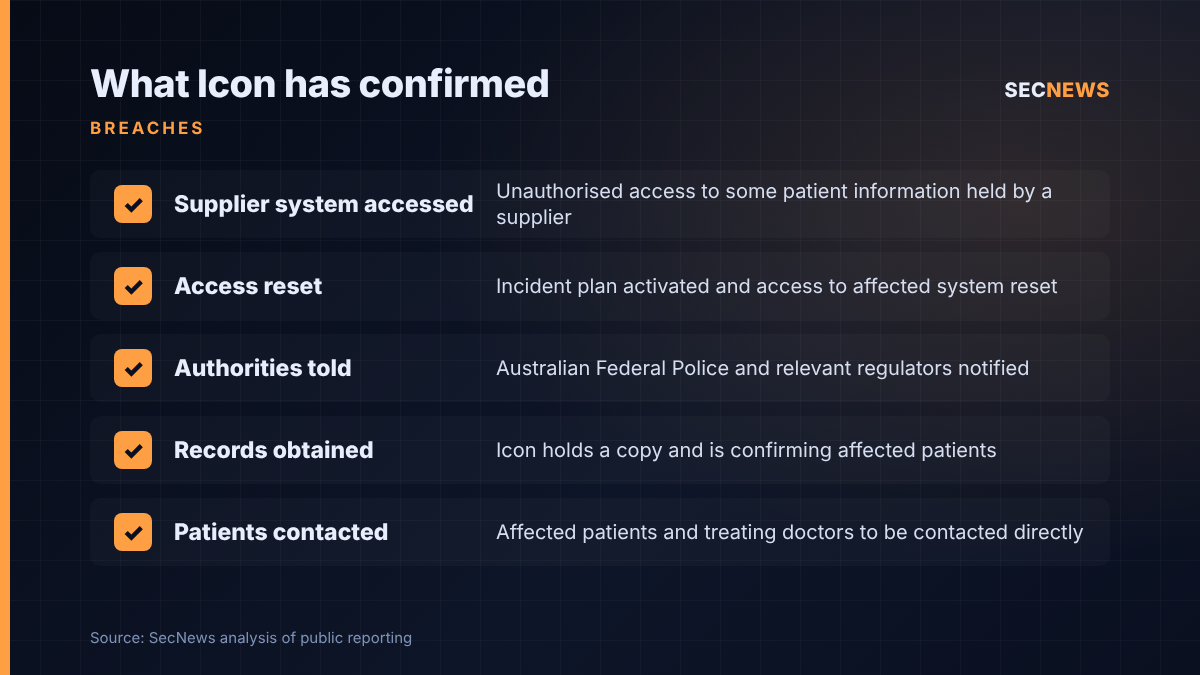
On 12 October 2026, Icon Oncology Group, part of Icon Group, published a notice on its website confirming it was dealing with a data breach involving “unauthorised access to some patient information”. The information was not taken from Icon’s own estate. It sat on a system operated by a supplier, which the group has not named.
Icon says that on discovering the intrusion it invoked its incident plan, reset access to the system concerned, and brought in outside forensic and security specialists. It has also informed regulators and the Australian Federal Police. The group says it has obtained a copy of the affected records and is now working out exactly which patients and which details are involved. It will contact affected patients, and their treating doctors, directly. According to the notice, the incident appears to be limited to Australia, Icon’s own systems are secure, and treatment has carried on as normal.
The disclosure came two days after the data appeared for sale. According to Cyber Daily, which broke the story, and DataBreaches.net, which republished the report, a seller using the handle “2019” is advertising more than 31,000 “sensitive and confidential documents” on an underground forum as a single sale for cryptocurrency. Cyber Daily reports that, according to the listing, the files hold Medicare details, diagnoses, addresses and patient names. Icon has not confirmed the number of documents or what the listing says they contain. Cyber Daily also reports that the actor has been active since January 2026 and focuses on Australian organisations.
The detail
The most useful line in Icon’s statement is its description of the records. The group believes they are individual items of business correspondence rather than full patient records. That is a real distinction, and it probably narrows the clinical depth of what was exposed. It should not be read as reassurance, though. In oncology, correspondence covers referral letters, treatment summaries, letters between consultants and GPs, appointment confirmations and billing paperwork. One referral letter can carry a name, home address, date of birth, diagnosis and planned treatment in a few paragraphs of plain text.
Several important facts are still unknown. Icon has not named the supplier or said what service it provides, whether that is document management, transcription, outsourced printing and posting, or a cloud collaboration platform. It has not explained how the attacker got in or how long they had access. The fact that Icon focused on resetting access suggests the way in was a credential or an access route rather than malware that encrypted systems, but that is my reading, not something Icon has said. None of the reporting so far links the incident to a ransomware group.
Why it matters for UK organisations
Icon Group lists the United Kingdom among its markets alongside Australia, New Zealand and Asia, and it has been growing its UK presence, including through the acquisition of specialist pharmaceutical business Pharmaxo. To be clear, Icon says this incident appears to affect Australia only, and nothing in the reporting so far suggests UK patients are involved. The UK lesson is about the structure of the breach, not direct exposure.
British healthcare has already paid heavily for supplier risk. The June 2024 ransomware attack on pathology provider Synnovis, claimed by Qilin, disrupted London hospitals, and stolen test data was still causing notifications almost two years later. By early June 2026 Bedfordshire Hospitals NHS Foundation Trust had said nearly 33,000 of its patients were affected, and Mid and South Essex NHS Foundation Trust put its initial figure at 2,380 records. Synnovis has said that the healthcare provider, as data controller, carries the duty to tell patients.
That duty is the same under UK GDPR whoever holds the data. A controller must report a notifiable breach to the ICO within 72 hours of becoming aware of it, and that deadline does not stop while a supplier finishes its forensic work. Private hospitals, independent sector providers, pharmacies and GP federations depend heavily on third-party platforms for letters, dictation, e-referrals and outsourced mail. The Cyber Security and Resilience Bill is set to bring more service providers into regulatory scope and give regulators powers over critical suppliers.
Expert view
When we test healthcare organisations, the core clinical systems are often in reasonable shape. The leaks tend to come from the correspondence path: shared mailboxes, scanning bureaux, transcription services and letter-outsourcing portals that sit outside the main identity platform, often with single-factor logins and stale accounts. Contracts usually contain the right wording about security. What is missing, in my experience, is anyone checking that the wording matches what is actually configured.
Icon’s description of the records as correspondence also shows a gap between how defenders and attackers value data. To a records manager, a letter is less sensitive than a full chart. To a criminal, a readable letter that combines identity with a cancer diagnosis is ideal material for targeted fraud, fake billing demands and extortion of individual patients. Organisations should rank document stores at least as highly as structured databases when they assess risk.
Icon’s ability to work from its own copy of the records is the positive point. Many organisations could not obtain that from a supplier within days.
What to do now
- Map the correspondence trail. List every supplier that stores, prints, transcribes or sends patient letters, and record it in your record of processing activities.
- Bring supplier portals under your identity controls. Require multi-factor authentication and, where possible, single sign-on through your own identity provider so you can revoke access centrally. This maps to the Cyber Essentials user access control requirement.
- Clean up accounts. Remove leavers, shared logins and dormant supplier accounts, and review privileged access every quarter. This is another user access control requirement.
- Minimise retention. Agree in contracts that suppliers delete documents once delivery or transcription is complete.
- Tighten assurance. Require breach notification within hours, not days, plus audit rights and access to logs. Ask for Cyber Essentials Plus and, for NHS suppliers, a current Data Security and Protection Toolkit submission.
- Rehearse a supplier breach. Run a tabletop exercise covering the 72-hour ICO deadline, how to obtain affected records, patient communications and monitoring of criminal forums.
- Warn patients early. Tell them to expect convincing follow-up scams that quote real appointment or diagnosis details.
Bottom line
Icon has handled the visible part of this incident sensibly: it disclosed publicly, involved the police and is working from a copy of the records. The breach still happened in a place many healthcare providers barely watch, a supplier’s document system. For UK organisations, the question is not whether Icon’s UK operations are affected, which the group says appears not to be the case. It is whether you could name every supplier holding your patients’ letters today, and whether any of them still relies on a password alone.
Sources
- Icon Group: Important notification – data breach incident
- Cyber Daily: Exclusive: Australian patient data compromised in Icon Cancer Centre hack
- DataBreaches.net: Australian patient data compromised in Icon Cancer Centre hack
- Icon Group: About Icon Group
- Silicon UK: Essex NHS Trust alerts patients over stolen data