Cisco has confirmed attackers are exploiting a second Secure Email Gateway zero-day in as many months, this time a flaw that turns a single malicious attachment into root access. With no workaround and a CISA deadline of 17 October, UK organisations running on-premises Cisco mail filtering should treat this as an emergency change.
What happened
On Wednesday 14 October 2026 Cisco published advisory cisco-sa-esa-afw-zqYJkjxp for CVE-2026-76519, a critical vulnerability in Cisco Secure Email Gateway, the appliance many organisations still know by its older names, ESA or IronPort. The flaw carries a CVSS 3.1 base score of 9.8. Cisco says its Product Security Incident Response Team learned during October that it was being exploited in real attacks.
The US Cybersecurity and Infrastructure Security Agency (CISA) added CVE-2026-76519 to its Known Exploited Vulnerabilities (KEV) catalogue the same day. Federal agencies have until 17 October to remediate, an unusually short three-day window. CISA also flags the entry for forensic triage, so agencies are expected to look for signs of compromise as well as patch.
This is not the first time this autumn. In September Cisco patched CVE-2026-76461, a separate, actively exploited SQL injection flaw in the same product’s email parsing that also gave unauthenticated attackers root. Cisco has not said who is behind the new attacks or how many customers are affected, although it has contacted Secure Email Cloud customers where it found signs of compromise.
The technical picture
The vulnerability lives inside Cisco’s Advanced Malware Protection (AMP) component, in how the appliance processes attachments when the File Reputation service is switched on. CISA classes it as a relative path traversal weakness (CWE-23). In practical terms, a remote attacker with no credentials can send an email carrying a crafted attachment through an affected gateway. If successful, the attacker can write files of their choosing to the underlying operating system and run commands as root.
Two conditions must both be true for an on-premises appliance to be exposed. File Reputation must be switched on within at least one mail policy, inbound or outbound, and the Content Scanner Tools package must be older than version 25.3.0.5525. Physical and virtual gateways are both in scope. Cisco’s Secure Web Appliance and its Secure Email and Web Manager are not affected.
The fix comes in two forms. The quickest route is to update Content Scanner Tools to 25.3.0.5525 or later, which Cisco distributes to all supported AsyncOS releases and which needs neither a software upgrade nor a reboot. The longer-term fix is a fixed AsyncOS release: 15.5.5-014 for the 15.5 train or 16.5.0-780 for 16.5. Customers on 16.0 must migrate, and Cisco’s preferred target for anyone below 16.5 is 16.5.0-780. Cisco has already deployed the fixed scanner package across its hosted Secure Email Cloud service. There is no workaround.
Cisco’s compromise guidance is worth reading closely. The appliance includes a log check for “System Security” messages that reports whether a compromise indicator was found. Because exploitation yields root, however, Cisco warns that attackers may wipe their tracks, and urges customers to corroborate with firewall and network logs held elsewhere. It also points out that clustered gateways share SSH key pairs, so one compromised node could expose the others.
Why it matters for UK organisations
Email security gateways sit in an awkward place. They accept untrusted input from anyone on the internet by design, they usually live in a DMZ with routes into internal mail servers, and they hold credentials, certificates and directory integrations. A flaw that needs nothing more than an inbound email is about as low-friction as initial access gets: the attacker does not need to find an exposed management interface, steal a password or persuade a user to click anything.
Plenty of UK organisations still filter mail through on-premises Cisco gateways. According to BleepingComputer, Shadowserver tracks nearly 300 Secure Email Gateway instances exposed online, though it is not clear how many are honeypots or already secured. A headline count is not the whole picture either: a gateway’s job is to accept mail from the internet, so any unpatched appliance with File Reputation enabled is reachable by the attack.
For organisations that will fall within the Cyber Security and Resilience Bill, and for operators already under the NIS Regulations, an email gateway compromise is exactly the kind of event that can turn into a reportable incident: mail interception, credential theft and onward movement into core systems.
Expert view
In my experience, email gateways are among the least scrutinised boxes on the network. They are bought as a security control, so they rarely get treated as an attack surface in their own right. When we test perimeter estates, mail filtering appliances often run older firmware than the firewalls around them, with automatic content updates disabled because someone once worried about a bad signature push. That habit matters here, because the fastest fix is precisely one of those content updates.
Two back-to-back root-level zero-days in the same product is a signal in itself. Someone is investing in this platform, and the attachment-handling and parsing code clearly offers a rich seam. I would assume further research, and further exploitation, will follow.
I would also caution against reading “Cisco contacted affected cloud customers” as reassurance for everyone else. On-premises owners are on their own for detection, and root access gives an intruder every opportunity to tidy up. If your gateway has been exposed since the start of October with an old scanner package, assume compromise until evidence from outside the box says otherwise.
What to do now
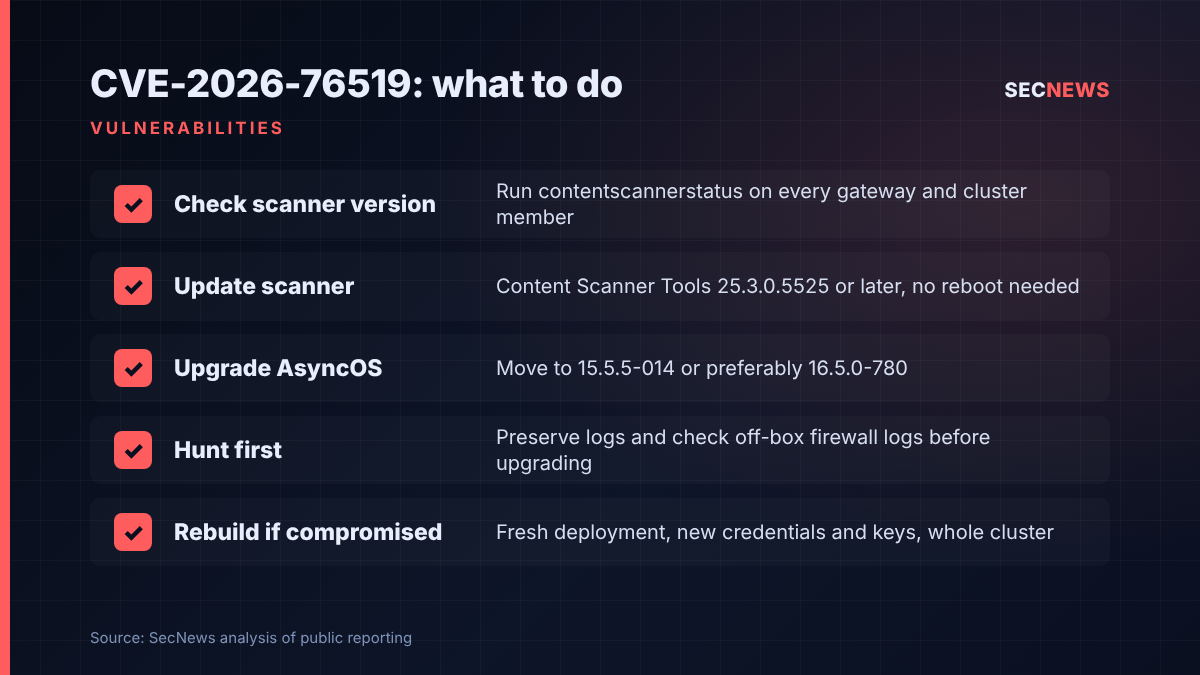
- Update Content Scanner Tools today. Run contentscannerstatus on every gateway and cluster member. Anything below 25.3.0.5525 needs updating, manually if automatic updates are off. This maps to the Cyber Essentials security update management control, which expects critical fixes within 14 days; this one warrants hours, not days.
- Plan the AsyncOS upgrade. Move to 15.5.5-014 or, preferably, 16.5.0-780. Anyone on 16.0 must migrate.
- Hunt before you patch. Upgrading can destroy forensic data, so check the appliance’s “System Security” log output first and preserve logs. Review firewall and proxy logs for unexpected outbound uploads from the gateway or downloads from unfamiliar addresses since early October.
- Rebuild if compromised. For virtual appliances, Cisco advises a fresh deployment on a fixed release, rebuilding the configuration rather than importing it, and renewing all credentials and cryptographic material. Treat every member of an affected cluster as exposed.
- Harden the platform. Separate mail and management interfaces, block internet access to management, send logs to an external collector and enable automatic content updates. This fits the Cyber Essentials firewall and secure configuration controls.
- Check September too. If CVE-2026-76461 was never patched, you have two open root-level holes in the same box.
Bottom line
CVE-2026-76519 lets an attacker gain root on a Cisco email gateway simply by sending it mail, and it is already being used. The fix is a scanner update that needs no restart, so there is little excuse for delay. Patch now, then look hard at logs held off the appliance, because by the time you read the advisory an attacker may already have been inside for days.
Sources
- Cisco: Cisco Secure Email Gateway Arbitrary File Write Vulnerability (cisco-sa-esa-afw-zqYJkjxp)
- CISA: Known Exploited Vulnerabilities Catalog (CVE-2026-76519)
- BleepingComputer: Cisco patches new Secure Email Gateway zero-day exploited in attacks
- RedLegg: Emergency Security Bulletin: Arbitrary File Write Vulnerability in Cisco Secure Email Gateway Advanced Malware Protection
- SecurityOnline: Critical Cisco Secure Email Gateway Vulnerability CVE-2026-76519 Actively Exploited in the Wild