Acronis has replaced its chief executive with Prakash Panjwani, who spent a decade running WatchGuard, and signalled a continued focus on selling through managed service providers. For UK businesses that get their backup and endpoint protection through an MSP, a change at the top of the vendor matters more than it might seem.
What happened
On 16 October 2026 Acronis announced that Prakash Panjwani is its new chief executive, with immediate effect. He takes over from Jan-Jaap “JJ” Jager, who leaves the role but keeps his shareholding. According to ChannelWeb, Jager had only become CEO in November 2025, so this is the second change at the top in under a year.
Warren Adelman, who chairs the Acronis board, made the announcement. He thanked Jager for his work on AI features and partner growth. He said Panjwani was chosen for his security background, his record of scaling global platforms, his knowledge of the MSP market and his experience of growing businesses both organically and through acquisitions.
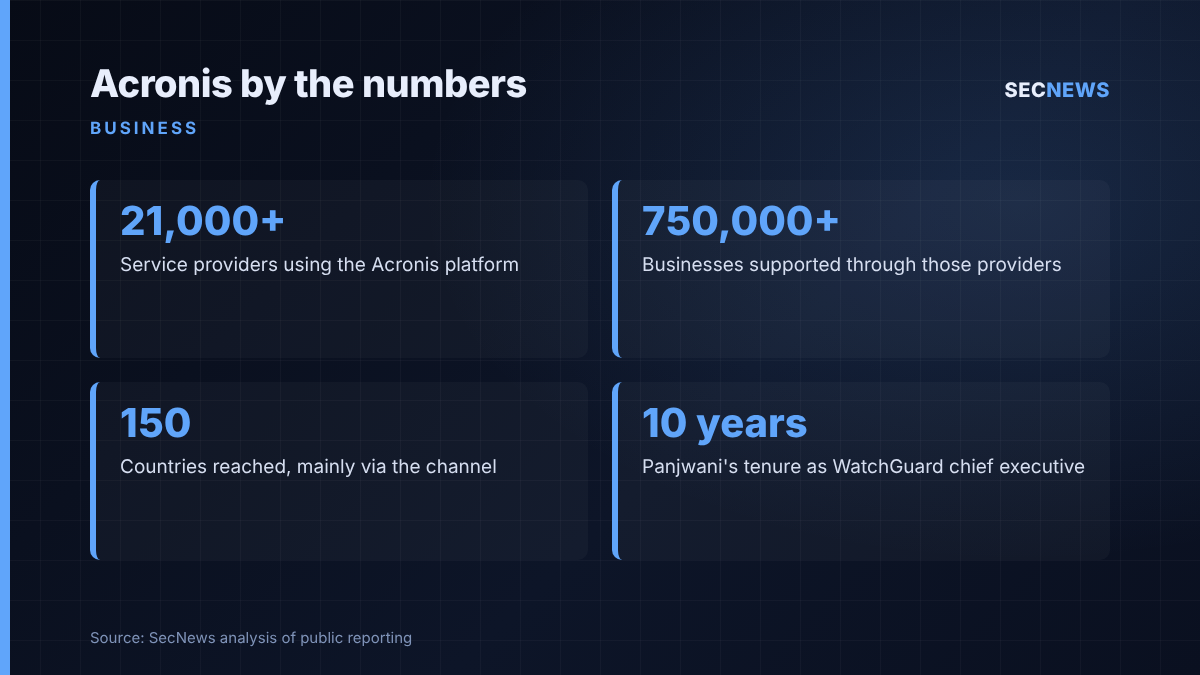
Panjwani is a well-known figure in the security channel. Before Acronis he was chief executive of WatchGuard Technologies and, before that, SafeNet. In his ten years at WatchGuard the company moved from being mainly a firewall vendor to selling a wider platform. Over that period it added EDR, XDR and MDR services, much of it sold and run through partners.
The detail
Acronis is headquartered in Schaffhausen, Switzerland. It sells software that combines cyber protection, backup and recovery, IT operations and hybrid infrastructure management. Most of it reaches customers through the channel. It says its platform is used by over 21,000 service providers, which between them support more than 750,000 businesses in 150 countries.
The board’s statement leaves little doubt about strategy. Panjwani’s job is to bring security, data protection, infrastructure management and service automation together in one integrated platform built for MSPs. In his own comments he called Acronis “an AI-native cyber platform” and said service providers should adopt tools designed for cyber protection from the start, using automation to cut the cost of delivering services to their clients.
Three points stand out to me. First, the board specifically mentioned M&A when explaining the choice. That may hint at acquisitions to fill gaps in the product range, perhaps in detection and response, where WatchGuard grew under Panjwani, though Acronis has announced no deals. Second, the leadership has been changing for a while. ChannelWeb reports that Acronis recently named Gerald Caron as chief information security officer and brought in Jim Tedesco as chief revenue officer in May. Third, backup vendors and endpoint or network security vendors are now chasing the same MSP budget, each hoping to become the one console a provider uses for every customer.
Why it matters for UK organisations
Most small and medium-sized UK firms never buy security software directly. A managed service provider handles their backups, endpoint agents, patching and often their Microsoft 365 setup. Vendors like Acronis sit underneath those providers. So the vendor’s priorities, prices and product roadmap reach thousands of UK businesses that may never have heard of it.
The regulatory picture is changing too. The Cyber Security and Resilience Bill would bring managed service providers into the UK’s regulatory regime for the first time and add a 24-hour initial incident reporting requirement. As MSPs prepare for that, they will look harder at the platforms they depend on. That includes how well those platforms log and report activity, how they handle privileged access across customer estates, and whether the vendor can show its own security is in good order. A vendor committing to the MSP channel needs to be ready for those questions.
There is also concentration risk. When an MSP runs security and backup for every client from one console, a weakness in that console reaches all of them. Consolidation saves cost but creates a single point of failure.
Expert view
A new chief executive does not change the code on your servers on day one. Over the next year, though, pricing, licensing, product priorities and which acquired tools reach the main platform can all shift. In my experience, that is where the risk for customers lies.
The “single pane of glass” pitch is attractive to MSPs, and it makes sense. A small provider with a stretched team cannot run six consoles well. However, when we test MSP environments, the weaknesses tend to be the same each time. Remote management and backup consoles are too often reachable from the internet. Technician accounts are shared or lack strong MFA. One set of credentials reaches far too many customer tenants. A combined security and backup platform increases the damage if any of those go wrong. If an attacker can reach the system that both protects and restores your data, they can switch off the protection and delete the backups in the same session.
So I would judge this appointment on what follows it. Do Acronis’s MSP products get stronger tenant separation, phishing-resistant authentication for technicians, immutable backup storage that is on by default, and audit logs an MSP can pass to its customers? WatchGuard under Panjwani built a credible managed detection offering for the channel, and if he applies that thinking to Acronis’s backup base, partners could gain from it. If the focus is mainly on adding acquisitions and selling more modules, MSPs will need to keep their own controls strong.
No reason was given for the speed of the change, and I would not read too much into it. Still, two chief executives in roughly a year is a fair prompt for partners to check their contracts and roadmap commitments.
What to do now
- Know your stack. Ask your MSP which platforms it uses to manage, protect and back up your systems, Acronis or otherwise.
- Lock down the management plane. Make sure remote management and backup consoles require phishing-resistant MFA for every technician, have no shared accounts and are not openly exposed online. This matches the Cyber Essentials controls for secure configuration and user access control.
- Protect the backups from the backup tool. Keep at least one immutable or offline copy that an attacker with console admin rights cannot delete. Then test an actual restore from it.
- Check contract and licence terms. Leadership changes often lead to pricing and packaging reviews. MSPs should confirm renewal dates, price-protection clauses and end-of-life commitments for any modules they rely on.
- Prepare for the Bill. MSPs should map how their vendor platforms would support 24-hour incident reporting, including what logs exist, how long they are kept and who can get to them quickly.
- Watch the roadmap. If Acronis announces acquisitions, ask how and when they will be integrated, and how security fixes will be handled across products during the transition.
Bottom line
Hiring Prakash Panjwani is a clear statement that Acronis’s future depends on managed service providers and on putting security and backup together on one platform. For UK businesses whose IT is run by an MSP, this is a good time to check who controls the console that protects your data. Make sure it is properly secured, and keep at least one copy of your backups that the console cannot delete.