The Financial Stability Board has published a final set of 12 sound practices for the use of artificial intelligence in banks, insurers and other financial firms, and it wants boards to own them. The practices are not binding, but the FSB is chaired by the UK’s central bank governor, so UK firms should expect supervisors to use them as a yardstick.
What happened
The Financial Stability Board (FSB), the Basel-based body that coordinates financial regulators across 24 jurisdictions, released on 15 October 2026 its final report on Sound Practices for Responsible Adoption of Artificial Intelligence. A consultative draft came out in June, and the FSB has published a summary of the feedback it received alongside the final text.
Andrew Bailey, who runs the Bank of England, also chairs the FSB. That link is why this matters more in London than most international publications. Computer Weekly and the American Bankers Association’s Banking Journal both reported the release, and the ABA noted that it had pushed during the consultation for a clearer definition of machine learning and for the list to be consolidated so banks of all sizes could apply it.
According to Regulation Tomorrow’s summary of the report, the practices are not a binding international standard. The FSB calls them a toolkit that firms can tailor to their own context and slot into existing control frameworks, with cyber and third-party risk named specifically. It also says it will revise them as the technology moves on.
The detail
The 12 practices fall into two groups. The first four deal with AI as an organisation-wide governance question:
- Strategic direction: boards and senior leaders keep AI adoption aligned with the firm’s business model, risk appetite and strategy.
- Governance and accountability: clearly defined roles and responsibilities, inside a proper governance framework.
- Risk management and documentation: AI risks sit inside the existing risk framework, and firms keep a record of where AI is actually used.
- Organisational adaptability: oversight and capability keep pace as AI changes.
The remaining eight cover the life of each AI use case, from inception to retirement. They ask firms to assess the materiality and risk of every use case at the start and again later; to choose models and systems against business and technical needs; to govern training and test data so it is fit for purpose; to understand how explainable each type of AI is, using compensating controls where it is not; to monitor performance; and to keep human oversight in proportion to how autonomous and complex a system is.
Two of those lifecycle practices are squarely security matters. Practice 11 asks firms to manage AI-related cyber and ICT risk, including by building AI attack scenarios into tests and exercises, sharing information, and using AI tools in their own defences. Practice 12 covers third-party AI dependencies, with explicit attention to transparency, data quality, the supply chain, concentration risk and business continuity.
Why it matters for UK organisations
For FCA and PRA regulated firms this does not arrive in a vacuum. In May 2026 the FCA, the Bank of England and HM Treasury issued a joint statement warning that the cyber capabilities of frontier AI models were already outstripping skilled human practitioners in speed, scale and cost. It told firms to make sure boards understand frontier AI risk, to speed up vulnerability triage and remediation, and to manage AI cyber risk across third parties and open-source dependencies, all under the existing operational resilience rules. In September the FCA followed with observations from firms on frontier AI and cyber resilience, highlighting human oversight, clear ownership of AI decisions and the risk of a wave of vulnerability findings swamping change processes.
The FSB practices give that UK direction an international structure. A supervisor now has a 12-point list it can use for questions, and the chair of the body that wrote it also runs the Bank of England. Resultsense’s analysis made the same point: boards unable to evidence an AI inventory and materiality ratings should be ready for scrutiny.
The third-party practice also sits neatly beside the UK’s critical third parties regime. Since 13 July 2026, Microsoft, Google Cloud, Amazon Web Services and Oracle have been designated by HM Treasury and fall under direct oversight by the PRA, FCA and Bank of England. Concentration risk in a few AI model suppliers is the same problem in a new form. Outside financial services the practices have no formal force, but they make a useful template for anyone explaining AI governance to auditors or insurers.
Expert view
I welcome this, mainly because it is not new law. Most firms I deal with do not need another rulebook. They need to apply the controls they already have to systems they barely realise they are running. The first practical hurdle is the inventory. When we test financial services estates, AI is rarely limited to the sanctioned pilot. It sits inside SaaS features, developer tooling, browser extensions and supplier platforms, often without a single risk record attached.
Practice 11 is where security teams should start. Putting AI attack scenarios into exercises means testing what happens when an agent with broad permissions is manipulated through prompt injection, when a model API key leaks, or when a supplier’s model changes behaviour overnight. In my experience, most incident response playbooks have no branch for any of those situations. Using AI defensively is sensible too, provided the same oversight and logging apply.
The weakness is that “proportionate” and “where appropriate” do a lot of work in the text. That suits mature firms and gives everyone else room to do very little. UK supervisors are unlikely to let that slide, given how pointed the May joint statement was.
What to do now
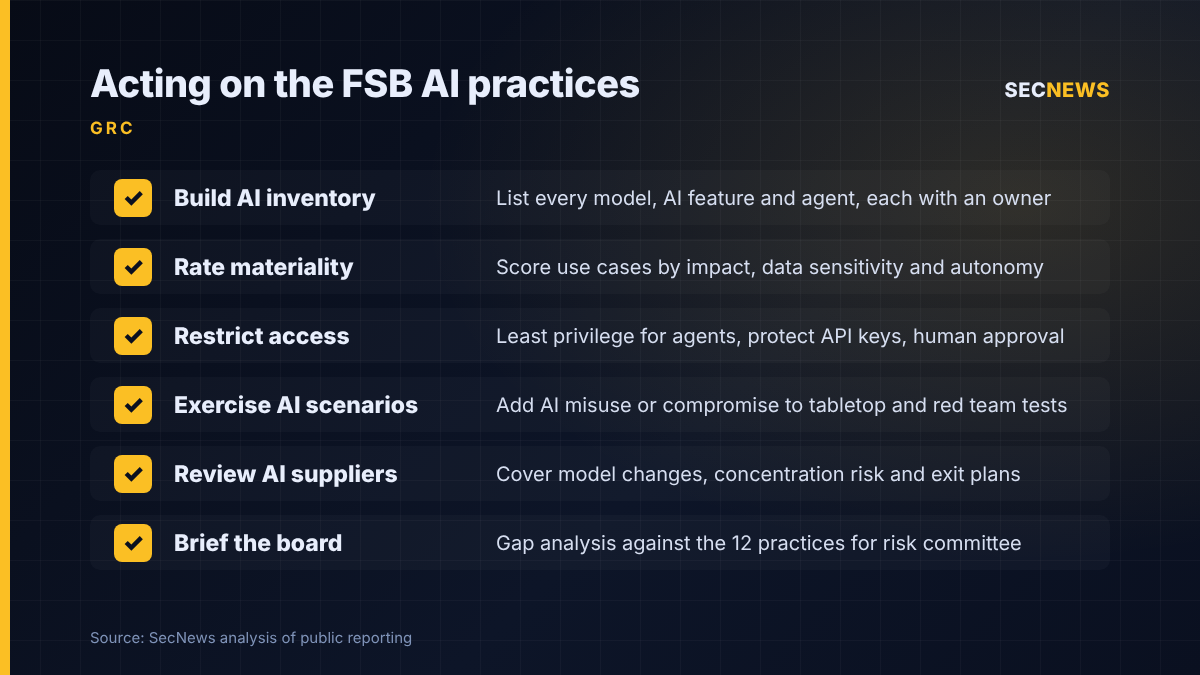
- Build the AI inventory. List every model, AI feature and agent in use, including those embedded in supplier products, and give each one an accountable owner.
- Rate materiality. Classify each use case by business impact, data sensitivity and level of autonomy, and link the high-rated ones to your important business services.
- Restrict access. Apply least privilege to AI agents and service accounts, protect model API keys like any other secret, and require human approval for high-risk actions. This maps directly onto the Cyber Essentials user access control requirements.
- Add AI to your exercises. Run at least one tabletop or red team scenario covering AI misuse or compromise, and update incident playbooks to match.
- Review AI suppliers. Update third-party risk assessments to cover model changes, data handling, concentration and exit plans. Ask suppliers how they handle vulnerability reports and security patching.
- Brief the board. Take the 12 practices to the risk committee as a gap analysis, mapped against your existing operational resilience self-assessment.
Bottom line
The FSB has not created a new obligation, but it has given UK supervisors a ready-made checklist for AI governance, written under the Bank of England governor’s chairmanship. Firms that can show an inventory, materiality ratings, tested AI incident scenarios and managed AI suppliers will be in good shape. Those that cannot should assume the questions are coming, and start on the gap analysis now.
Sources
- Financial Stability Board: FSB finalises sound practices for the responsible adoption of artificial intelligence (AI)
- Regulation Tomorrow: FSB issues sound practices for responsible adoption of AI
- Computer Weekly: International finance body espouses sound practices for AI adoption
- ABA Banking Journal: Financial Stability Board finalizes sound practices for AI adoption
- Resultsense: FSB finalises 12 sound practices for responsible AI in finance
- FCA: FCA, Bank of England and Treasury joint statement on frontier AI models and cyber resilience
- Sullivan & Cromwell: UK Brings Large Tech Providers into Regulatory Perimeter as Critical Third Parties
- Regulation Tomorrow: FCA multi-firm: Frontier AI and cyber resilience