GB Group, the Chester-based identity verification and fraud prevention firm, has said its chair Richard Longdon will retire at the end of November. The change comes three days after a trading update that flagged lower profit, one-off restructuring costs and a goodwill write-down on its troubled US identity business.
What happened
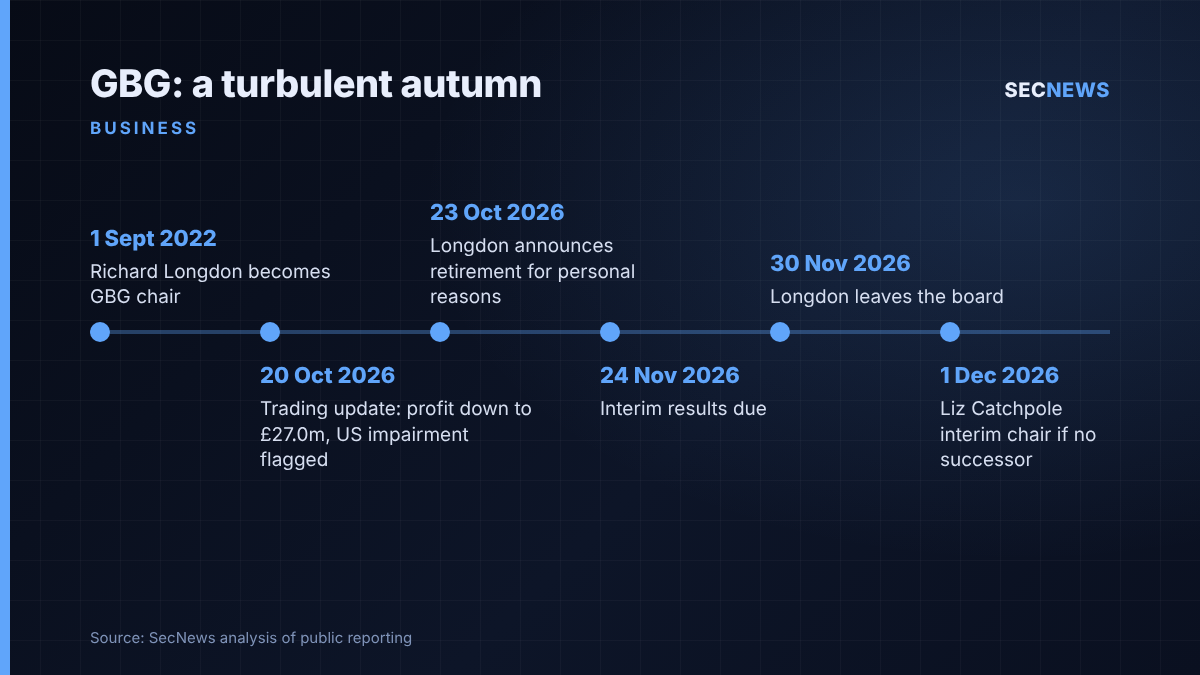
In a stock exchange announcement released at 07:00 on 23 October 2026, GB Group plc (GBG) said Richard Longdon intends to leave the board, where he is chair and a non-executive director, on 30 November 2026. The company gave personal reasons. Longdon has chaired the board since 1 September 2022, after 33 years at AVEVA, 17 of them as chief executive.
The board says it will begin a search for a permanent successor immediately. Senior independent director Liz Catchpole will lead the search, and if nobody has been appointed by 1 December 2026 she will act as interim chair. Longdon said he remains “fully supportive of GBG’s strategy and future prospects”. GBG’s interim results are still scheduled for Tuesday 24 November 2026, six days before he leaves.
The timing matters. On 20 October GBG published a pre-close update for the six months to 30 September. It expects first-half revenue of £139.5m, up 1.4% at constant currency. Adjusted operating profit is expected to fall to £27.0m from £29.5m a year earlier, which the company attributes to extra spending on its GBG Go platform. It also reported about £4.5m of exceptional costs from cost-efficiency measures and warned of a non-cash goodwill impairment on its Americas Identity business. Sharecast reported that the shares came under pressure that morning. According to BusinessCloud, GBG’s share price has fallen about 65% during Longdon’s time as chair, from roughly 450p to 156p, valuing the company at around £358m.
The detail
GBG’s three businesses are moving in different directions.
- Location (address data and verification) grew revenue by 8.9%, helped by enterprise channel partners and the Asia-Pacific region.
- Identity grew by 2.4% overall. Growth outside the Americas was in double digits, driven by EMEA demand from gaming and financial services and by customers ramping up volumes on GBG Go. Americas Identity lost business because a handful of direct customers left or cut volumes. Location and Identity together make up about 95% of group revenue.
- Global Fraud Solutions, the non-core fraud business, is about 5% of revenue. It shrank more than expected because of licence renewal timing, customer churn and fewer new wins. GBG says it is still assessing strategic options for the unit, which it describes as profitable and cash generative.
AJ Bell’s coverage notes that GBG kept its recently lowered guidance. The company still expects full-year revenue growth of 1% to 3% and adjusted operating profit in line with analyst consensus. Chief executive Dev Dhiman described the half as a “resilient performance”.
Why it matters for UK organisations
For most security teams, a supplier’s boardroom changes are background noise. Identity verification is different, because it sits directly on the path between an attacker and a fraudulent account. GBG says it serves more than 20,000 customers worldwide with identity and location checks. In the UK, such products support customer due diligence in financial services, age and identity checks for gambling operators, and platform onboarding.
In practice, when a firm says it “does KYC” or runs age assurance, part of that control is often an API call to a third party. If the supplier’s fraud unit is under strategic review, a business line is losing customers, or the board is changing, the buyer’s job is not to take a view on the share price. The buyer has to check whether the control it relies on stays funded, supported and developed. Synthetic identities and deepfaked selfies evolve fast, so a verification product that stops improving soon falls behind.
Nothing in GBG’s announcements suggests any problem with the security or availability of its services, and the company says most of the group is performing well. The point for UK organisations is narrower: a change of chair, an impairment and a strategic review of a fraud product are exactly the events supplier assurance processes are meant to catch.
Expert view
In my experience, identity verification gets less scrutiny than almost any other security dependency. Firewalls and endpoints are tested every year, while the service that decides whether a new customer is real is often integrated once and then left alone. When we test onboarding journeys, the weak points are rarely in the vendor’s core matching engine. They show up in how the client handles a failed check, a timeout or an “unable to verify” response. Some journeys fail open. Others send the customer to a manual review queue that is understaffed and easy to socially engineer.
That is why supplier changes matter. A vendor reshaping its portfolio may retire features, merge platforms or change terms, and each can quietly alter how your fallback paths behave. Any platform migration, including a move to GBG Go, needs testing, not just a contract amendment.
I would also urge caution about reading too much into one board change. Chairs retire, and orderly succession under a senior independent director is normal governance. What I would want to see from any critical identity supplier at its interim results is clear commitment to its products’ roadmaps, clarity on the future of the fraud business, and continuity of the people customers deal with. None of this is a judgement on the company’s prospects.
What to do now
- Map your dependency. List every journey that calls an external identity, address, age or fraud check, whether from GBG or anyone else. Record the product name, the contract owner and what happens when the service is unavailable or returns an inconclusive result.
- Test the failure modes. Make sure verification failures and timeouts fail safe and do not quietly approve an account. Include these paths in your next penetration test or application security review. This supports the secure configuration and access control themes in Cyber Essentials, which assume controls are enforced and not bypassed.
- Review supplier assurance. For critical identity suppliers, check contractual notice periods for product end-of-life, service levels, data processing terms and exit arrangements. If you use a fraud module, ask directly about its roadmap while the vendor reviews its options.
- Plan migrations properly. Treat any platform move as a change project and re-test match rates, false positives, liveness checks and logging before switching over.
- Keep manual review robust. Fallback queues are a social engineering target, so give staff clear escalation criteria and log and sample decisions.
- Watch the interim results on 24 November. Feed any product or strategy changes into your third-party risk register.
Bottom line
GBG’s chair is leaving after a difficult period marked by weaker US trading and a strategic review of its fraud unit, and there is a clear interim arrangement in place. For UK security and fraud teams, the story is about dependency rather than markets. If your onboarding, age checks or anti-fraud controls rely on an identity supplier, a moment like this is a good prompt to confirm that the control, and your fallback when it fails, still does what you think it does.
Sources
- Investegate (RNS): GB Group – Board Change: Retirement of Chair and succession arrangements
- Investegate (RNS): GB Group – Pre-close 1H27 trading update
- BusinessCloud: GBG chair to retire after overseeing 65% drop in share price
- AJ Bell: GB Group guides lower half-year profit amid Americas Identity charge
- Hargreaves Lansdown / Sharecast: GB Group sees interim profits slip, reaffirms outlook
- GBG: Chair succession announcement (2022)