Navigate360 has now publicly confirmed that roughly 8.3 million records were stolen from the anonymous tip platform run by its subsidiary P3 Global Intel, months after the data first surfaced. For UK organisations that hand whistleblowing or anonymous reporting to a third party, the way this vendor kept revising its account is the real lesson.
What happened
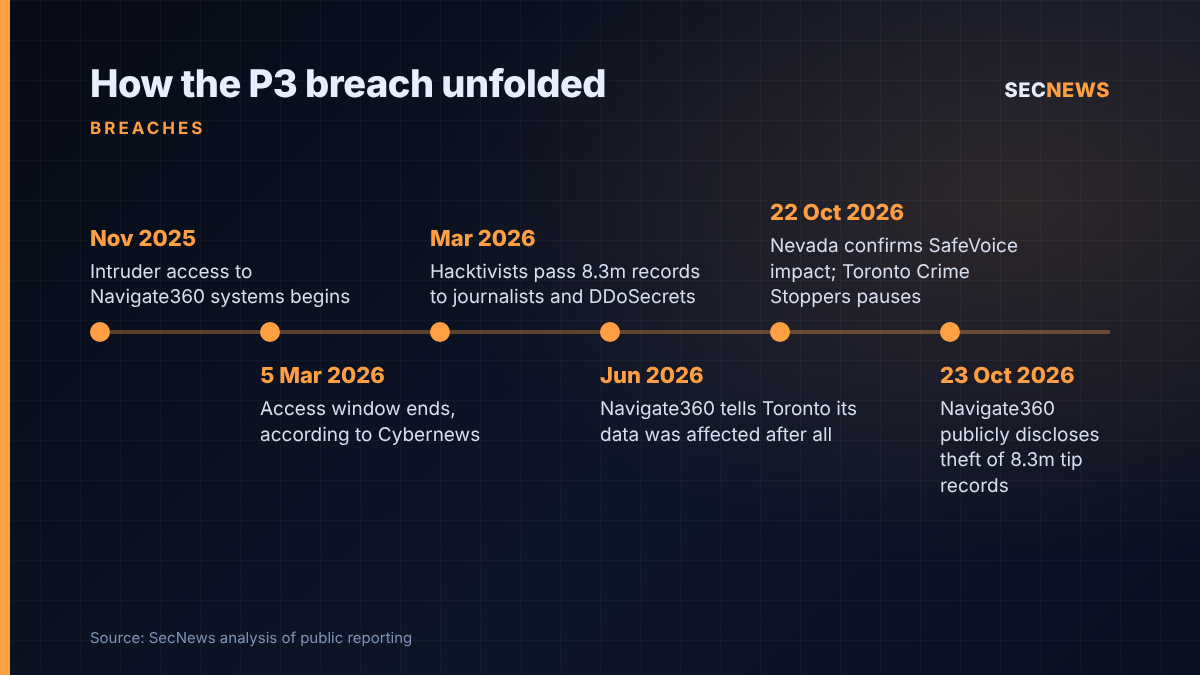
On 23 October 2026, Navigate360, an Ohio-based emergency management software company, publicly disclosed that an unauthorised party had stolen about 8.3 million tip records. Its P3 Global Intel platform runs anonymous reporting lines for schools, police forces, Crime Stoppers programmes and parts of the US military. According to Cybernews, the intruder had access between 21 November 2025 and 5 March 2026. Depending on the record, the stolen data may include names, home addresses, phone numbers, email addresses, dates of birth, student ID numbers, US Social Security numbers and medical information.
This is not a new leak. In March, a hacktivist group calling itself Internet Yiff Machine gave the dataset to Straight Arrow News, and DDoSecrets received a copy. Malwarebytes reported at the time that Navigate360’s chief executive, JP Guilbault, said the firm had “not confirmed that any sensitive information has been accessed”. In April, US Senators Maggie Hassan and Jim Banks wrote to the company. They argued that leaked identifying details about tipsters “undermines public trust” in platforms sold as anonymous.
The new development is formal confirmation of the breach, together with very public criticism from customers. On 22 October, Nevada’s education and public safety departments said about 10% of tips containing personal data that were submitted to SafeVoice Nevada between November 2025 and March 2026 had been compromised. Nevada blamed Navigate360 for repeatedly giving incomplete impact reports. As SafeVoice is anonymous, the state cannot contact affected students. In Canada, The Record reported that Toronto Crime Stoppers paused operations and told Navigate360 to stop taking its tips. This followed a CBC finding that more than 1.5 million Canadian Crime Stoppers tips were exposed. Toronto’s own timeline says Navigate360 called P3 secure in March, denied Toronto’s data was taken in April, then admitted in June that it had been affected. It reportedly later put the figure at 176,859 Toronto tips.
The technical picture
Navigate360 has not said how the intruder got in, and I will not guess. The reporting does support three technical points.
First, the data went back a very long way. Straight Arrow News said the records run from 1987 to November 2025. Holding nearly four decades of reports looks like a retention failure before a security one.
Second, “anonymous” did not mean unidentifiable. Straight Arrow News reported that the leaked material included unencrypted messages that revealed who the tipsters were. Many such products protect identity at the point of collection, then store free-text conversations and metadata in plain form. Once an attacker reaches that store, anonymity depends on what people typed, and people often type their own names.
Third, the access window was long. Roughly three and a half months of undetected access to a single platform serving more than 35,000 schools and over 5,000 law enforcement agencies suggests weak monitoring of bulk data access.
Why it matters for UK organisations
There is no public evidence that UK bodies used P3. The relevance is structural. Across the UK, anonymous reporting has quietly moved to the cloud. Employers use hosted whistleblowing hotlines, schools and universities use online concern-reporting tools, and councils and charities take anonymous reports through third-party portals. Toronto Crime Stoppers is the closest parallel: a charity that relied on a specialist supplier, could not get a straight answer about its own data, and in the end had to stop accepting reports.
Under UK GDPR, the organisation that commissions the platform is normally the controller and the supplier is the processor. Article 28 requires a written contract that commits the processor to appropriate security, to help the controller meet its breach obligations, and to delete or return data when the service ends. The processor must tell the controller about a personal data breach without undue delay. The controller then has 72 hours from becoming aware to report to the ICO, unless the breach is unlikely to pose a risk to individuals. If a supplier tells you in March that everything is secure and in June that you were affected after all, you have lost months in which you could have assessed risk and warned people.
The data involved is also unusually sensitive. Reports about self-harm, abuse or violence often contain health information or allegations of criminal behaviour. These fall under special category or criminal offence data, which carry stricter conditions under UK data protection law. Exposing a whistleblower can lead to retaliation no notification letter can undo.
Expert view
In my experience, third-party reporting platforms almost never appear in the scope of a penetration test. They are bought by HR or safeguarding teams rather than IT, and nobody asks how tenant data is separated or encrypted. When we do look at these systems, the questions that matter are dull ones: how long reports are kept, who at the supplier can read them, whether message bodies are encrypted with keys the customer controls, and what logging would show a bulk export.
The Navigate360 timeline also shows how a vendor-side breach plays out for the customer. You depend on someone else’s forensics and appetite for bad news. Nevada, as reported by Cybernews, described a “multi-vendor security incident”, which may mean the supply chain went deeper than one firm. Without contractual rights to specific information, you learn the scope from journalists.
Finally, anonymity is a design property, not a marketing line. If you promise a report cannot be traced, know what the platform actually stores.
What to do now
- Inventory your reporting platforms. List every whistleblowing, safeguarding, complaints and anonymous tip service in use, including ones bought outside IT, with supplier, hosting location and data held.
- Check the Article 28 contract. Confirm it sets breach notification timescales, an obligation to provide specific scope details, audit rights and deletion at end of contract. Fix gaps at the next renewal.
- Set and enforce retention. Agree a retention period for closed reports and get written confirmation that older material has been deleted, not only archived.
- Ask about encryption and access. Find out whether report content is encrypted at rest, who holds the keys, and which supplier staff can read submissions. Customer-held keys are preferable for highly sensitive services.
- Apply access control to your own side. In line with Cyber Essentials user access control, restrict admin accounts on these portals to named individuals, enforce MFA and remove leavers promptly.
- Rehearse a supplier breach. Run a tabletop exercise in which the vendor gives you conflicting information. Decide who contacts the ICO and when you would suspend the service, as Toronto did.
- Review your promises. Make sure the wording on your reporting pages matches what the platform can technically guarantee about anonymity.
Bottom line
Navigate360’s confirmation finally puts a number on a breach that customers had been chasing for seven months. For UK organisations, any outsourced confidential reporting service is only as private as the vendor’s retention, encryption and candour when things go wrong. Check all three now.
Sources
- Cybernews: Navigate360 breach exposes 8.3M school crime-tip records, including student SSNs
- The Record: Toronto crime tips org freezes operations after details of data breach come to light
- Malwarebytes: Hackers claim to have accessed data tied to millions of crime tipsters
- Straight Arrow News: Senators demand answers over breach of 8.3 million ‘anonymous’ crime tips