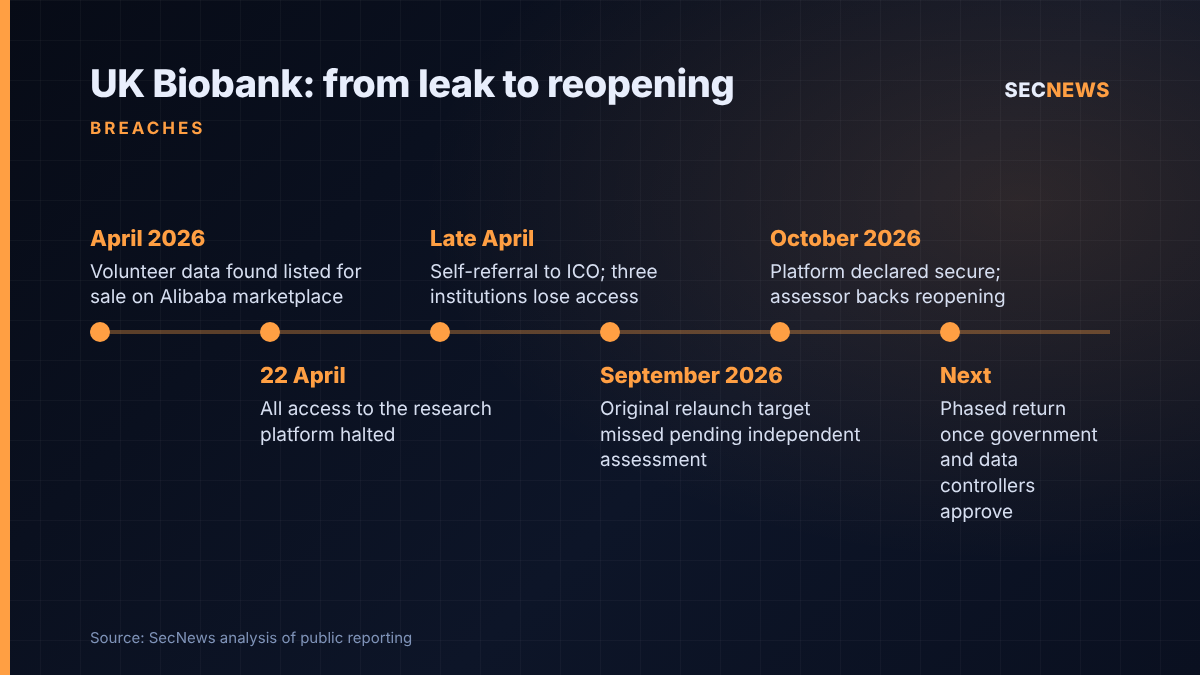
UK Biobank says its research platform is now secure and an independent assessor has backed reopening it, six months after data on all 500,000 volunteers turned up for sale on Alibaba. More than 20,000 researchers will come back to a much tighter environment, though government sign-off is still pending.
What happened
UK Biobank chief executive Professor Sir Rory Collins told researchers last week that the charity has finished hardening its cloud-based Research Analysis Platform (UKB-RAP). In a message posted on the UK Biobank community site, he said the organisation had “completed the work to ensure that the UKB-RAP is secure”, adding that an independent cyber security company had confirmed this and that its report supports reopening.
The platform has not reopened yet. UK Biobank says it is waiting for the UK health data controllers and central government to agree to give researchers access to participants’ health outcome data again. When that approval comes, researchers will return in phases and under rules much stricter than those in place before the incident.
In April 2026 the charity found that de-identified participant data had been advertised on an Alibaba-owned consumer marketplace in China. The data had been downloaded by three accredited Chinese academic institutions. In a statement to the Commons, technology minister Ian Murray said at least one listing covered all 500,000 volunteers. He also said no sales were believed to have happened. The UK and Chinese governments worked with the vendor to have the listings removed. UK Biobank revoked the institutions’ access, referred itself to the Information Commissioner’s Office and filed a serious incident report with the Charity Commission. All access to the platform was halted on 22 April.
The technical picture
This was not a classic intrusion. Nobody broke through the perimeter. Approved users with legitimate credentials took data off the platform and then broke their contracts with it. According to reporting at the time, the listings included gender, age, month and year of birth, lifestyle and socioeconomic details, and biological sample measurements, but no names, addresses or phone numbers. Collins accepted that combining such data with other sources could make re-identification possible, while saying there was no evidence that had happened.
The remediation is therefore aimed at data egress and researcher behaviour more than at keeping outsiders out. According to UK Biobank’s guidance for researchers, as reported by both outlets, the main changes are:
- A two-way airlock. Uploads from untrusted sources will be blocked too. At first, no files can be downloaded at all, results included. Human reviewers will then check results by hand before release, with limited capacity at first. UK Biobank is aiming for an automated version in 2027, later than the end-of-2026 target it set in April.
- Tighter sessions. Sessions log out after 15 minutes of inactivity and need two-factor authentication to resume.
- Less direct access to compute. Researchers can no longer SSH into jobs. Interactive tools run through isolated browsing that limits data moving between web apps and the user’s own machine, and use of the command line is restricted.
- Collaboration limits. Researchers cannot build public apps or share tools with colleagues outside their approved application until output checking is fully running, and for now they cannot refresh their data or receive new data.
The weakest point is now code repositories rather than downloads. Collins admitted that a small number of repositories still hold de-identified participant data despite repeated reminders. The charity runs daily automated scans of these repositories. Researchers found exposing data must move their analysis onto the platform, delete anything they downloaded and complete extra training before they get access back. Institutions that have not confirmed deletion of data from finished projects will be kept out. UK Biobank said in September that more than 90% of legitimately downloaded data had been deleted.
Why it matters for UK organisations
UK Biobank is described as the world’s most comprehensive biomedical dataset. The six-month shutdown has left many projects on cancer, dementia and other diseases in a holding pattern. Public trust is the other cost. Chi Onwurah, chair of the Commons science committee, welcomed the progress but wants the charity to be open about exactly what it has changed and learned.
Any UK organisation that shares data with partners, suppliers, academics or analytics firms has the same exposure: trusted third parties who are allowed to copy data out and are then bound only by a contract. Under UK GDPR, pseudonymised data is still personal data if it can reasonably be linked back to people. The ICO said in April that organisations sharing data for research must pair pseudonymisation with controls that prevent unauthorised disclosure. A breach of contract by a recipient does not end the controller’s accountability.
Expert view
For me, this incident shows the limits of governing data by contract. Material Transfer Agreements are useful legal tools, but they are not technical controls. When data has been copied to a machine you do not own, the only thing between it and a marketplace listing is someone’s honesty.
The new design is a trusted research environment model done properly: compute goes to the data, and only checked outputs come out. That is the right direction, and the specific measures are sensible. Removing SSH and limiting the command line closes the quiet bulk-copy routes that I would try first in a data exfiltration test.
There are still gaps. Manual output checking is only as good as the reviewers and how much they can handle, and the automated system has already slipped from the end of 2026 into 2027. The repository problem shows that data spreads in ways an airlock cannot see. Professor Til Wykes of King’s College London has asked whether training is sufficient, and I think that is a fair question. Training reduces mistakes. It does not stop someone who intends to take the data. Ongoing monitoring of where participant data ends up, beyond the platform’s boundary, will matter as much as the boundary does.
What to do now
- Map every route data takes out to third parties. List who receives copies of your data, in what form and under what agreement. Assume pseudonymised data can be re-identified.
- Prefer access over transfer. Where partners need to analyse sensitive data, give them a controlled environment with output checking instead of sending them extracts.
- Restrict admin-style access paths. Remove SSH and unrestricted shells from analysis environments unless they are clearly needed, in line with the Cyber Essentials secure configuration and user access control themes.
- Enforce MFA and session timeouts on any platform that holds sensitive datasets, including for accredited external users.
- Scan your code estate for data. Run secret and data-pattern scanning across internal and public repositories, and look specifically for exported records.
- Make deletion something you can prove. Require attested deletion when a project ends, and have a clear sanction for non-compliance.
Bottom line
UK Biobank has rebuilt its platform around a sound principle: data stays put and only checked results leave. Reopening now depends on government approval, and researchers still holding data in their repositories are the main open risk. Every UK organisation that shares data should note what this case shows: a signed contract does not stop data leaving.
Sources
- The Register: UK Biobank back online soon, months after someone tried to sell 500k people’s data on Alibaba
- Research Professional News: UK Biobank set to reopen to researchers after data breach
- UK Biobank: When will the UKB-RAP re-open?
- UK Biobank: Strengthening UK Biobank
- Civil Society: Research charity refers itself to ICO after data found on Chinese consumer website
- Progress Educational Trust: UK Biobank takes steps after data listed for sale in China
- Freevacy: UK Biobank data found for sale on Chinese website Alibaba
- Health Research Authority: Our response to concerns over UK Biobank data