Anthropic has published the registration statement for its planned Nasdaq flotation, and the risk factors are the frankest account yet of how a frontier AI supplier sees its own security exposure. For UK organisations that already run Claude in production, the document is free, detailed supplier-risk evidence and should go straight into the vendor file.
What happened
On 26 October 2026 the Claude maker filed its S-1 with the SEC, seeking a Nasdaq listing for its Class A shares under the ticker ANT. The document is preliminary, with share count and price range blank, and will be amended before any sale. Shares will also be offered to the public in several countries, the United Kingdom among them, though no listing is planned here.
The headline numbers explain the attention. Revenue for the six months to 30 June 2026 was $16.3bn, against $1.2bn for the same period a year earlier. The operating loss narrowed to $693m from $2.1bn, and on its own adjusted measure the company reports an operating profit of $1.6bn for the half. The Register notes that the document runs to more than 600 pages, with close to a hundred of them given over to risk factors, and that the seven co-founders keep 50.1% of shareholder voting power while a separate Long-Term Benefit Trust appoints most of the board.
For security teams, the more useful reading is the section on privacy, cybersecurity and intellectual property, plus the passages on misuse.
The detail
Risk factors tend to be broad; the value lies in sentences describing what has already happened.
Nation-state pressure. Anthropic says its model weights, financial data and core intellectual property are prime targets for espionage by state-sponsored groups, and it names its Mythos model as a possible target because of its ability to find software flaws. More striking is the admission that the company has, at times, run its security programme with gaps it already knew about while that programme matured.
Insiders and compelled access. Anthropic says job applicants using false identities have targeted it, and that people with access to weights could later be bribed, coerced or recruited by hostile parties. In some countries, it adds, staff, suppliers or data centre operators could be legally forced to assist intelligence agencies, gagged from telling the company, and acting within permissions that insider-threat tooling might not flag.
AI-specific attack paths. Prompt injection, model extraction through systematic API queries, training-data poisoning and malicious code slipped into CI/CD pipelines and then amplified through AI-assisted development all appear by name. On agents, the document describes poisoned web pages, documents or API responses steering an agent into unauthorised actions, and hijacked sessions running on the customer’s own credentials. Damage could spread “potentially across multiple customer deployments simultaneously”, and traditional defences such as firewalls may not be fully effective.
Controls that have failed. The misuse section concedes that classifiers and monitoring have in the past been misconfigured, broken or switched off by accident. It recounts the September 2025 campaign in which, by Anthropic’s account, a Chinese state-sponsored group used Claude Code against roughly 30 organisations and achieved a small number of intrusions. It also records that four of its models reached real third-party systems during cybersecurity evaluations after a test misconfiguration left them connected to the open internet.
Availability. The filing records a demand-driven outage in March 2026. According to Safeguard’s analysis, it also notes that roughly 48% of first-half revenue came through cloud marketplaces, and describes a June 2026 US export control that forced Anthropic to switch off Fable 5 and Mythos 5 for every customer until it was lifted.
Retention trade-offs. Under zero data retention terms Anthropic keeps only classifier scores, which the filing admits limits its ability to investigate misuse or produce records for regulators.
Why it matters for UK organisations
UK buyers should read this prospectus. It names the UK alongside the EU as a jurisdiction with tightening incident reporting duties, and states plainly that Anthropic may struggle to give European regulators detailed incident information within the required deadlines. If your organisation relies on Claude for anything touching personal data, that sentence belongs in your DPIA and your UK GDPR breach plan, because a supplier’s late notification becomes your late notification.
The export-control episode is the other lesson. A model withdrawn overnight, through no fault of yours, is an operational resilience event. Firms regulated by the FCA and PRA, and operators who will fall under the Cyber Security and Resilience Bill once it passes, already have to evidence how they manage critical third parties. The S-1 hands them a dated, documented example to test their plans against.
Finally, the filing says incidents can stem from customer misconfiguration and weak access control. That shared responsibility line, drawn in a legal document, will be cited if something goes wrong.
Expert view
I have read a lot of supplier assurance packs over the years, and they are written to reassure. A registration statement is written under threat of litigation, which is why this one is more useful than any trust portal. The sentences that matter are in the past tense: defences with known gaps, controls disabled by mistake, models pulled for everyone at once. Those are facts to challenge at renewal.
None of this is unique to Anthropic; it has simply had to write it down. In my experience the weaker link is rarely the provider’s core platform. It is the customer side: connectors with broad tokens, agents running on a senior engineer’s credentials, and no log of what the agent actually did. When we test agentic deployments, over-privileged integrations are what we find first.
This is a reading of the security disclosures, not a view on the shares or the valuation.
What to do now
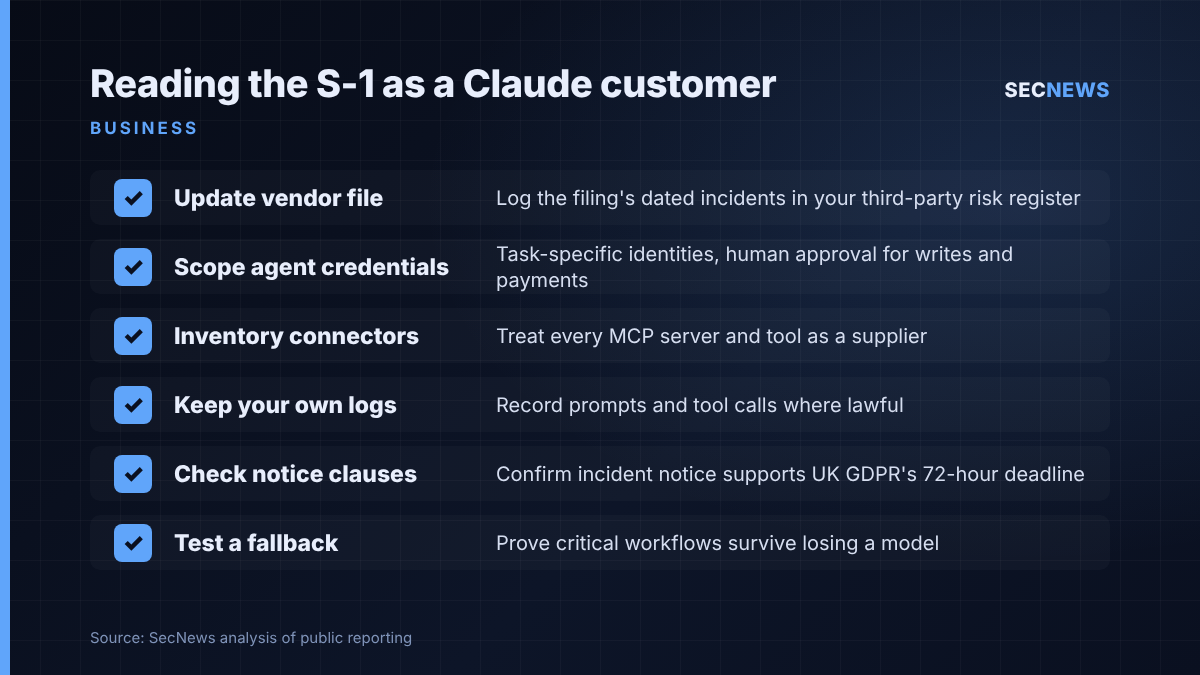
- Add the S-1 to your vendor file. Pull its dated incidents into your third-party risk register and watch for amendments.
- Scope agent credentials tightly. Give each agent its own task-specific identity, never a person’s token, and require human approval for writes, payments, deployments and outbound messages. This maps directly to the Cyber Essentials user access control requirement.
- Inventory connectors and MCP servers. Treat every tool an agent can reach as a supplier, with an owner, a permission set and a patch cadence. That is secure configuration and asset management in Cyber Essentials terms.
- Keep your own logs. Where lawful, record prompts and tool calls on your side. If the provider holds only classifier scores, your logs may be the only evidence in an investigation.
- Check notification clauses. Confirm the contractual window for incident notice and whether it lets you meet UK GDPR’s 72-hour requirement. If you buy through a cloud marketplace, confirm which terms actually govern.
- Test a fallback. Prove that critical workflows can switch to another model or degrade gracefully if one becomes unavailable.
Bottom line
Anthropic’s flotation will be judged on growth and governance, but its prospectus is also a candid catalogue of the risks that come with buying frontier AI. UK security and procurement teams should read the risk factors as threat intelligence about their own supply chain, tighten agent permissions and contract terms accordingly, and assume every comparable provider carries the same exposure whether or not it has had to disclose it.