Cisco Talos has analysed VOLTA-AUTODOXER, a Windows infostealer that hands its stolen haul to commercial AI models and asks them which victims are worth pursuing. The theft itself is familiar, but outsourcing the triage to an LLM changes how fast a criminal can act on what they take.
What happened
On 31 October 2026 Cisco Talos published research into a self-deleting Windows stealer whose authors call it VOLTA-AUTODOXER. Talos found it through CAIRN, its research effort that hunts for offensive tooling built around AI. Talos describes the malware as a mature stealer with an optional AI stage attached at the end of the run.
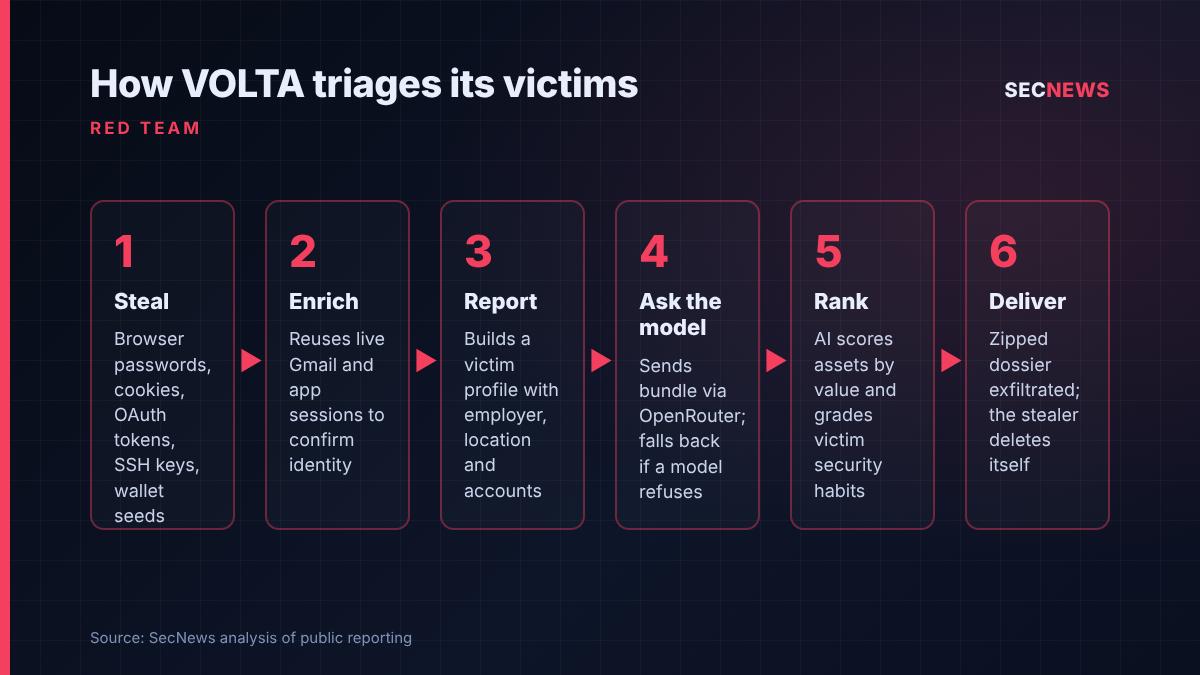
That final stage is what makes VOLTA worth attention. Once it has collected credentials and sessions, the malware sends a structured bundle of evidence about the victim to OpenRouter, a commercial gateway that brokers access to many large language models. According to Talos, the prompt casts the model as a forensic intelligence analyst writing a target assessment. The report it asks for includes a section headed “WHAT THEY’RE WORTH”, which sorts the victim’s assets into low, medium and high monetisation tiers, and another headed “THEIR OPSEC”, which grades the victim’s password habits and overall security posture.
Talos says the default model is Anthropic’s Claude Opus 4.6. If the reply looks like a refusal, VOLTA falls back to Moonshot’s Kimi K2 and then Google’s Gemini 2.5 Flash. The malware still works without this stage when no API key is configured, so the AI layer adds to the theft rather than enabling it.
Indicators shared alongside the research give a PE compile timestamp of 17 August 2026 and a first sighting on 11 October. No victim numbers, targeted countries or scale of use have been published.
The technical picture
Collection is broad. Talos lists browser passwords, cookies and card details, Microsoft OAuth tokens, wallet seed phrases, SSH keys, cloud configuration files, Wi-Fi credentials and screenshots, plus data from Discord, Telegram, Slack, Steam and Roblox. A built-in component also tries to crack wallet vaults locally.
Much of the session theft, Talos notes, relies on getting past Chrome’s App-Bound Encryption, the protection Google added to make cookie theft harder. The tell-tale behaviour defenders can watch for is Chrome being started in headless mode by a process that has no business doing so.
The enrichment step is the part I find most instructive as a tester. Instead of simply exporting cookies, VOLTA uses them. Talos describes the malware riding the victim’s live Gmail session to search for shopping and delivery receipts, which help confirm a home address, reading order history from stolen food delivery sessions, using Discord tokens to fill in profile details, and querying a Roblox trading site to price virtual items. The findings land in a file called Identity_Report.txt, covering identity, employer, location, partial card details and workplace accounts.
The model’s verdict is saved as AI_Analysis.txt and zipped with the identity report for exfiltration. The inference request is made from the victim’s own machine and network, with a low temperature setting to keep answers consistent. And Talos observed no attacker-owned infrastructure: the endpoints are legitimate third-party services. Talos thinks VOLTA is offered to criminals as a builder, each buyer filling six configuration slots, such as their own API keys and a Telegram channel, and getting ranked reports there. It also found that buyers’ credentials are protected with a key derived from constants inside the binary, which reverse engineering can recover.
Talos frames the whole design as “effort displacement”: the tedious analyst work of sifting thousands of stolen logs is pushed onto a model.
Why it matters for UK organisations
Stealer logs already feed initial access brokers and ransomware affiliates. The bottleneck has been triage: a gamer’s log and a finance director’s look alike until someone reads them. VOLTA is built to remove that bottleneck. A cheap model call can flag that a victim holds a Microsoft OAuth token for a corporate tenant, SSH keys for production servers and a Slack workspace, and put that log at the top of the pile.
The UK exposure is real because the line between personal and work devices is blurred. Hybrid working means many staff check personal Gmail, game or shop on the same machine that holds corporate sessions, and many contractors and small suppliers use unmanaged kit. Session tokens are the prize here because they can let an attacker act as an already authenticated user, sidestepping the password and, in many cases, the multi-factor prompt. An organisation that has rolled out MFA and considers identity solved can still be exposed through a single infected endpoint.
The reliance on legitimate services also hampers detection: there is no command server to block, and traffic to an AI gateway or Telegram can blend in where staff already use those tools.
Expert view
When we test organisations, stolen browser sessions are frequently a quicker route in than any software flaw, and that was true long before AI arrived. What VOLTA changes is the economics. Picking valuable victims out of a mass campaign used to take time or a skilled affiliate. Now it costs an API call and produces a dossier any buyer can act on.
The refusal handling is also telling. The authors expected safety controls to bite and built a fallback chain to route around them. Model guardrails are a speed bump, not a control defenders can count on. Talos also found weaknesses, such as the recoverable key and a debug log that outlives the malware. It is capable rather than polished.
In my experience, the organisations that cope best treat a compromised endpoint as a compromised identity, not just a machine to reimage.
What to do now
- Treat stealer infections as identity incidents. When an endpoint is compromised, revoke all sessions and refresh tokens for every account used on it, rotate passwords from a clean device, and replace any SSH keys and cloud credentials stored there.
- Hunt for headless Chrome. Alert on Chrome launched with the headless flag by anything other than known developer or automation tooling, and consider application control rules to block it on standard user devices (Cyber Essentials: secure configuration, malware protection).
- Preserve evidence before cleanup. Talos says the %APPDATA%\volta_debug.txt collection log can survive the executable’s deletion and shows what was taken and whether the AI stage ran.
- Shorten token lifetimes and bind sessions. In Microsoft Entra ID, review sign-in frequency, use Conditional Access to require compliant devices, and enable token protection where licensing allows, so stolen cookies are harder to replay elsewhere.
- Get credentials out of browsers and files. Use a managed password manager, keep SSH keys in hardware-backed stores where possible, and discourage saved passwords in browsers on work devices (Cyber Essentials: user access control).
- Watch AI gateway traffic. If OpenRouter or similar services have no business purpose in your estate, log or block them, and review unexpected outbound calls to AI APIs from endpoints.
Bottom line
VOLTA does not steal anything new. It simply lets a model decide faster which stolen identities are worth the effort. For UK defenders the lesson is unchanged but more urgent: assume any infected endpoint means stolen sessions, revoke them quickly, and make tokens harder to replay.
Sources
- Cisco Talos: Appraisal by AI: Model-driven victim prioritization in the VOLTA infostealer
- GBHackers: New VOLTA Infostealer Uses Claude, Gemini, and Kimi AI to Profile Victims and Rank Stolen Data
- Cyber Security News: VOLTA Malware Steals Gmail and Discord Sessions, Then Uses AI to Build Detailed Victim Profiles