Check Point Software says its revenue has bottomed out after a quarter in which firewall appliance sales fell and list prices went up. For UK organisations running Check Point estates, the numbers say a good deal about renewal costs, refresh timing and where the vendor is putting its money.
What happened
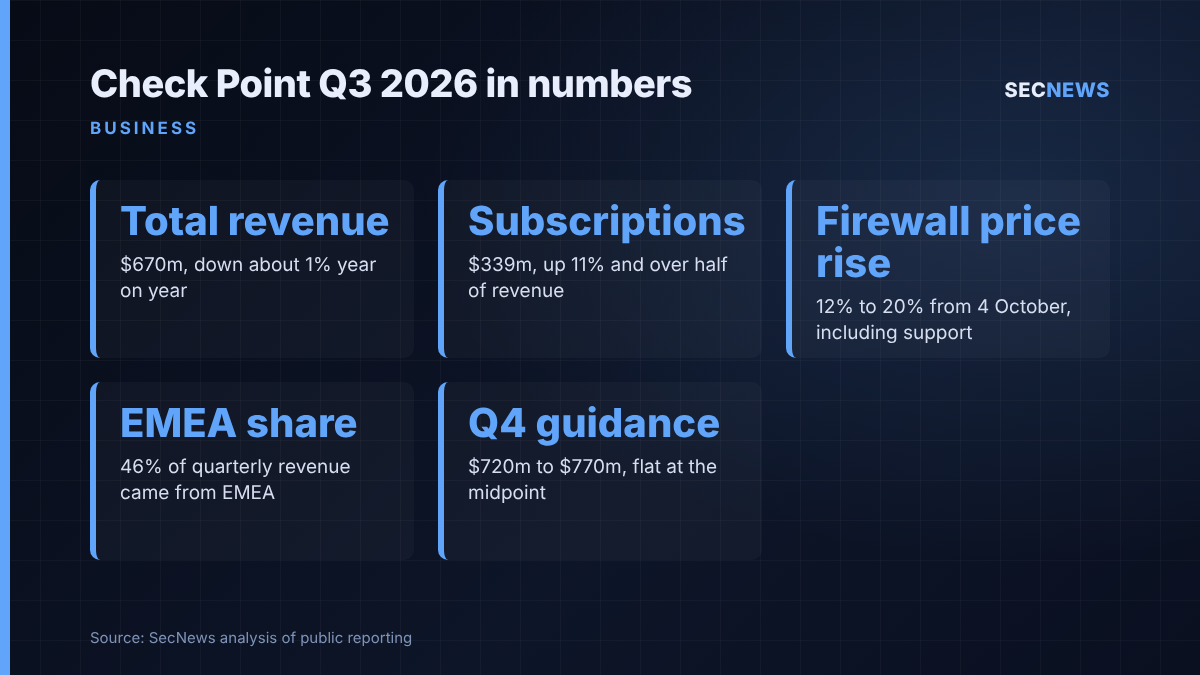
On 2 November 2026 Check Point Software Technologies published its results for the three months to 30 September. Total revenue came in at $670 million, roughly 1% lower than a year earlier and slightly below analyst expectations, according to Seeking Alpha. The miss was small, about $2.3 million, but the direction of travel matters.
The weak spot was hardware. Fewer customers refreshed their firewall appliances during the quarter, and that knocked on to the support contracts and professional services that usually accompany a new box. Against that, security subscriptions grew 11% to $339 million and now make up just over half of all revenue. Check Point credited demand for its email security, continuous threat exposure management (CTEM) and AI security products, which together grew annual recurring revenue by more than 38%. Email security alone has passed $200 million in ARR, the company told analysts.
Chief executive Nadav Zafrir, who took over from founder Gil Shwed, described the quarter as the trough and said he expects gradual improvement from the fourth quarter. He also conceded the timetable has slipped: “The recovery is taking longer than anticipated,” he said in the results release. Shares dropped around 7% in premarket trading. CTech notes the stock is down 18% so far this year, while many rival security stocks have climbed.
The detail
Profitability remains strong. Non-GAAP operating income was $251 million, a margin of about 37%, and operating cash flow reached $264 million. GAAP earnings per share of $1.82 look dramatically lower than last year’s figure, but that comparison is flattered by a one-off tax benefit booked in the third quarter of 2025. Stripping that out, earnings per share edged up by around 1%.
Gross margin slipped to 87%. Chief financial officer Roei Golan put that down to rising memory prices, a cost he expects to persist. Currency is also biting: the weaker dollar against the shekel has added roughly $30 million to operating costs this year, and Golan warned the extra hit in 2027 could reach $50 million at current rates.
Two decisions stand out for customers. First, Check Point raised prices on its firewall products by between 12% and 20%, effective from 4 October, and the increase covers attached support and subscriptions as well as the hardware. Golan estimated that full realisation would lift revenue growth by as much as three points, though the company has historically kept a little under half. Second, Check Point is pushing new paid add-ons, including an AI Network Firewall sold as a separate subscription, a refreshed Maestro Hyperscale Orchestrator aimed at AI data centres and telecoms operators, and a Firewall-as-a-Subscription offer.
Guidance for the final quarter is $720 million to $770 million in revenue, flat at the midpoint compared with last year, and the company expects subscription growth to slow slightly before picking up in the first half of 2027. It is targeting more than $1.5 billion in annual subscription revenue next year.
Capital allocation remains a sore point. Check Point holds around $4 billion in cash, yet spent $325 million on buybacks in the quarter; CTech reports investors would prefer it closed gaps in its cloud and AI portfolio.
Why it matters for UK organisations
Check Point is not a distant name for British buyers. Europe, the Middle East and Africa generated 46% of revenue in the quarter, more than the Americas, and the company is due to meet investors in London on 9 December. Its firewalls guard many UK enterprises, public bodies and service providers, so its pricing lands directly on UK budgets.
The price rise is the most immediate issue. Any organisation renewing support or subscriptions on Check Point gateways from now on should expect a materially larger bill, and those planning a hardware refresh face higher appliance costs on top of memory-driven inflation across the market. Budgets built on flat renewals need revisiting.
There is a security dimension too. A slowdown in refresh activity across the customer base means more organisations are sweating older appliances for longer. That is rational on a tight budget, but edge devices nearing end of support are prime attacker targets. The NCSC has repeatedly warned about edge devices that are unpatched or obsolete, and the Cyber Security and Resilience Bill will raise expectations on managed service providers that run these estates for others.
Expert view
When we test perimeter estates, the firewall itself is rarely the weakest point. The problems tend to be ageing appliances, management interfaces exposed to the internet, sprawling rule bases nobody wants to touch, and VPN gateways left a version or two behind because an upgrade means downtime. A vendor price rise does not cause any of that, but it does change the economics of fixing it, and in my experience budget pressure is when good hygiene quietly slips.
The financial picture also shows where the industry is heading. Check Point is moving revenue away from boxes and towards subscriptions, and its fastest-growing lines are email security, exposure management and AI controls, not traditional network gateways. That mirrors what customers are actually worried about. The risk for buyers is that useful capability arrives as yet another add-on, pushing up the cost of a single-vendor estate without matching gains in protection.
None of this is cause for alarm: the company is highly profitable and cash-rich. But a vendor under pressure to grow will lean on pricing and upsell, and procurement teams should be ready for that conversation.
What to do now
- Check your renewal dates. List every Check Point appliance, support contract and subscription, note when each renews and model the 12% to 20% uplift so it is in next year’s budget.
- Review end-of-support status. Identify gateways approaching end of life. Under Cyber Essentials, boundary firewalls must run supported software that is patched promptly, so ageing kit is a certification risk as well as a security one.
- Lock down management access. Make sure firewall management and VPN portals are not needlessly reachable from the internet, and enforce multi-factor authentication for administrators, in line with the Cyber Essentials secure configuration and user access control requirements.
- Challenge new add-ons on evidence. Before buying AI firewall or other subscription bundles, ask for a defined use case, measurable outcomes and an exit route, and compare against capability you already own.
- Talk to your MSP. If a provider runs your perimeter, ask how it will pass on the price change and how it is handling customers on older appliances.
Bottom line
Check Point’s third quarter confirms a business in transition: hardware is soft, subscriptions are growing and management is relying on price rises and new add-ons to restart growth. UK customers should treat that as a signal to plan renewals early, retire ageing perimeter kit on their own timetable and make sure every pound spent on new features buys real risk reduction.
Sources
- PR Newswire: Check Point Software Reports 2026 Third Quarter Financial Results
- CTech: Check Point’s recovery remains elusive as revenue and profits continue to fall
- The Motley Fool: Check Point (CHKP) Q3 2026 Earnings Call Transcript
- Seeking Alpha via TradingView: Check Point shares fall after revenue misses; CEO sees gradual recovery
- MarketBeat: What Check Point Software Technologies (CHKP) Said on Its Q3 Earnings Call