ISC2 has published the exam outline for a new AI security certification and is recruiting 3,000 volunteers to sit a pilot from mid-December. If the pilot works, the credential launches in 2027, and UK employers and practitioners should start planning for it now.
What happened
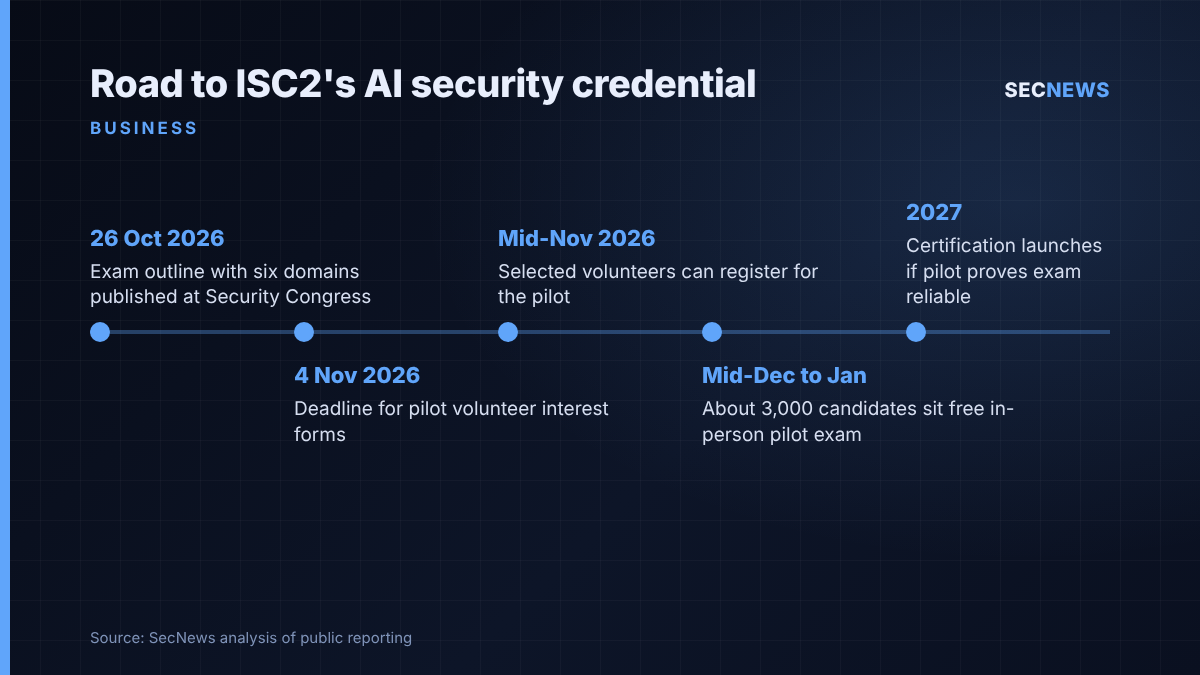
ISC2, the non-profit membership body best known for the CISSP, used its Security Congress in Denver on 26 October 2026 to release the outline of a new AI security certification. It will be the organisation’s tenth credential. Chief executive Scott Beale told Infosecurity Magazine the qualification “doesn’t even have a name yet”, but the shape of the exam is now public.
The pilot phase begins shortly. ISC2 plans to pick roughly 3,000 candidates from a volunteer list and run in-person exams between mid-December and late January. Anyone who wants to take part has to submit an interest form by 4 November 2026, and selected candidates can register from mid-November. If the pilot data shows the exam measures competence reliably, the certification goes live in 2027. Infosecurity Magazine reports that ISC2 is aiming for early 2027, with January a possibility.
Chief operating officer Casey Marks said in the announcement that the pilot will produce the evidence needed to judge whether the exam tests AI security skill “reliably, fairly and defensibly”. ISC2 says nearly 10,000 volunteers contributed through job task analysis surveys, item writing and expert review.
The detail
The outline sets out six domains:
- AI concepts and security fundamentals
- AI governance, ethics, risk and compliance
- AI data management, privacy and model security
- Secure AI architecture, engineering, and identity and access management
- Secure AI operations and incident response
- AI threats, testing and lifecycle management
The proposed entry bar is four years’ paid, full-time work, added up across roles, in cyber security or AI-related fields. Two of those years must be in security, and one must cover at least two of the exam domains. An active CISSP, CCSP, CSSLP, ISSAP, ISSEP or ISSMP removes the experience requirement entirely. A relevant degree can count for up to a year. Candidates do not need an existing ISC2 certification, and the organisation is explicitly inviting non-members with AI security experience to volunteer.
The pilot itself is free, English-only and in person. It has 160 items with a three-hour limit, a linear format and no option to skip questions. It runs only at ISC2-authorised Pearson Professional Centres, not at Pearson Authorised Test Centres.
The move did not come from nowhere. In July, Marks told Network World that practitioner feedback showed AI security had outgrown the approach of adding AI material to existing exams, and that teams were struggling with prompt injection, data poisoning and model inversion, as well as frameworks such as the NIST AI Risk Management Framework and ISO/IEC 42001. Beale has also said AI content is being added to every current ISC2 certification, and the body launched a Cyber AI Workforce Coalition on 20 October.
Why it matters for UK organisations
The UK government’s own figures show why demand for an AI security benchmark is building. The Department for Science, Innovation and Technology’s 2026 labour market study, published in September, found that 70% of cyber security businesses say staff use AI in their daily work, up from 53% a year earlier. The same report put the share of businesses with a basic technical skills gap at 57%, up from 49%. Firms are adopting AI faster than they are building the skills to secure it.
What follows is my professional view rather than anything ISC2 has said. In the UK, the most immediate effect will be on hiring. CISSP remains one of the most common requirements in UK security job adverts, in both the public and private sectors. Because an active CISSP satisfies the experience rule, a large pool of existing UK holders can sit the new exam straight away. I would expect “AI security certification desirable” to start appearing in UK job specifications within months of launch, much as CCSP did for cloud roles.
It also raises a question for the UK Cyber Security Council. Its Associate, Principal and Chartered titles are meant to be the profession’s UK benchmark, and employers and procurement teams will want to know how a vendor-neutral AI credential sits alongside them. Nobody has answered that yet. Organisations writing AI security roles into their structures should avoid treating any single exam as a substitute for demonstrated competence.
There is a practical catch for UK volunteers. The pilot is only offered at Pearson Professional Centres, so candidates outside the larger cities should check where their nearest one is before applying.
Expert view
I welcome a practitioner-built standard here, with some caveats. When we test AI-enabled systems, the weak points are rarely exotic. They are usually ordinary failings in a new setting: over-privileged service accounts behind an agent, training data with no provenance, logging that never captures what a model was asked or what it did. An exam that weights identity, data handling and incident response alongside AI-specific threats is pointed in the right direction.
My concern is shelf life. Agent tooling, model supply chains and attack techniques are moving faster than any multiple-choice question bank can follow, and a 2027 syllabus will need frequent revision to stay honest. Certifications prove a baseline of knowledge, not the ability to break or defend a real deployment. In my experience the best AI security people combine solid fundamentals in infrastructure and application security with hands-on curiosity about models. A certificate can signal the first part, but it cannot show the second.
I also expect the commercial side to move quickly. Training providers, bootcamps and employers will all respond, and UK organisations should be wary of paying for “exam prep” before the final syllabus and name are even confirmed.
What to do now
- Decide on the pilot by 4 November. If you have senior staff already working on AI systems, the pilot is a free chance to shape the exam and be among the first holders. Check availability at a Pearson Professional Centre first.
- Map your AI security responsibilities. Use the six domains as a checklist to find out who in your organisation owns AI governance, model and data security, and AI incident response. Gaps here are risks today, whatever happens with the certification.
- Bring AI into your existing controls. Agents and AI services should fall under the same Cyber Essentials disciplines as everything else: user access control and least privilege for service identities, secure configuration of AI platforms, and patching of model-serving software and dependencies.
- Update job descriptions with care. List AI security skills in terms of outcomes and experience. Do not make a not-yet-launched credential a hard requirement.
- Budget for training, not just exams. Hands-on lab time with AI systems will build capability faster than certificates alone.
Bottom line
ISC2’s AI security certification is the clearest sign yet that securing AI is becoming a recognised specialism rather than a side topic. For UK organisations, it gives a useful map of the skills involved and a likely future hiring filter. It does not replace building those skills in-house now, while AI adoption keeps outpacing the people able to secure it.
Sources
- ISC2 via PR Newswire: ISC2 Releases AI Security Certification Pilot Exam Outline
- ISC2: ISC2 Developing AI Security Certification
- Infosecurity Magazine: First ISC2 AI Security Certification Expected for Early 2027
- Network World: ISC2 seeks input from IT pros for AI security certification
- GOV.UK: Cyber security skills in the UK labour market 2026