Maximus, the US government services group that is a major supplier of UK employment, health and disability services, has agreed to pay $660m in cash for federal cyber and AI contractor Agile Defense. The deal is aimed squarely at the US defence market, but UK public-sector buyers who rely on Maximus should still pay attention to it.
What happened
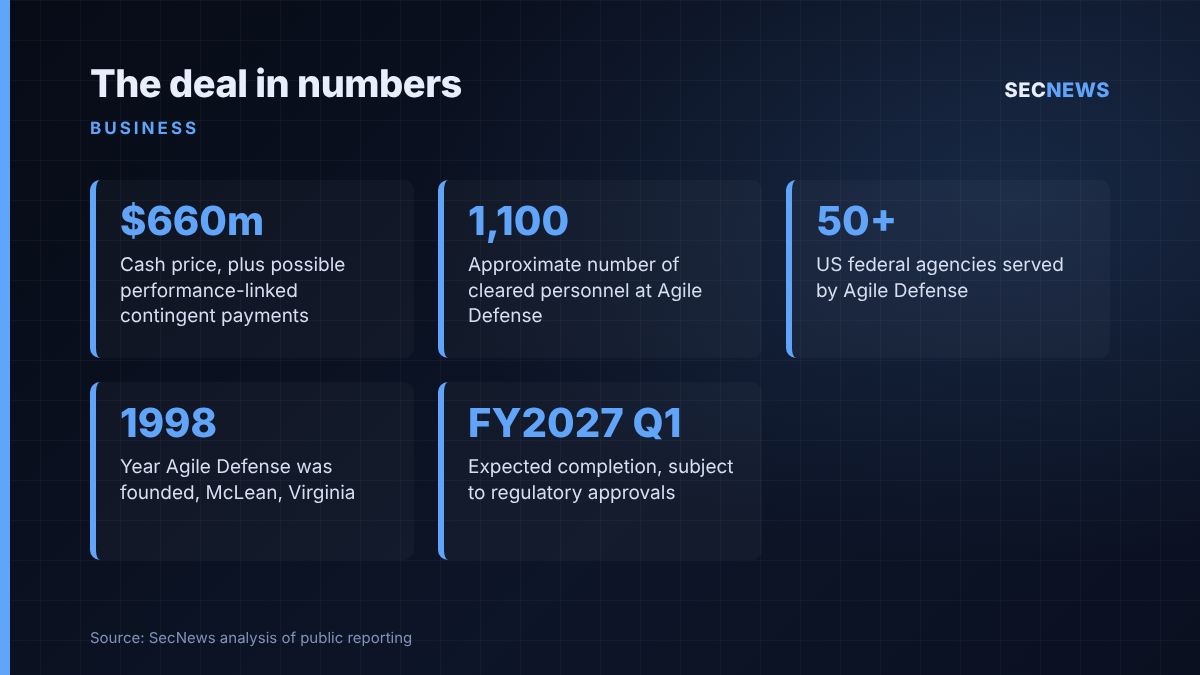
On 19 October 2026, Maximus (NYSE: MMS) said it had signed a binding deal to buy Agile Defense, LLC together with some of its affiliates. The headline price is $660m, payable in cash at completion and subject to the usual adjustments. Further contingent payments are tied to performance targets. Completion is expected in the first quarter of Maximus’s 2027 fiscal year, which, because the company’s financial year ends on 30 September, points to a close before the end of this calendar year. Regulatory approvals and customary conditions still apply.
Agile Defense was founded in 1998 and is based in McLean, Virginia. It brings roughly 1,100 cleared personnel, works for more than 50 federal agencies, and describes cyber security, data analytics, AI and work for the intelligence community as its core. Maximus calls its research arm, Agile Labs, an innovation engine and key differentiator. Its backer, Enlightenment Capital, is a private investment firm focused on aerospace, defence and government technology.
Maximus chief executive Bruce Caswell said the deal would extend the group’s reach into “the Departments of War, Homeland Security, and other national security agencies”. Agile Defense chief executive Rick Wagner pointed to the combination of his firm’s cyber and AI expertise with Maximus’s scale.
The detail
Read the announcement closely and the real asset becomes clear. Maximus is not buying a product. It is buying people with US security clearances, existing contract vehicles and approved systems. Clearances and approvals take years to build, which is why services firms buy them. The press release also cites Maximus’s existing work in FedRAMP and CMMC environments, the US federal cloud authorisation scheme and the defence supply chain’s Cybersecurity Maturity Model Certification.
GuruFocus data put Maximus’s market capitalisation at about $3.2bn when the deal was announced, so this is a large bet relative to the size of the company. The same data rated the group’s balance sheet strength as moderate, partly because of recent debt issuance. The announcement does not say how the cash price will be funded. That matters for anyone holding a long-term contract with the group, because acquisition debt and integration work compete with existing delivery for management attention and money.
It also matters where Maximus already sits. Its UK arm presents itself as a major supplier of employment support, health and disability programmes to government, councils, businesses and charities across the UK. It carries out functional assessments on behalf of government, runs digital and contact-centre services, and holds a place on Lot 1 of the Crown Commercial Service RM6295 Citizen Experience framework. The group’s 2026 proxy statement records that its international expansion into the UK, Canada and Australia was achieved mainly through acquisitions.
Why it matters for UK organisations
For UK public-sector buyers, the first point is concentration and dependency. Maximus UK handles large volumes of highly sensitive personal data: health conditions, disability information, employment histories and details of vulnerable people, including through helplines such as the Veterans’ Gateway. When a supplier at the centre of that kind of service shifts its strategic weight towards US defence, contract owners should ask what changes for them, if anything. That covers investment priorities, group-level security governance, shared platforms and where support staff and tooling sit.
The second point is opportunity. Maximus is building AI and cyber capability. Its UK arm already markets AI-driven customer service and a composable technology model to government clients. If expertise from Agile Labs finds its way into the international business, UK clients could benefit from stronger security engineering. They could also find more of their service running on group-wide platforms whose controls are designed around US federal standards rather than UK ones.
The third point concerns the wider UK cyber services market. This fits a familiar pattern in which a large government services provider buys cleared cyber talent rather than training it. The UK market has the same pressures in the same places: security-cleared staff are scarce, and suppliers that already hold the right accreditations command a premium. UK mid-sized cyber consultancies with List X status, SC and DV-cleared teams, CHECK or CREST credentials and public-sector framework places should expect continued interest from trade buyers and private equity.
Expert view
In my experience, the security risk in an acquisition rarely comes from the headline. It comes eighteen months later, when identity systems, ticketing, remote access tooling and logging are merged under one roof to cut costs. That is when you find shared administrative accounts nobody owns, trust relationships between domains that should never have been joined, and third-party access that survived because no one knew it was there. When we test environments that have been through rapid acquisition-led growth, the seams between the inherited estates are often where the most interesting findings live.
I would also urge some caution about reading too much into this deal for the UK specifically. Nothing in the announcement says Agile Defense’s people, systems or data will touch UK contracts, and the US clearance and export regimes make that unlikely in the short term. The sensible reading is that the UK business keeps running as it does today, while the parent group’s priorities shift towards US national security work. For contract managers, that is a prompt to check what their contract guarantees, not a reason for alarm.
Finally, paying a substantial share of your own market value for cleared cyber and AI capability shows how highly that capability is now prized. UK departments trying to recruit similar skills directly are competing with that.
What to do now
- Review your supplier contracts. If Maximus is a supplier, check the change-of-control, sub-processing and data-location clauses, and confirm with your account team in writing whether any services, platforms or support functions are expected to change.
- Refresh your supplier assurance. Ask for current evidence of Cyber Essentials Plus, ISO 27001 scope and recent penetration test summaries. Make sure group-level changes cannot quietly alter the scope of those certificates.
- Map identity and access. List every supplier account, VPN, API key and remote support route into your estate. Integration periods are when access control and secure configuration (both Cyber Essentials controls) tend to drift.
- Watch data flows. Confirm where personal data is processed and that no new international transfers are introduced without a UK GDPR assessment.
- If you sell cyber services, recognise that cleared staff and accreditations are what the market currently pays for, and protect them through retention plans and documented processes.
Bottom line
Maximus’s $660m move for Agile Defense is a US defence deal at heart. Its significance for the UK comes from Maximus’s large footprint in UK public services and from what the price says about the value of cleared cyber talent. UK buyers should treat it as a routine trigger for supplier assurance rather than a crisis. UK cyber firms should note how much a strong cleared bench is now worth.
Sources
- Maximus: Maximus to Acquire Agile Defense, Advancing Defense and National Security Growth Strategy
- RTTNews: Maximus To Acquire Agile Defense For $660 Mln
- GuruFocus: Maximus (MMS) to Acquire Agile Defense for $660M in Cash
- Maximus UK: About us
- Maximus UK: Crown Commercial Service Supplier (RM6295)
- Maximus UK: Government and public sector
- Maximus: 2026 Proxy Statement