Orange Cyberdefense has become the first European managed security provider in Mistral AI’s design partner programme for Large 4, and plans to build a security-focused version of the model into its testing and investigation services. Behind the deal is a commercial bet: that clients will pay for AI-driven security work that stays on European infrastructure.
What happened
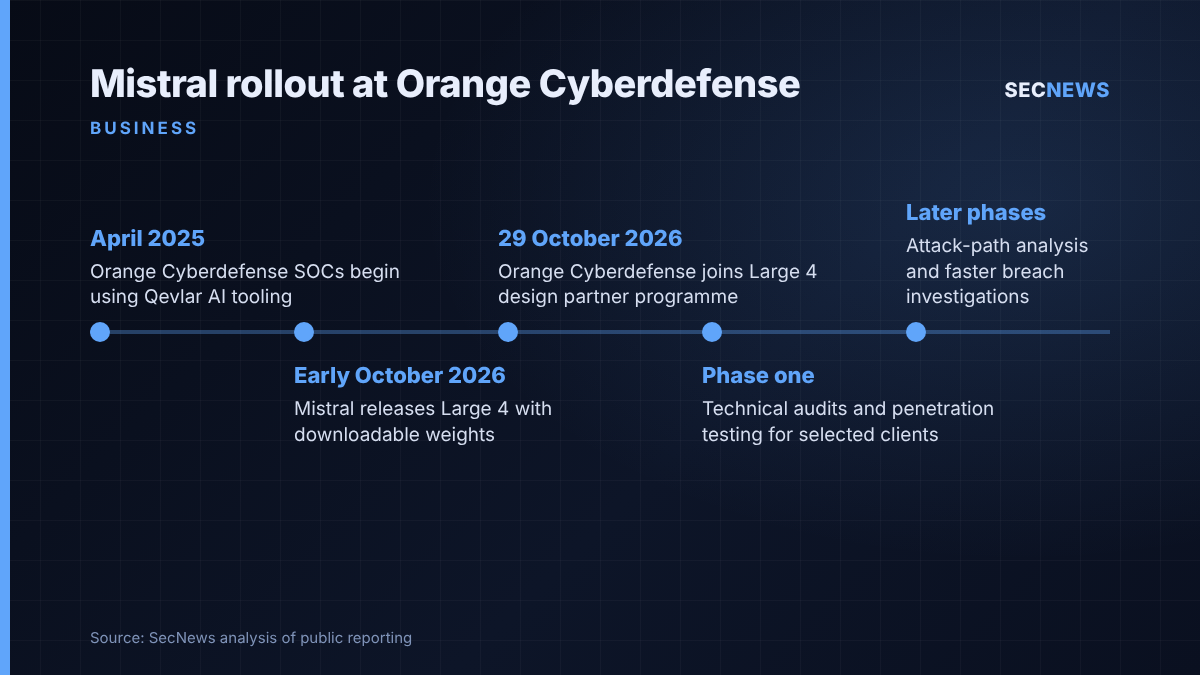
On 29 October 2026 Orange Cyberdefense, the security services arm of the French telecoms group Orange, announced that it had joined the design partner programme for Mistral Large 4. According to Reuters, the agreement gives the provider access to a cybersecurity variant of the French startup’s newest model, which it will build into its own products. The Next Web reported that Orange Cyberdefense is the first European managed security services provider (MSSP) to sign up.
Financial terms were not disclosed. The rollout is gradual, initially covering selected services for business and public-sector clients, starting with technical audits and penetration testing. The Next Web says later phases will use the model to map possible attack paths and to speed up breach investigations. Orange Cyberdefense says the model will run on compute located in Europe. The Next Web specifies Mistral’s own European data centres, and the company presents this as a way for clients to keep control of their data.
Reuters gives its 2025 revenue as EUR1.3 billion and describes it as one of Europe’s largest cyber security providers. This is also not its first AI supplier: according to The Next Web, its security operations centres have used tooling from Qevlar AI since April 2025.
The detail
According to The Next Web, Mistral released Large 4 in early October as a one-trillion-parameter model whose weights are available to download. The security-tuned variant is a different matter. The Next Web reports that only a small group of partners are testing it, and that they may use it only against systems they own or are authorised to assess. That restriction matters commercially. It means the security-tuned version is not simply a public download, and it turns a design partnership into a gated route to the product.
A design partner programme is not a reseller agreement or an acquisition. As usually understood in the software industry, the partner gets early access to a product still in development and gives feedback that shapes it, often in exchange for preferential terms later. For Mistral, an MSSP of Orange Cyberdefense’s size provides real-world security workloads and a sales channel into enterprise and government buyers. For Orange Cyberdefense, it secures a European model that it can sell on the strength of where the data is processed, not just on how well the model performs.
The services chosen for the first phase say a lot. Audits and penetration tests are bounded, scoped engagements with written authorisation, which makes them a relatively safe place to introduce an offensive-capable model. Attack-path analysis and incident investigation come later. They involve live client environments and time pressure, where mistakes cost more.
Why it matters for UK organisations
The following is my reading of the market, not something either company has said about the UK. The deal is a sign of how managed security will be sold over the next couple of years. MSSPs are under pressure from two directions. Frontier AI labs are selling vulnerability discovery and security tooling directly to large enterprises, and attackers are using AI to work at a scale that pushes up the volume defenders must handle. Providers that only resell other vendors’ tools will struggle to justify their margins. Locking in access to a capable model and wrapping services around it is one way to stay relevant.
For UK buyers the selling point to watch is “European compute”. It is a real consideration for organisations that must think hard about where security telemetry, vulnerability data and incident evidence end up, especially in the public sector, defence supply chains and regulated financial services. But processing in Europe is not the same as processing in the UK, and it does not answer every question about subprocessors, model training on client data or who can access logs. Under UK GDPR, transfers to EU-based infrastructure are generally straightforward, but buyers still need the contract to say what happens to their data.
There is also a regulatory dimension. The Cyber Security and Resilience Bill is set to bring managed service providers into the UK’s NIS-style regime. If your MSSP’s core delivery increasingly depends on a third-party AI model, that model becomes part of your supply chain risk, and part of theirs. Procurement and third-party risk teams should expect to ask about it.
Expert view
In my experience, the most useful thing AI has done in testing so far is take on the grind: enumeration, correlating findings, drafting reports. It does not replace the judgement of an experienced tester. A model tuned for security could speed up the early stages of an engagement and widen coverage, which is good for clients if it means more of the estate is tested for the same budget. The risk is that “AI-assisted” becomes a reason to cut senior time on an engagement while the price stays the same.
The authorisation restriction on the security variant is sensible and fits how UK testers already have to work under the Computer Misuse Act: no written scope, no testing. When we test, the rules of engagement are agreed before anything touches a client system. Any provider using AI agents in offensive work should be able to show how those agents are kept inside scope, logged and stopped. I would treat a vague answer to that question as a red flag.
Commercially, I expect other large European MSSPs to announce similar arrangements, with Mistral or with US labs, before long. Model access is becoming a point of differentiation in a crowded services market, much as threat intelligence feeds were a decade ago.
What to do now
- Ask your MSSP and testing provider directly which AI models they use in delivery, where those models run and whether your data is used for training. Get the answers written into the contract.
- Update rules of engagement for penetration tests and red team work so they cover AI agents explicitly: scope limits, logging, kill switches and human sign-off before any exploitation step.
- Treat AI providers as subprocessors in your third-party risk register, and check data residency claims against your UK GDPR obligations and sector rules.
- Keep the Cyber Essentials basics tight. Faster AI-assisted testing will find weak secure configuration, missing security updates and loose user access control more quickly, and so will attackers using similar tools.
- Watch the pricing. If a provider claims AI efficiency gains, ask whether you will see them as broader coverage, faster turnaround or lower cost.
Bottom line
Orange Cyberdefense’s deal with Mistral is a commercial move as much as a technical one. It positions a big European provider to sell AI-driven testing and investigation on the basis of sovereignty, ahead of the likely rush by competitors. For UK organisations, the sensible response is not to chase the headline but to ask every security supplier the same questions about models, data and control.