A poisoned build of the paid Rank Math PRO SEO plugin was handed to WordPress sites through the vendor’s own download and update channel for roughly 11 hours last week. Any site that activated it should be treated as compromised, and installing the clean release on its own will not fix that.
What happened
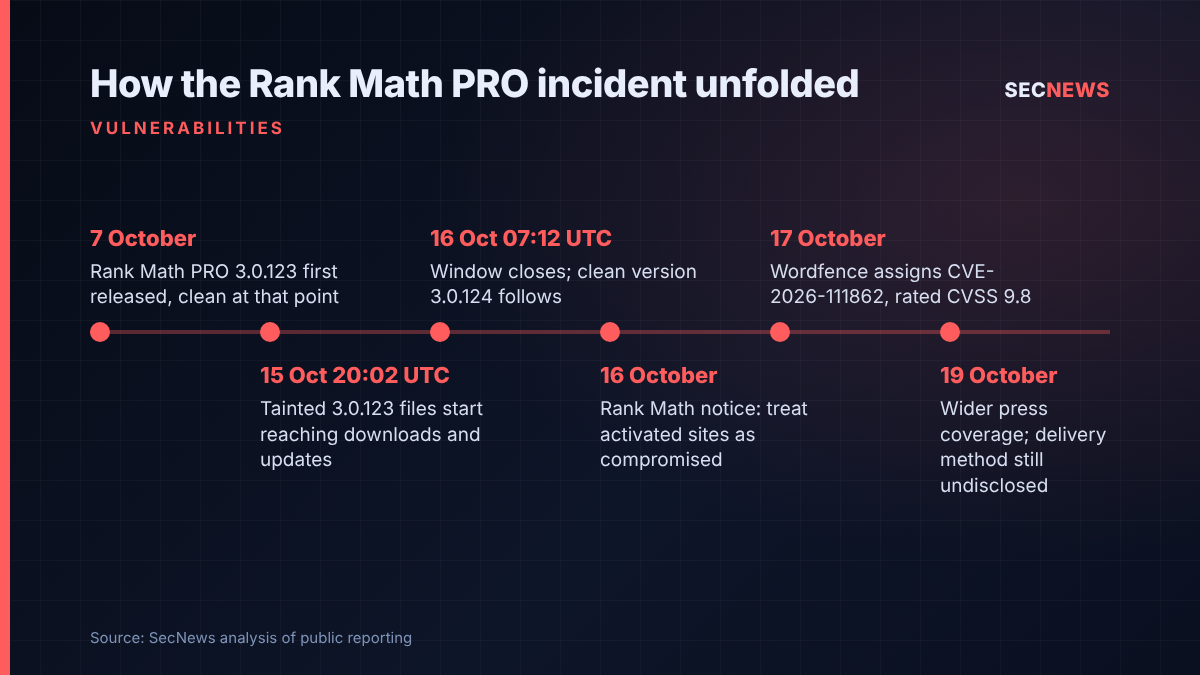
Rank Math, whose SEO plugin is one of the most widely deployed in the WordPress ecosystem, published a security notice on 16 October 2026 confirming that copies of Rank Math PRO version 3.0.123 contained malware. The tainted files were served to customers who downloaded the plugin, or received it as an update, between 20:02 UTC on 15 October and 07:12 UTC on 16 October. For UK site owners that window runs from 21:02 on the Thursday evening to 08:12 on the Friday morning, BST.
The company says it removed the affected files and shipped a clean build, 3.0.124. Wordfence followed with an advisory on 17 October and assigned the incident CVE-2026-111862 with a CVSS score of 9.8. Patchstack lists it as a backdoor and notes that, because the compromise sat inside the vendor’s own infrastructure, a firewall rule cannot mitigate it. Wider press coverage followed on 19 October.
The free Rank Math SEO plugin distributed through WordPress.org is not affected, according to the vendor. Only the PRO edition, which customers fetch from rankmath.com, is in scope.
The technical picture
This is not a coding error waiting to be exploited. It is a supply chain compromise: an attacker got malicious code into a legitimate release path, so the “update” itself was the attack. There is no vulnerable function to patch; the payload simply ran wherever the plugin was activated.
Rank Math’s description of the malware is what defenders need to absorb. The implant can regenerate its concealed backdoor each time the site receives a visitor, so deleting obvious files in the wrong order may achieve nothing. The vendor warns the attacker may have planted additional PHP files in other plugins and themes, created administrator accounts, dropped a fake file posing as part of WordPress core, altered .htaccess so that cache files execute as code, and added scheduled tasks. The Hacker News adds that SSH keys and must-use plugin folders are also on the list of places to check. Outbound contact was made to a lookalike domain, rank1cdn[.]com, which Rank Math advises blocking.
Two details make this nastier than a typical plugin flaw. First, the version number is not a reliable indicator: 3.0.123 was originally released around 7 October, so a copy fetched before the window is clean while one fetched during it is not. Second, the official clean-up guidance relies partly on checksum verification, but The Hacker News found that WordPress.org publishes no checksum file for the PRO plugin, so owners cannot easily prove their copy is genuine.
Rank Math has not said how the files got into its distribution system, how many customers received them, or whether automatic updates delivered them. Nobody has publicly attributed the attack. According to The Hacker News, the domain used was registered about a day before the window opened, which suggests the infrastructure was prepared in advance.
Why it matters for UK organisations
WordPress underpins an enormous share of UK small business, charity, membership and local services websites, and SEO plugins are among the first things an agency installs. Rank Math PRO is a paid product, so it tends to sit on commercial sites that matter to the owner: e-commerce shops, lead generation sites and client portfolios run by digital agencies. A single agency with a multi-site licence and automatic updates switched on could have pushed the bad build to dozens of client sites overnight.
The vendor tells affected owners to assume that any secret the website could reach has been exposed. On a WooCommerce shop that can include payment gateway keys, SMTP credentials and the database holding customer records. Where personal data may have been accessed, controllers need to make a reasoned decision about reporting to the ICO within 72 hours of becoming aware, as UK GDPR requires.
Expert view
In my experience, website compromises on small and mid-sized estates are rarely discovered by the owner. They surface weeks later as spam redirects, a blacklisting notice from a search engine, or a card skimmer flagged by a customer’s bank. A self-restoring backdoor on a site that also stores SMTP and payment credentials is precisely the kind of foothold that lingers quietly.
The deeper problem is trust in update channels. We spend years telling clients to patch quickly, and auto-update is usually the right default for WordPress plugins. But when the update mechanism itself is the delivery vehicle, speed works against you. By The Hacker News’s count, 2026 has now seen three or more premium WordPress vendors ship backdoored builds through their own update channels. Premium plugins sit outside the WordPress.org review and checksum ecosystem, so the security of every customer site depends on one vendor’s build and release hygiene.
When we test web estates, the weak point is rarely WordPress core. It is the long tail of commercial add-ons, shared admin accounts and no monitoring for new users or changed files.
What to do now
- Establish exposure. Check every WordPress site you own or manage for Rank Math PRO, and use update logs, backups or your agency to determine whether 3.0.123 was installed or updated during the 15 to 16 October window. A version number alone does not answer the question.
- If it was activated, treat the site as compromised. The vendor’s preferred route is restoring the site and database from a backup taken before 20:02 UTC on 15 October, then scanning it. Follow Rank Math’s published recovery notice in order; the order matters because the malware rebuilds itself.
- Rotate every credential the site could reach. That covers WordPress accounts, database passwords, the wp-config.php security keys and salts, payment and email API keys, hosting panel, SFTP and SSH access, and administrator two-factor settings. Do this even after a clean restore.
- Install 3.0.124 last, downloaded by logging in to rankmath.com directly. The vendor says it will never email login or download links, so treat any such message as phishing.
- Block and monitor outbound traffic to rank1cdn[.]com at your host or firewall, and watch for unusual outgoing connections over the following days.
- Assess UK GDPR obligations. If customer or member data was reachable, document your assessment and consider whether an ICO report is required.
- Map to Cyber Essentials. Review user access control (remove unknown or shared admin accounts), secure configuration (disable PHP execution in uploads and cache locations), malware protection (file integrity monitoring and a reputable scanner) and security update management (know which plugins auto-update, and from where).
Bottom line
The Rank Math PRO incident is a reminder that a trusted update can be the attack. Updating to 3.0.124 is necessary but nowhere near sufficient for anyone who activated the poisoned build. UK site owners and the agencies that run their websites should confirm exposure today, restore or clean methodically, rotate secrets and take an honest view of whether personal data was at risk.
Sources
- Rank Math: Rank Math PRO 3.0.123 Security Incident: How to Secure Your Website
- Wordfence: Rank Math SEO PRO 3.0.123 malware advisory
- Patchstack: Backdoor in WordPress Rank Math SEO PRO Plugin
- The Hacker News: Popular WordPress SEO Plugin Rank Math PRO Hijacked to Deliver Self-Restoring Backdoor
- SecurityWeek: Rank Math PRO WordPress Plugin Compromised in Supply Chain Attack