Apps in a network of more than 400 linked apps and domains passed Apple and Google review as pet portrait, language and fitness tools, then used server-side switches to reveal explicit deepfake generators to selected users. Apple has now pulled 19 of them, and the case shows how little a one-off store review can promise once content comes from a server the developer controls.
What happened
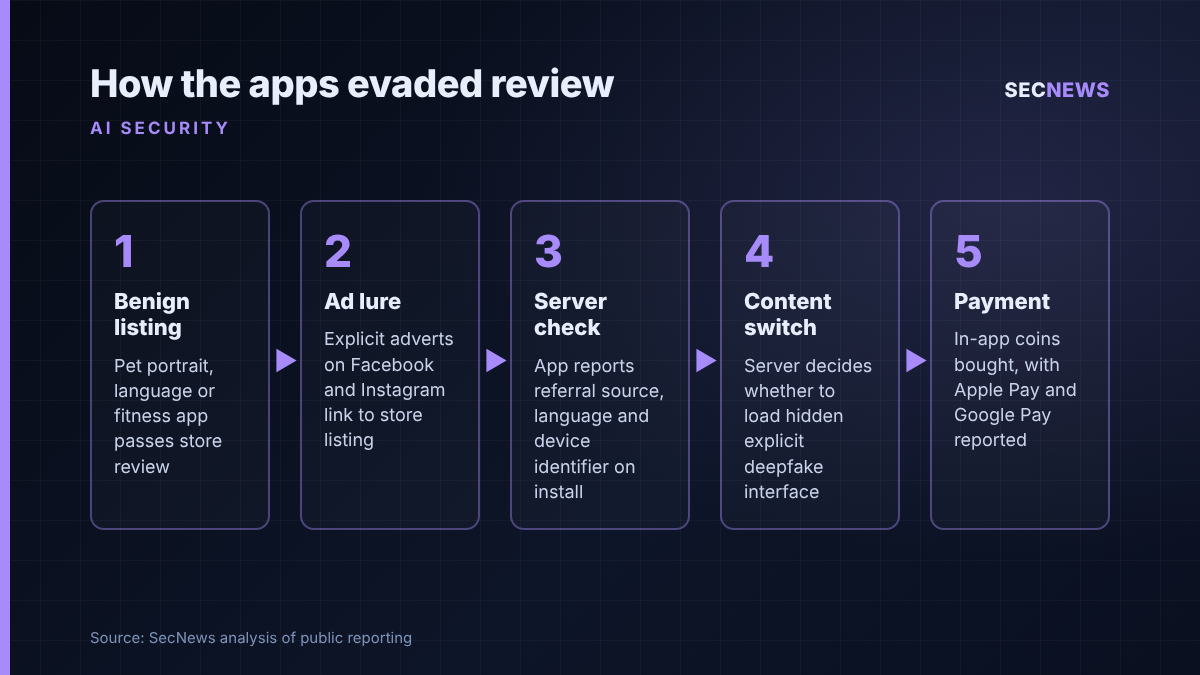
On 2 November 2026 WIRED published an investigation into a commercially run network of so-called nudify services hidden inside apps that looked entirely ordinary. Viefur, which promised anthropomorphic pet portraits, was one example; others posed as language tutors or AI workout coaches.
Under certain conditions, however, the apps loaded a web interface offering dozens of sexually explicit image and video templates into which users could upload photographs of real people, some depicting sexual violence. Payment ran through in-app digital currency, with Apple Pay and Google Pay accepted, according to WIRED.
Researchers found the network by following links from thousands of explicit deepfake adverts on Facebook and Instagram. Paul Bouchaud of the non-profit AI Forensics reverse engineered the apps and websites, and Infoblox threat researcher Maël Le Touz tied almost 500 domains together, WIRED reports. Registrations began towards the end of 2025 and spiked in spring 2026, at one point roughly 30 new apps and sites a week.
Apple removed 19 apps, including Viefur, after WIRED shared the associated domains. On Google Play, 27 related apps were live in September with more than 350,000 combined downloads, many rated suitable for all ages. Google had removed most of them before being approached. Meta says it banned Hong Kong registered KeLing Technology Limited, which WIRED links to the operation, from advertising in 2025, and has since acted against 11,600 ad accounts and blocked 209 apps from advertising.
The technical picture
This is not an AI vulnerability as such; the models are the payload. The real security story is the delivery mechanism, which borrows from techniques normally associated with malvertising and mobile malware.
First, cloaking. On each install the app contacted a server and reported details such as referral source, device language and a unique identifier. The server then decided whether to present the harmless experience or swap in the explicit interface. Arriving through one of the linked Meta adverts appears to have been one trigger. A reviewer installing from a clean device would see exactly what the listing promised.
Second, bait and switch. Apple told WIRED the apps “complied with our rules when we reviewed them”, and that the developers later altered the website the apps loaded content from. The reviewed binary never changed; the remote content did. Apple added that it had suspended tens of thousands of apps for similar tactics over the past year and has recently tightened its rules on nudify tools.
Third, disposability at scale. The operators used generic privacy policies, free webmail addresses, obscure developer names and advertising pages with nonsense payer names and no followers. A JavaScript bundle on the websites reportedly listed every domain and app in the network, with encryption keys and ad trackers, which let researchers map the estate.
Why it matters for UK organisations
The law in England and Wales has moved sharply this year. Since 6 February 2026, section 138 of the Data (Use and Access) Act 2025 has made it a crime to create, or ask someone else to create, a sexually explicit deepfake of an adult without consent. From 29 June 2026, section 99 of the Crime and Policing Act 2026 went further by targeting anyone who builds, modifies or provides a tool for generating such images, with up to three years’ imprisonment and an unlimited fine. Police guidance dated October 2026 confirms the definition reaches apps, websites, bots and fine-tuned models, that companies can be liable alongside senior people who consent or connive, and that UK incorporated firms and UK nationals can be pursued for conduct abroad.
The same guidance notes that the Online Safety Act 2023 does much of the practical work. Creating and sharing non-consensual intimate images are priority offences, so regulated user-to-user and search services must assess the risk and act to stop UK users encountering these generators, wherever the operator is based. Enforcement there sits with Ofcom rather than the police.
For everyone else, the issue is closer to home. These apps sat in official stores with innocuous names and family-friendly ratings. Staff and their children install such apps on phones that also hold corporate email, Teams and authenticator apps. Software built around uploading photos of real people, phoning home to an opaque server and taking payments under fake identities is exactly what you do not want on a managed or BYOD device.
Expert view
In my experience, many organisations treat “it came from the App Store” as a security control. This case is a useful corrective. Store review is a point-in-time check of a binary, and it struggles against anything that decides at runtime what to show and to whom. The same switch could just as easily hide a phishing page. When we test mobile estates, remotely configured web views are one of the first places we look, because they let a developer change behaviour without shipping a new release.
The ad-cloaking element is equally familiar. Targeting by referral source means the people who see the harmful version are precisely those the operator wants, while reviewers and researchers see a pet photo app.
I would also caution against filing this purely under content moderation. The new offences aim squarely at builders and suppliers, and the “all reasonable steps” defence sets a high bar. Any UK business offering image generation features, or integrating a third-party model that could be steered towards this use, should be able to evidence its safeguards.
What to do now
- Control what runs on devices. Cyber Essentials malware protection allows application allow listing, and secure configuration expects unnecessary software to be removed. Use MDM to restrict generative image apps on managed phones and review what is already installed.
- Set a clear BYOD position. Where personal phones reach corporate data, use app protection policies or work profiles so unmanaged apps cannot touch corporate content.
- Govern remote configuration in your own apps. Log and approve changes to remotely loaded web content and feature flags with the same rigour as code releases.
- Review platform duties. If your service is in scope of the Online Safety Act, check your illegal content risk assessment covers adverts and links to nudification tools.
- Assess AI image features you supply. Document safeguards against generating intimate images of real people and take legal advice on the new offence.
- Prepare support routes. Make sure staff know deepfake abuse is a crime, how to report it and what help is available.
Bottom line
A pet portrait app that becomes a deepfake generator for users arriving from the right advert is a lesson in how runtime cloaking defeats store vetting. The UK now has criminal law aimed at those who build and supply such tools, but organisations should not wait for prosecutions: control what runs on devices that touch your data, and treat the official store as one control among several, not a guarantee.
Sources
- WIRED: Hundreds of Mundane AI Apps Are Hiding Sexually Abusive Deepfake Features
- Digital Trends: A hidden network of nudifying tools was found lurking inside harmless looking AI apps
- TUAW: Apple removes 19 AI apps hiding abusive deepfake tools
- GOV.UK: Making or Supplying Purported Intimate Image Generators, Non-Statutory Guidance for the Police
- legislation.gov.uk: The Data (Use and Access) Act 2025 (Commencement No. 5) Regulations 2026
- Wiggin: Intimate Image Abuse and AI Chatbots, Crime and Policing Act becomes law
- End Violence Against Women Coalition: Survivors and campaigners welcome new deepfake law