France’s lower house has finally passed the law transposing NIS2, two years late and with a case already before the EU’s highest court. UK businesses with French subsidiaries, customers or supply chain roles should start compliance work now.
What happened
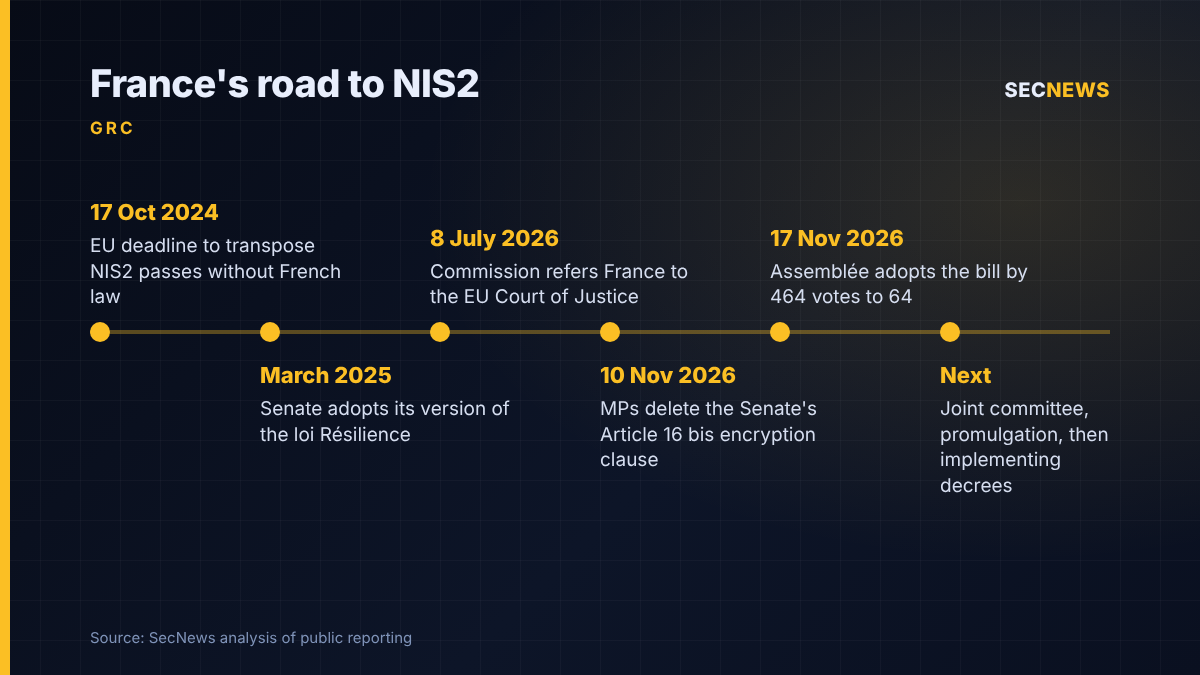
On Tuesday 17 November 2026 the Assemblée nationale adopted the so-called “loi Résilience”, formally the bill on the resilience of critical infrastructure and the strengthening of cyber security, in a late-afternoon solemn vote. The official result was 464 in favour and 64 against, with 16 abstentions. IT for Business reports that every vote against came from La France Insoumise.
The bill transposes three EU texts: the NIS2 Directive (EU) 2022/2555, the Critical Entities Resilience directive and the directive that accompanies DORA. The NIS2 deadline was 17 October 2024. The European Commission opened infringement proceedings in November 2024 and, according to Next, referred France to the Court of Justice of the EU on 8 July 2026, alongside Ireland, Spain and the Netherlands.
The Senate had passed its version back in March 2025. The text then stalled for months in the Assemblée, largely over Article 16 bis, a Senate addition that would have barred the state from forcing encrypted messaging providers to build in backdoors. MPs deleted it on 10 November by 69 votes to 37, which cleared the way for the final vote.
It is not law yet. Under the accelerated procedure each chamber reads the text once, so a joint committee of seven deputies and seven senators is expected to reconcile the two versions. Promulgation and implementing decrees, which will hold much of the operational detail, come after that.
The detail
The core obligations come straight from the directive. Coverage grows to 18 sectors: 11 highly critical ones, including energy, transport, banking, health, water and managed ICT services, plus seven others such as manufacturing, food, chemicals and digital providers. Local authorities with at least 30,000 residents are also in scope.
Estimates of the number caught range from about 15,000, the rapporteurs’ figure, to the 18,000 to 20,000 cited by Anne Le Hénanff, the minister for AI and digital affairs. Journal du Net reports rapporteur Vincent Thiébaut saying ANSSI’s supervisory remit will grow around thirtyfold.
In-scope entities must adopt risk management measures that their management bodies approve and oversee, and board members must be trained. Significant incidents must be reported to ANSSI in three steps: an early warning within 24 hours, a fuller notification within 72 hours and a final report within a month. Maximum fines are at least €10 million or 2% of worldwide turnover for essential entities and €7 million or 1.4% for important entities, whichever is higher. The state and local authorities are exempt from fines.
According to Journal du Net’s account of the debate, MPs also went beyond the directive, often against the government’s wishes:
- A single incident report covering ANSSI, the CNIL and, for finance, the ACPR and AMF, with ANSSI in the lead. The minister reportedly argued this was not legally possible under current EU law.
- Digital sovereignty measures, including a preference for ANSSI-qualified providers established in France (also reported by Solutions Numériques) and an amendment, passed 36 to 29, requiring essential entities to use hosting not subject to extraterritorial laws.
- Approved e-invoicing platforms reclassified as essential entities, after several were attacked.
- State identification of entities using business activity codes, rather than relying only on self-declaration.
Journal du Net also reports the general rapporteur, Éric Bothorel, indicating that the joint committee would be used to correct some of these additions, so the final text may look different.
Why it matters for UK organisations
A UK headquarters does not put a business outside NIS2. Under Article 26 of the directive, most entities are supervised wherever they have an EU establishment, so a UK group’s French manufacturing or health subsidiary will answer to ANSSI. Digital providers listed in Article 26(3), including cloud, data centre, managed service and managed security service providers, are supervised from one main EU establishment and must appoint an EU representative if they have no base in the Union.
Many more UK firms will feel the law through contracts. Supply chain security is one of the core NIS2 risk measures, so French essential and important entities will push security clauses, audit rights and incident notification duties down to their suppliers. A UK MSP or software house with French clients should expect questionnaires that mirror the 24-hour and 72-hour reporting windows.
The sovereignty amendments are the wild card. If the preference for French-qualified providers or the limit on hosting exposed to extraterritorial law survives the joint committee, it could narrow the field for non-French suppliers. That is far from settled: Journal du Net reports that the government opposed bringing sovereignty into the text, and that the rapporteur repeatedly cited EU rules on the free provision of services.
Meanwhile the UK’s Cyber Security and Resilience Bill is scheduled to return to the Commons on 24 November for MPs to consider Lords amendments, so cross-Channel groups will soon have two overlapping regimes to map.
Expert view
In my experience, organisations struggle with a new regime less because they misread the law than because they cannot quickly say which entities, systems and suppliers are in scope. The French minister has told organisations not to wait for promulgation, and that is sound advice. The decrees will settle the details, but the obligations themselves have been in the directive since 2022.
The reporting clock is where I would focus first. A 24-hour early warning means detection, triage and escalation to someone with authority to notify must already work outside office hours. When we run incident exercises, the weak point is usually who signs off a regulatory notification at 2am, not the technology. Groups with UK and French entities should also decide now how a single incident affecting both will be reported to ANSSI, and in future to UK regulators, without contradictory messages.
What to do now
- Classify your French footprint. List every French entity and every French customer relationship, and decide provisionally whether each is essential, important or out of scope based on sector and size.
- Check whether you are an Article 26(3) digital provider. If you offer cloud, data centre, managed or managed security services into France, confirm where your EU main establishment sits or whether you need an EU representative.
- Build a 24/72-hour notification playbook that also covers GDPR breach notification to the CNIL, and name an out-of-hours decision-maker.
- Brief the board. Management bodies must approve and oversee cyber risk measures and be trained, so get that on the next board agenda.
- Prepare for supplier scrutiny. Cyber Essentials Plus (firewalls, secure configuration, access control, malware protection, patching) is a useful baseline for French customers, but it does not cover incident reporting or continuity.
- Watch the joint committee for the fate of the single reporting portal and the sovereignty clauses before committing to hosting changes.
Bottom line
France’s vote ends two years of delay and makes NIS2 a near-term reality in a major UK trading partner. Details may change; the core duties will not. UK firms with French operations or customers should treat 17 November as the start of their compliance programme, not wait for the decrees.
Sources
- Leto: NIS 2, l’Assemblée adopte la loi Résilience par 464 voix contre 64
- Next: Dernière ligne droite pour le PJL Résilience
- IT for Business: Loi Résilience, l’Assemblée adopte le texte qui transpose NIS 2
- Solutions Numériques: Loi Résilience, l’Assemblée adopte la transposition de NIS2
- Agora News Sécurité: NIS 2, l’Assemblée vote enfin la loi Résilience
- Journal du Net: NIS2, l’Assemblée adopte enfin la transposition
- nisd2.eu: Art. 26 NIS 2, headquarters outside the EU
- CSRB guide: Cyber Security and Resilience Bill clears the Lords