Trezor has confirmed that three Safe 5 hardware wallets sold through former reseller CryptoBilis carried a hidden circuit board designed to read recovery phrases off the screen and send them out over a mobile network. The case has the hallmarks of a hardware supply chain attack, and the lessons reach well beyond cryptocurrency into how UK organisations buy any security device.
What happened
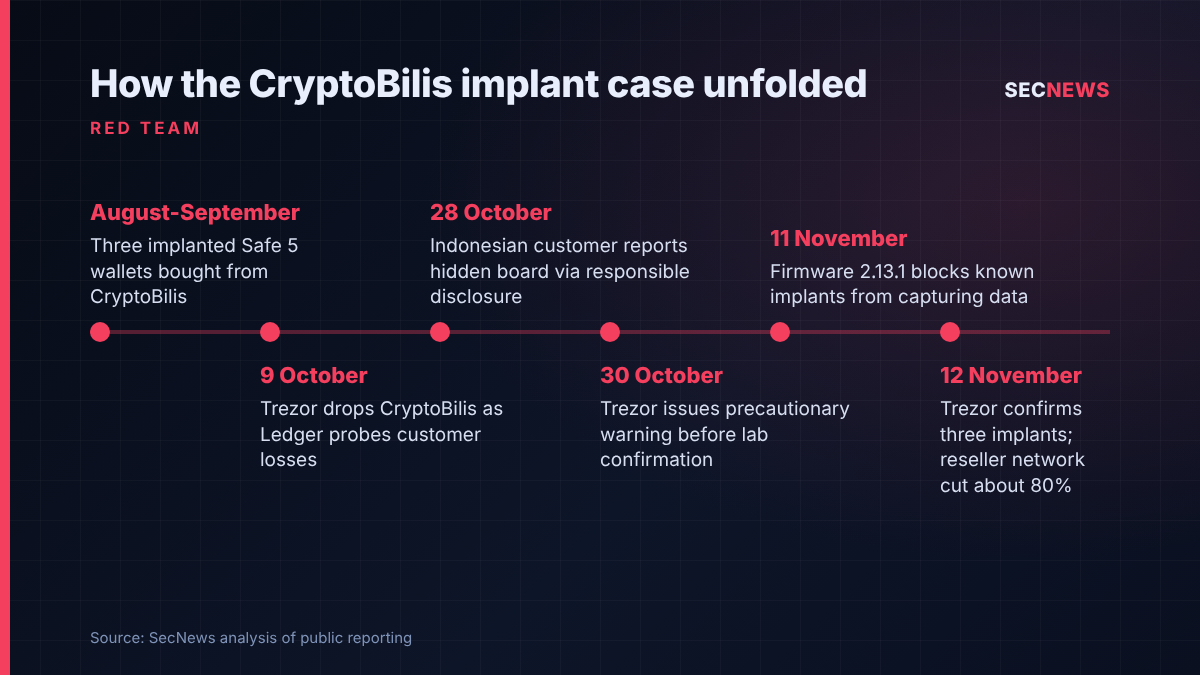
On 12 November 2026, hardware wallet maker Trezor published an investigation update confirming that three of its Safe 5 devices had been physically tampered with before reaching their owners. All three were bought from CryptoBilis, an Indonesian company that was an authorised Trezor reseller in Southeast Asia until 9 October, between 20 August and 23 September 2026. Trezor says CryptoBilis sold devices directly and through its Tokopedia and Shopee stores.
The story began on 28 October, when a customer in Indonesia used Trezor’s responsible disclosure programme to report an unexpected board inside his device. Trezor went public with a precautionary warning on 30 October, before its lab had seen the hardware. Its lab has since analysed that unit and spotted two more compromised wallets in owners’ photographs. Forty-eight CryptoBilis customers have come forward so far.
Trezor released firmware 2.13.1 on 11 November, which it says stops the implants found to date from capturing anything. It stresses that the update cannot help if a recovery phrase was already stolen. No affected owner has reported losing funds. The company has also cut its global reseller network by roughly 80% and is offering replacement devices to anyone who bought from CryptoBilis since March 2026.
This follows Ledger’s investigation into the same reseller, which secnews.co.uk reported in October. Ledger confirmed that genuine devices sold by CryptoBilis had been fitted with hidden components and that victims’ wallets were drained in a coordinated operation. Trezor’s confirmation means two separate manufacturers’ products were compromised through one distribution channel.
The technical picture
The attack is notable for what it leaves untouched. The extra board is wedged between the display and the Safe 5’s main board. It does not alter Trezor’s firmware and it does not touch the Secure Element, the tamper-resistant chip that guards the wallet’s keys. Instead, it watches what the screen shows.
A hardware wallet’s entire security model assumes the display is trustworthy. When a user creates a new wallet, the device shows the recovery words so they can be written down; when restoring, the user enters them on the device. The implant captures those words at either moment, along with any passphrase that appears on screen. It then encrypts the data and sends it to an attacker-controlled server using its own cellular module and antenna, so it never needs the victim’s computer or network. If there is no signal, it stores the data and keeps retrying.
From an offensive perspective this is elegant. Every software integrity check will pass, because the software is genuine, and firmware attestation says nothing about an extra component tapping the display. The exfiltration path never touches the corporate network, so network monitoring cannot see it.
Trezor has not explained how the fix stops the current implants capturing anything, and says it is deliberately withholding technical detail. That is a sensible call, but it also implies the next generation of implant could adapt. Trezor has not said who fitted the boards or at which point in the chain the tampering happened, and it advises against owners weighing or opening devices to check, because neither is a reliable test.
Why it matters for UK organisations
Filing this under “crypto problem, Southeast Asia” would be a mistake. The tradecraft here, intercepting genuine products in distribution and adding a covert component that leaves the vendor’s code intact, applies to any device that displays or handles secrets: hardware security keys, smartcard readers, encrypted USB drives, firewalls, even laptops.
UK organisations buy a surprising amount of security hardware through channels that are not the manufacturer or an audited distributor. Online marketplaces, third-party sellers on large retail platforms, refurbished stock, and the occasional “urgent” purchase on a company card all appear in procurement trails. In the CryptoBilis case the seller was not even grey market: it was an authorised reseller, trading through mainstream marketplaces. An “official partner” badge is not assurance.
There is also a direct exposure for UK firms holding digital assets, from treasury functions to fintechs regulated by the FCA, and for staff who keep personal crypto on devices that may be plugged into work machines. Trezor also warns that scammers are already exploiting the incident with fake emails, letters and calls.
Expert view
When we run physical and supply chain assessments, the weakest point is rarely the device itself. It is the assumption that a sealed box from a named seller is what it claims to be. This implant is the hardware equivalent of a keylogger on a perfectly patched machine.
In my experience, few organisations can say with confidence where every security key or hardware token in their estate came from. Asset registers track serial numbers, not provenance. That gap is precisely what this kind of operation exploits.
Trezor’s response deserves some credit. Its point that the dropped resellers were not untrustworthy, simply unable to meet stricter sourcing, storage and access controls, is the right framing: supply chain security is about controls you can verify, not reputations.
The open question is attribution and scale. A cellular-capable implant fitted to two different manufacturers’ devices suggests a well-resourced, organised operation rather than a lone insider. Until we know where in the chain the tampering occurred, it is unwise to assume it was confined to one reseller.
What to do now
- Check provenance first. Identify any hardware wallets, security keys or tokens bought outside direct-from-manufacturer or audited distributor channels. If any Trezor or Ledger device came from CryptoBilis, follow the vendor’s advice: transfer assets into a freshly created wallet with its own recovery phrase, then contact support.
- Update firmware. Apply Trezor firmware 2.13.1, which Trezor’s changelog lists for the Model T, Safe 3, Safe 5 and Safe 7. This maps to the Cyber Essentials security update management control.
- Tighten procurement policy. Require security hardware to be bought direct or from named, vetted distributors. Ban marketplace and personal-card purchases for anything that stores secrets.
- Record provenance in the asset register. Log supplier, purchase date and delivery chain alongside serial numbers, so you can scope exposure quickly next time.
- Treat key generation as sensitive. Generate and back up critical keys on devices with verified provenance, ideally in a controlled environment, rather than on whatever unit arrived first.
- Warn staff about replacement scams. Remind users that no vendor will ever ask for a recovery phrase, and that “free replacement” letters or calls should be verified through official channels.
- Use NCSC supply chain guidance. Fold hardware sourcing into your supplier assurance work rather than treating it as a purchasing detail.
Bottom line
The CryptoBilis implants show that attackers no longer need to break a secure chip when they can simply watch the screen next to it. For UK organisations, the lesson is not about cryptocurrency at all: if you cannot prove where a security device came from, you cannot prove it is secure.