World Triathlon has confirmed that an attacker abused a weakness in its Metabase reporting tool to copy athlete medical declarations, contact records and coach evaluations. Fraudsters are already using lookalike email domains to request payments, and UK athletes, officials and clubs should treat any payment request linked to the sport with suspicion.
What happened
In a 13 November 2026 memo to national federations from Secretary General Jon Wyatt, reported by Slowtwitch and echoed in a notice from Triathlon Ireland, the governing body said an unauthorised outside party exploited a security flaw in Metabase, the third-party business intelligence and reporting tool World Triathlon used, and reached the organisation’s underlying databases.
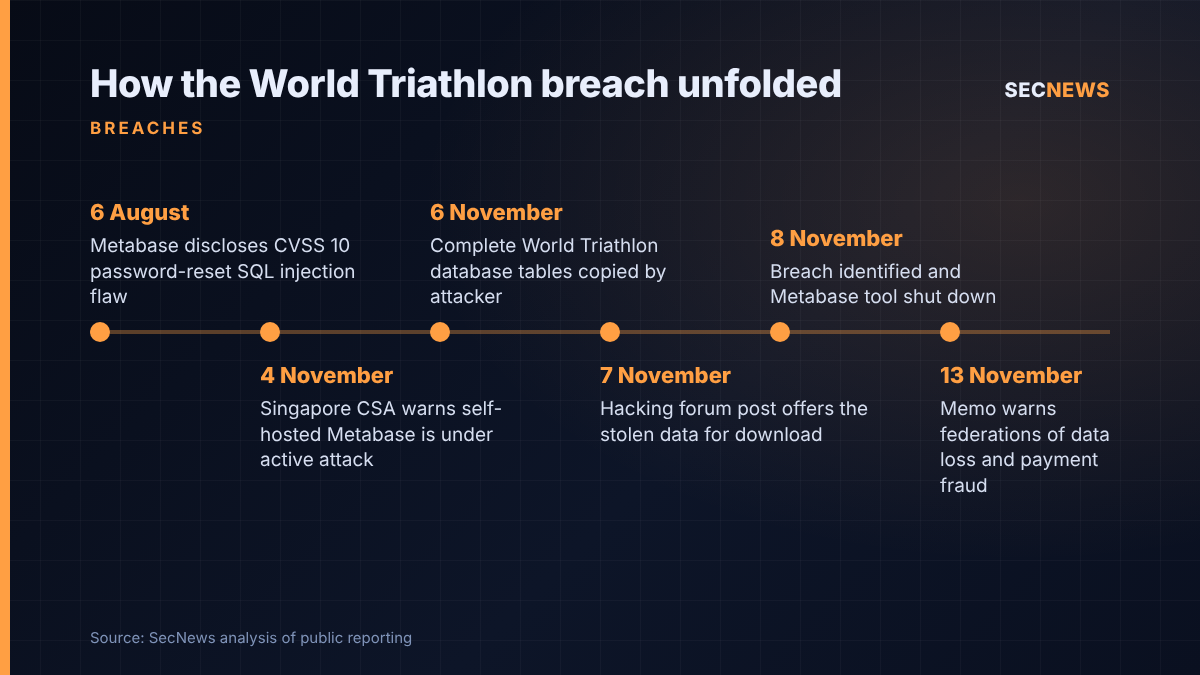
The timeline is short and uncomfortable. Complete database tables were copied on 6 November. A day later, a post on a hacking forum offered the data for download. Detection came on 8 November, when World Triathlon took the Metabase tool offline. It has not explained how the intrusion was noticed, how many people are affected or who was responsible.
The data taken covers most of the people who make the sport run. World Triathlon lists names, email and postal addresses, the national federation and confederation contact lists, member, athlete and entrant records with entries and results history, and records for technical officials and coaches including positions, evaluations and certifications. Most sensitive of all, it confirms that medical information athletes supply for event medical delegates, such as allergies, illnesses and medication, was downloaded. Passwords for the NF Portal and Entries accounts were also copied, though in hashed form. The body says no financial data was accessed.
Its response so far has been to reset every NF Portal and Entries password, sign all users out, change database credentials, bring in a cyber security firm for a forensic investigation and notify Swiss police, the Swiss data protection commissioner (FDPIC) and regulators under both EU and UK GDPR. Affected individuals are due to be contacted directly by email.
The fallout has started. The memo warns that criminals have already used lookalike email domains to ask for payments to new bank accounts. Bermudian triathlete Tyler Smith told the Royal Gazette the medical exposure was “disappointing news”.
The technical picture
World Triathlon has not said which Metabase weakness was abused or which version it was running, so the exact route in remains unconfirmed. The most likely candidate, though nobody involved has said so, is CVE-2026-72898. Metabase disclosed this flaw on 6 August after attackers used it against its own cloud service.
The bug is an SQL injection in the unauthenticated password-reset endpoint, /api/session/reset_password. Bishop Fox’s analysis explains that the endpoint failed to reject request fields it had not declared, and that attacker-supplied values in those fields could end up being treated as part of a query against the Metabase application database. It is scored CVSS 10.0, needs no credentials and no user interaction, and Metabase has confirmed exploitation in the wild. Fixed releases exist for every supported branch, from 58.24 up to 63.5.
Why does that matter so much? A reporting tool is, by design, wired into the databases an organisation cares about. Control of the application database, Bishop Fox expects, would let an attacker become an administrator, lift stored secrets and query every connected data source with Metabase’s own privileges.
Metabase patched its hosted service itself, but anyone running their own copy has to upgrade it. According to Slowtwitch, Dataminr counted around 11,000 self-hosted instances exposed online in October, of which 4,309 looked vulnerable, and Singapore’s Cyber Security Agency warned on 4 November that self-hosted installations were being actively attacked with public exploit code available.
Why it matters for UK organisations
There are two audiences here. The first is the British and Irish triathlon community: athletes who have raced internationally, coaches, technical officials and federation staff whose records sit in World Triathlon’s systems. The organisation has reported under UK GDPR, which suggests UK data subjects are in scope. Health data is special category data under UK law, and unlike a password it cannot be changed after a leak.
The fraud risk is immediate. Clubs, regional associations and event organisers routinely exchange invoices for entries, kit and travel, and an accurate federation contact list plus lookalike domains is the raw material for payment diversion fraud.
The second audience is every UK organisation running Metabase or a similar self-hosted analytics tool. These platforms tend to be set up by a data or finance team, exposed to the internet so remote colleagues can reach dashboards, and then left off the patching rota because they are not seen as core infrastructure.
Expert view
In my experience, business intelligence servers are among the most consistently overlooked systems on external tests. They rarely appear on the asset register the security team owns, they often hold read credentials to production databases, and their login pages are discoverable with a basic search. When we find one, it is often the shortest path to the crown jewels.
The detail I would focus on is the gap between disclosure and this breach. A maximum severity, unauthenticated flaw was public in early August, and a national cyber agency was shouting about live attacks by early November. If, as seems plausible, this was the route, the problem was not a clever attacker but a patch that never landed. The other lesson is data minimisation. Event medical information is needed on race day, but keeping it in the same reachable data store as entries and results, indefinitely, multiplies the harm when something goes wrong.
World Triathlon does deserve some credit: shutdown within about 48 hours of the complete tables being copied, and an early, specific fraud warning.
What to do now
- If you run Metabase, patch today. Upgrade self-hosted instances to the fixed release for your branch (58.24, 59.21, 60.17, 61.11, 62.9 or 63.5 and later). This is Cyber Essentials security update management: critical fixes within 14 days, and this one is long overdue.
- Assume compromise if you were exposed and unpatched. Review administrator accounts and audit logs, and rotate every database credential and secret that Metabase holds.
- Take analytics tools off the open internet. Put them behind a VPN, zero trust access proxy or single sign-on, in line with Cyber Essentials firewall and secure configuration controls.
- Give BI service accounts least privilege. Read-only access to the specific schemas needed, never blanket production access.
- Triathlon clubs and federations: verify every payment change. Confirm new bank details by phone using a number you already hold, and warn finance staff about lookalike domains.
- Athletes and officials: expect targeted phishing. Change any password reused from your World Triathlon accounts, enable multi-factor authentication elsewhere and consider a subject access request to see what was held.
Bottom line
World Triathlon’s breach shows how a reporting tool can become the doorway to an entire organisation’s data, including health information that can never be reset. The exact flaw is unconfirmed, but anyone running self-hosted Metabase should treat this as a final warning to patch, lock down and audit. Everyone in the sport should treat unexpected payment requests as hostile until proven otherwise.
Sources
- Slowtwitch: World Triathlon Data Breach Exposed Athlete Medical Information and More
- Triathlon Ireland: Data Security Incident at World Triathlon
- The Royal Gazette: Bermuda triathletes have data stolen from governing body
- Bishop Fox: Critical SQL Injection in Metabase via Password Reset: CVE-2026-72898