OpenAI has signed a formal testing partnership with Hacktron, the small offensive security firm whose researchers first came to its attention through its public bug bounty programme. It is a clear example of a bounty relationship turning into paid, scoped work, and it says a lot about where the money in vulnerability research is heading.
What happened
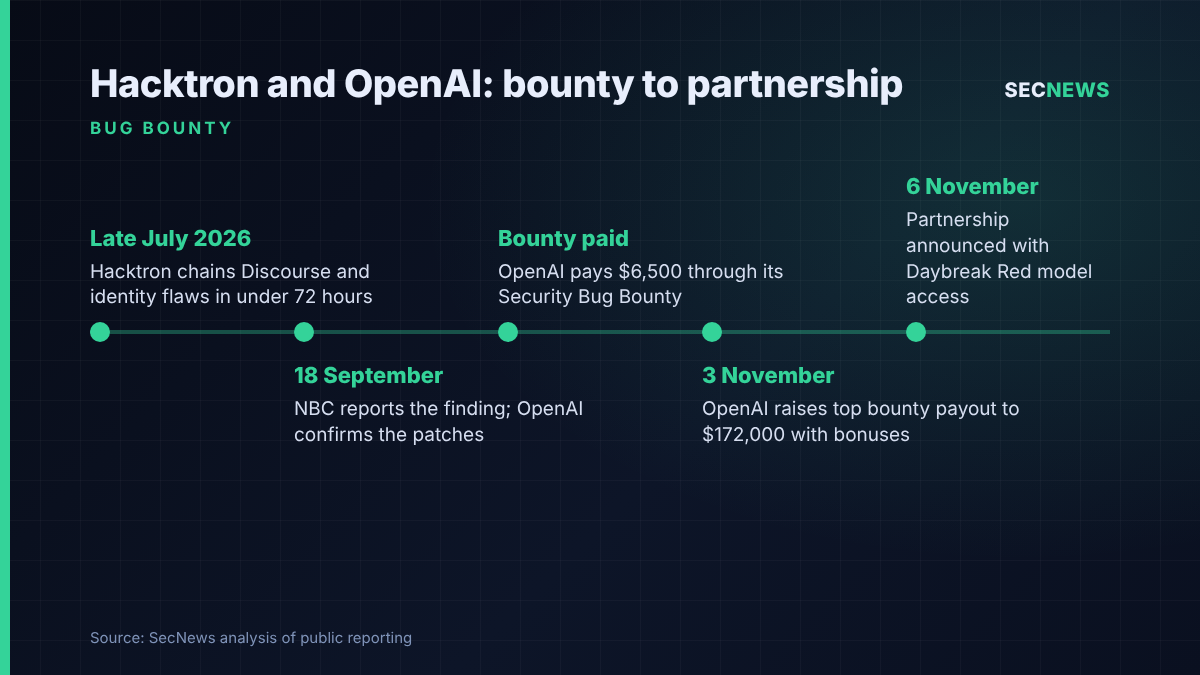
On 6 November 2026 OpenAI announced that it is working with Hacktron to find weaknesses in its own systems. Engineers from both sides will agree the priority areas together, and the first focus is where OpenAI’s platforms connect to third-party services. As part of the deal, Hacktron gets wider access to OpenAI’s most capable models through Daybreak Red, OpenAI’s restricted programme for offensive security work.
Both companies say the relationship started in OpenAI’s Security Bug Bounty programme. In September, NBC News reported that Hacktron researchers had chained two previously unknown flaws to reach OpenAI employees’ ChatGPT accounts. One flaw was in Discourse, the third-party forum software OpenAI uses, and the other was in how OpenAI verified its staff. According to NBC, the work took under 72 hours in late July and caused no damage. OpenAI confirmed the report, said the issues had been patched, and paid a $6,500 bounty, a figure given in Hacktron’s own write-up and repeated by NBC and NewsBytes.
This is a separate story from the two OpenAI bounty items secnews.co.uk has already covered: the $5,000 payment for a ChatGPT share-link account takeover on 1 November, and the reward increase announced on 3 November that raised the top payout to $172,000 with bonuses. The new development is not about how much OpenAI pays per bug. It is about OpenAI taking a researcher team out of the open bounty queue and putting it on a scoped engagement with privileged model access.
The detail
The firm sells AI agents that review code and carry out penetration tests and red team work. Much of its research looks at the joins between applications, cloud infrastructure and identity, which fits the September finding closely.
OpenAI presents the partnership as an answer to a newer kind of risk. As AI agents link services together in new ways, the trust boundaries between those services matter more and more, and they are hard to test from outside without context. A partner sitting with the defending engineers can see integration logic and identity flows that a bounty hunter only sees from outside.
Daybreak Red is the other half of the deal. HuggingNews describes it as a gated route for using OpenAI’s frontier models in offensive security. HuggingNews reported that OpenAI opened its new GPT-6 Cyber model to selected Daybreak Red participants the day before the Hacktron announcement. BigGo and hyper.ai note that it follows OpenAI bringing Cathedral researchers into its next security sprint.
Hacktron’s chief executive, Zayne Zhang, framed it as combining offensive expertise with OpenAI’s models, and said OpenAI was “setting a strong example” by giving researchers frontier cyber models.
Why it matters for UK organisations
First, the integration-layer bug class is not unique to AI labs. Most UK organisations rely on forums, help desks, single sign-on providers and SaaS connectors they did not write. The September chain started in third-party software and ended inside identity. That is a pattern we see repeatedly when we test UK estates, and AI agent connectors are adding more of these joins every month.
Second, it shows what a mature bounty programme can turn into. Many UK firms run a vulnerability disclosure policy, and some pay bounties. Far fewer have a plan for when a researcher keeps finding serious issues. OpenAI’s answer is to move that talent into a contracted relationship with agreed scope. For UK hunters, it confirms that a strong bounty record can lead to paid engagements.
Third, the legal footing is different here. A US company can bring a bounty researcher inside the tent with a contract. In the UK, researchers working outside a written programme still face the Computer Misuse Act 1990, whose broad unauthorised access offence has no public interest defence. The government committed in the May 2026 King’s Speech to rewriting the Act, but no draft bill appears to have been published yet. Peers raised the issue again during the Cyber Security and Resilience Bill’s report stage in late October, according to the CyberUp Campaign. Until that changes, a clear safe harbour in your disclosure policy is the clearest assurance a UK researcher can get.
Expert view
In my experience, the best bounty findings are rarely single bugs. They are chains that cross a boundary nobody owns: the vendor thinks the customer configured it, and the customer thinks the vendor secured it. Open programmes are good at surfacing these, but they are a slow way to fix the underlying design. Once a researcher has shown they understand your trust boundaries, sitting them next to your engineers is the logical next step.
There is a fair criticism, though. Privileged model access through programmes such as Daybreak Red concentrates capability in a small, approved group. That is defensible on misuse grounds, but it risks a two-tier market: contracted insiders with the strongest tools, and everyone else in an open queue already swamped with automated reports. UK programme owners should watch whether their own best researchers start disappearing into exclusive deals elsewhere.
The $6,500 figure also deserves attention. For a chain reaching internal employee accounts, many testers would call that modest. The real reward for Hacktron, though, appears to be the partnership itself. Bounties work as a recruitment funnel as much as a payment system, and organisations should design them with that in mind.
What to do now
- Map your third-party joins. List every externally hosted forum, help desk, SSO integration and AI connector that touches staff identity. Treat each one as in scope for testing. This links directly to the Cyber Essentials controls on secure configuration and user access control.
- Test identity flows end to end. Check how staff identity is verified when a request arrives through a third-party platform, and require MFA wherever accounts can be reached that way.
- Patch hosted platforms promptly. Self-hosted community or support software needs the same 14-day patch discipline as everything else.
- Publish or update your VDP. Use security.txt, give a clear scope and a written safe harbour statement, and say how you handle duplicates. In the absence of CMA reform, this is what protects good-faith researchers.
- Plan a path beyond the bounty. Decide in advance how you would turn a high-performing researcher into a scoped engagement, including contracts, data handling and testing windows.
- Review AI tool access. If you give partners or staff offensive AI tooling, keep authorisation records and scope controls as tight as you would for a CREST engagement.
Bottom line
OpenAI has turned a $6,500 bounty relationship into a standing partnership with privileged model access, aimed at the third-party seams where Hacktron’s earlier breach path began. For UK organisations, the takeaway is to test the joins between your services and identity, and to treat a good bounty researcher as a potential long-term ally. UK researchers, meanwhile, are still waiting for Parliament to give them proper legal protection.
Sources
- Hacktron: Partnering with OpenAI
- OpenAI: Partnering with Hacktron to find vulnerabilities in OpenAI’s systems
- HuggingNews: OpenAI partners with offensive security firm Hacktron to test third-party connections
- BigGo Finance: OpenAI taps Hacktron to probe system weaknesses, widens frontier model access
- hyper.ai: OpenAI partners with Hacktron to find system vulnerabilities
- NBC News: Hacktron researchers reached OpenAI employee accounts
- NewsBytes: Hacktron AI trio breached OpenAI systems
- Help Net Security: OpenAI raises top bug bounty payout to $172,000 with bonuses
- The Record: UK moves to shield security researchers in cybercrime law rewrite
- CyberUp Campaign: Latest news