The hoax bomb emails that reached around 1,300 schools in Scotland and Northern Ireland this week appear to have come from real university mailboxes whose credentials had been sitting in infostealer logs for more than a year, in one case since 2021. It shows old stolen logins being turned into trusted infrastructure for mass disruption.
What happened
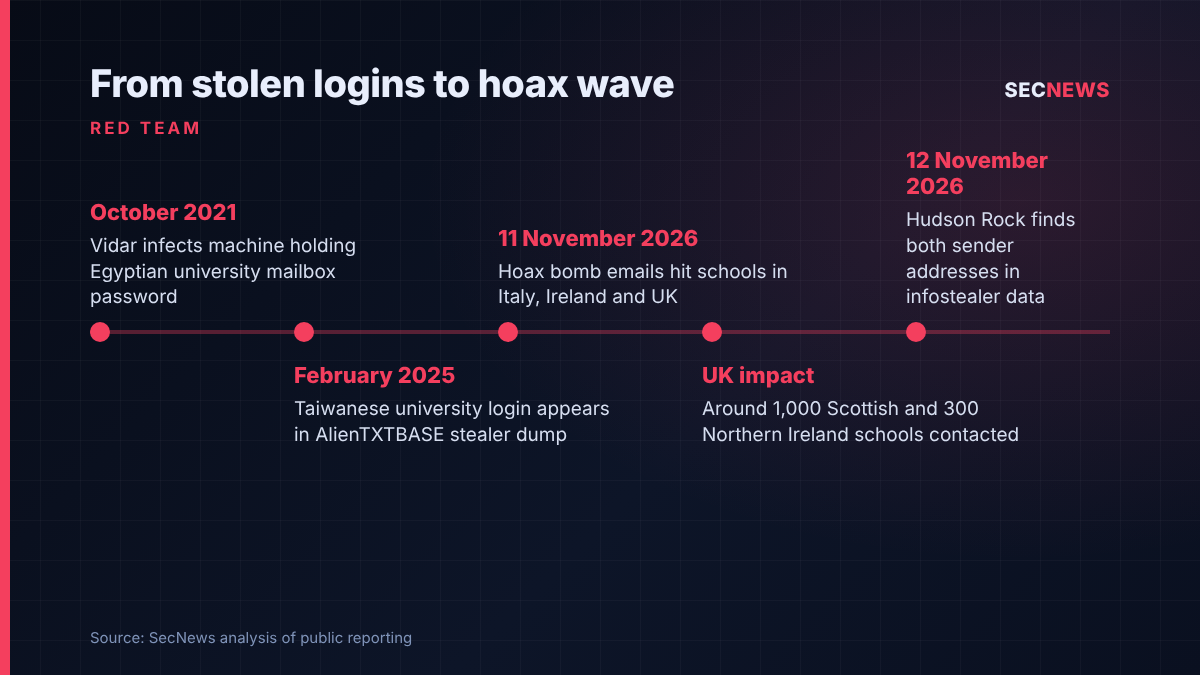
On Wednesday 11 November 2026, a wave of threatening emails warning of bombs on school premises arrived at schools across Italy, the Republic of Ireland and the UK. Around 1,000 Scottish schools were contacted, a figure The Register says Police Scotland confirmed, and more than 300 in Northern Ireland received the same message. In Italy, according to The Register, about 6,300 of the country’s 7,476 state schools were targeted and around 390 evacuated.
UK police quickly classed the messages as hoaxes. Police Scotland said they “do not represent a credible threat” and saw no need to evacuate or keep pupils at home. Its Cyber and Fraud Unit is working with UK and international partners to trace where the emails came from. The PSNI ran urgent inquiries, and the Department of Education told Northern Ireland schools to stay open unless officers advised otherwise. The Education Authority said the wording resembled a hoax sent in October, which closed schools in both nations.
The emails were signed by a “Mikhail Andropov”, described as leader of a made-up “Vilayat of Misoginistan”. Russia has denied involvement, and no person, group or state has been credibly named.
The cyber angle arrived on 12 November. Threat intelligence firm Hudson Rock looked at two sender addresses publicly linked to the threats, one at an Egyptian university (named by The Register as Kafrelsheikh University) and one at Da-Yeh University in Taiwan, and found both in its infostealer data.
The technical picture
Hudson Rock matched the Egyptian address to a Windows computer infected with the Vidar infostealer, with a system profile dated 1 October 2021. The stolen data included a Chrome password export of 112 saved logins. Twenty of them used the university address, two were stored against Microsoft sign-in pages, and entries for other services pointed to password reuse. Hudson Rock stresses these are entries in one export, not confirmed working accounts.
The Taiwanese address turned up as a Microsoft login entry in AlienTXTBASE, a huge aggregated collection of infostealer credentials. The Register puts that dump at February 2025, with around 284 million addresses, which matches when Have I Been Pwned loaded the collection. Da-Yeh University has said that an alumnus account had sent a large volume of email and had since been suspended, while it investigates the cause.
Hudson Rock is careful about what this proves. An address appearing in a threat does not identify whoever sent it, and the real account holder should not be treated as the author. The data does not show that a 2021 password still worked in 2026, or that the attacker definitely used these stolen credentials rather than some other route. Confirming that needs the provider’s sign-in logs, message traces and full email headers. What the findings do show is a window of more than a year in which these credentials were exposed and the accounts could have been locked down.
Mail from an established university domain with a clean sending history is far more likely to pass school mail filters than mail from a new domain or free webmail. Infostealer logs are cheap, plentiful and easy to search by domain. Dormant or loosely managed accounts, such as alumni mailboxes, are the least likely to have anyone watching for unusual sign-ins or a sudden burst of outbound mail.
Why it matters for UK organisations
The obvious lesson is for schools and local authorities. Even a hoax ruled out within hours pulls safeguarding staff into emergency procedures across hundreds of sites. The less obvious lesson is for anyone running a Microsoft 365 or Google Workspace tenant with a good sender reputation, including universities, colleges, councils, charities and businesses. Your domain’s reputation is an asset, and stolen logins let criminals borrow it.
UK higher education is particularly exposed. Universities often keep accounts open for alumni, visiting researchers and former staff, and students use personal devices that the institution does not manage. A malware infection on a student’s home laptop sits entirely outside the IT team’s view, yet it can still put a working institutional login into criminal hands. If that account then sends threats, the institution’s domain may end up on block lists.
Expert view
In my experience, infostealer logs are now one of the most productive sources of initial access, both for real criminals and for us on authorised red team work. When we scope an engagement and search breach and stealer data for a client’s domain, we nearly always find something. Much of it is years old, and a worrying amount still works.
The tradecraft here is not sophisticated; nobody needed a zero-day. Old passwords, saved in a browser on an infected machine and reused across services, are enough to borrow a trusted identity. The weaknesses are as old as the tools: passwords stored in browsers, password reuse, no multi-factor authentication on legacy or alumni accounts, and no process for acting on threat intelligence about leaked credentials.
I would also be wary of the attribution story. Hudson Rock’s data shows exposure, not authorship, and police have named no one. Defenders should concentrate on what they control: whether their own accounts could be the next ones borrowed.
What to do now
- Find your exposure. Use an infostealer or breach intelligence service, or your identity provider’s leaked-credential detection, to search for your domains. Treat every hit as a live incident until you have shown it is not.
- Reset and revoke properly. For exposed accounts, reset passwords through a trusted channel, revoke sessions and refresh tokens, and review app passwords, registered authentication methods, OAuth consents and mailbox forwarding rules. A password change on its own is not enough.
- Close dormant and alumni accounts, or restrict them. This sits under the Cyber Essentials user access control requirements: remove accounts that are no longer needed and limit what the rest can do. Alumni mail rarely needs to send to thousands of outside recipients.
- Enforce MFA everywhere, phishing-resistant where you can. Cyber Essentials expects it on cloud services; switch off legacy protocols that bypass it.
- Watch outbound mail. Set outbound spam policies and sending limits, and alert on sudden bulk sending or sign-ins from new locations.
- Deal with the endpoint. An infostealer infection will simply steal the replacement password. Clean or rebuild the device, and discourage saving work credentials in browsers in favour of a managed password manager, in line with the Cyber Essentials malware protection and secure configuration controls.
- Brief schools. Follow police and local authority advice, and keep original emails with full headers for investigators.
Bottom line
The hoax threats were not credible, but the delivery method was. Old infostealer credentials may well have handed whoever sent them trusted university mailboxes. Any UK organisation with a reputable domain should assume its leaked logins are a disruption tool as well as a breach risk, and act on that exposure before someone else uses it.
Sources
- Hudson Rock (InfoStealers.com): School bomb threats: Hudson Rock finds reported sender accounts in infostealer data
- The Register: Email addresses used in European school bomb hoaxes spotted in old infostealer logs
- The Irish News: Threatening messages to schools not credible and no risk to public, say police
- LBC: Schools evacuated across Scotland and Northern Ireland after nearly 800 receive threats
- Al-Monitor (Reuters): Hoax bomb alerts sent to schools in Italy, UK and Ireland in latest disruption