PostgreSQL has shipped what appears to be its largest security release to date, closing 52 CVEs across every supported branch, most of which let an ordinary database login become code execution on the host. The same update is the final one for PostgreSQL 14, which is now out of support.
What happened
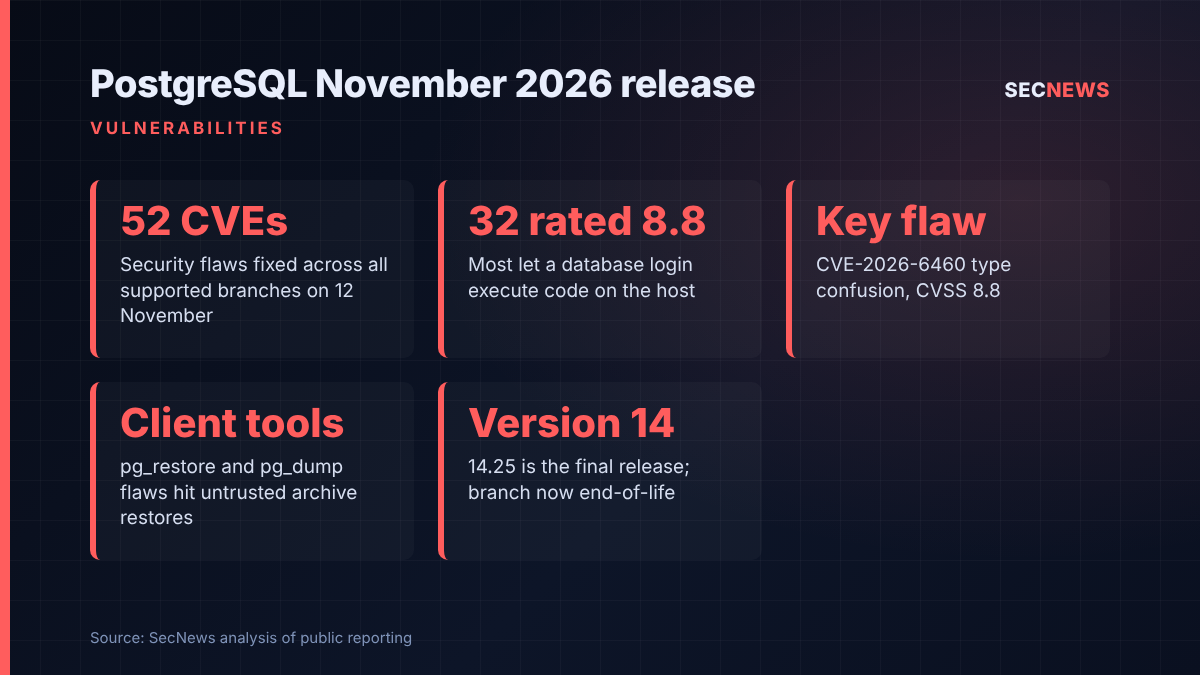
On 12 November 2026 the PostgreSQL Global Development Group published minor releases 18.7, 17.12, 16.16, 15.20 and 14.25, alongside the second release candidate of PostgreSQL 19. The project lists 52 security vulnerabilities in the announcement, together with more than 140 ordinary bug fixes. May’s release fixed 11 CVEs and August’s fixed 28, a record at the time according to HeroDevs; November nearly doubles it.
The severity profile is what stands out. By my count of the project’s own advisory list, 32 of the 52 issues carry a CVSS v3.1 score of 8.8, and the descriptions of most of those end with the same three words: “executes arbitrary code”. SecurityOnline and Secure.com reach the same figure.
The release also marks the end of the road for PostgreSQL 14. That branch, first shipped in September 2021, gets no further security or bug fixes. As of 14 November, neither the project nor the reporting I have reviewed has identified exploitation in the wild, and none of the 52 CVEs appears in CISA’s Known Exploited Vulnerabilities catalogue.
The technical picture
The flaw getting most attention is CVE-2026-6460, scored 8.8. The project’s advisory describes a type confusion in the core server through which any role able to create objects can execute code under the database’s operating system account. The main trigger is ALTER … SET DATA TYPE, though the advisory notes other DDL routes reach the same weakness. The root cause, in the project’s words, is inadequate tracking of typed values: stale values could survive in catalogue entries, procedural language variables and other places, after which the server would read old bytes as if they were the new type.
The release notes credit more than a dozen reporters, including Mehmet Ince. According to ByteIota, the underlying weakness traces back to May 2004, and Ince has published a write-up demonstrating the chain against 18.6 while holding back the final payload. I have not been able to confirm either claim from a second source, so treat them as ByteIota’s reporting rather than settled fact.
The rest of the list tours PostgreSQL’s internals: use-after-free and type confusion bugs in PL/Perl, PL/Tcl and PL/pgSQL, in dblink, in foreign data wrapper batch inserts, in text search functions and in logical replication, where CVE-2026-120145 lets a publisher write to a subscriber’s system catalogues. The common thread: the attacker needs a valid login, often with CREATE rights, but not superuser.
Three items break that pattern:
- CVE-2026-116314 and CVE-2026-116330 (both 8.8) sit in the client tools. A crafted non-plain archive fed to pg_restore, or a tampered tar-format dump’s restore.sql, can run code or inject psql commands on the machine doing the restore. No privileges are required, only that someone restores a file they should not trust.
- CVE-2026-116322 (5.3) affects PostgreSQL 18 only and needs no login at all: a cancel request sent before authentication can leave a spinlock held, which hits availability.
- Index and backup integrity fixes are not CVEs but matter operationally. The project asks users to rebuild some indexes (GIN, GiST using pg_trgm, and B-tree on bpchar columns) and to start a new full backup chain if they use incremental backups.
The release notes add that full protection against CVE-2026-6460 requires rebuilding C-language extensions, and that some extensions will need source-code changes, so a binary swap alone is not the whole job.
Why it matters for UK organisations
PostgreSQL is everywhere in UK estates, often in places nobody thinks of as “the database”. It underpins line-of-business applications, public sector digital services, SaaS back ends, analytics platforms and a long tail of appliances and vendor products that bundle their own copy. Managed cloud services will roll the fixes in on their own schedules; self-managed and embedded copies are the owner’s problem.
The “authenticated only” framing can lull teams into deprioritising this. It should not. In multi-tenant platforms, reporting tools that hand analysts direct SQL access, and web applications whose service account holds CREATE rights, an attacker who finds SQL injection or steals one set of application credentials is now a short step from a shell on the database host.
The end of PostgreSQL 14 is the longer-term issue. Under Cyber Essentials, software must be licensed and supported, and high and critical security updates applied within 14 days. A PostgreSQL 14 server is now unsupported software from a certification standpoint, and the next batch of fixes will not reach it.
Expert view
When we test internal networks, databases are rarely the first foothold but very often the place an engagement turns. Application service accounts with far more privilege than they need are a recurring finding, and this release makes that habit expensive. A low-privileged login that can create a table or a function is, on an unpatched server, effectively an operating system account.
The client-side flaws are the ones I expect to be underestimated. Restoring a dump from a supplier, a former contractor or a ticket attachment is routine work for DBAs and developers, frequently done from a privileged workstation. That workflow now needs the same scepticism we apply to opening an unknown document.
The version-14 cliff will bite hardest in vendor-supplied appliances and older internal applications, where the database is pinned to whatever version the product shipped with. Chase those suppliers now: given this year’s volume of database CVEs, the gap between “end-of-life” and “exposed” will close quickly.
What to do now
- Inventory every PostgreSQL instance, including copies embedded in products and containers, and record the major and minor version.
- Patch to 18.7, 17.12, 16.16 or 15.20 (or 14.25 as a stopgap) within 14 days as a minimum, sooner for instances where untrusted or semi-trusted users have SQL access. It is a minor update: no dump and reload is needed.
- Update client tools as well, particularly pg_dump, pg_restore and psql on DBA and developer workstations and backup servers.
- Complete the post-update steps: rebuild the affected indexes listed in the announcement, take a new full backup if you use incremental backups, and rebuild C-language extensions, as the release notes require for full protection against CVE-2026-6460.
- Cut privileges while you patch: revoke CREATE and TEMP from roles that do not need them, and review which application accounts can run DDL. This maps to Cyber Essentials user access control.
- Only restore trusted archives, using patched tools, and avoid restoring third-party dumps on privileged machines.
- Plan PostgreSQL 14 migrations to 16, 17 or 18, and ask suppliers of bundled products for their upgrade timeline in writing.
- Check database ports are not internet-facing (secure configuration and firewalls); the PostgreSQL 18 pre-authentication issue is a reminder of why.
Bottom line
There is no known exploitation yet, but 52 CVEs, 32 of them rated 8.8, turn any database login into a potential foothold on the host. Patch servers and client tools, tighten who can create objects, and treat PostgreSQL 14 as unsupported from today.
Sources
- PostgreSQL: PostgreSQL 18.7, 17.12, 16.16, 15.20, 14.25, and 19 RC 2 Released!
- PostgreSQL: CVE-2026-6460 security advisory
- PostgreSQL: Security Information
- SecurityOnline: PostgreSQL Security Update Fixes 52 CVEs, CVE-2026-6460
- Secure.com: PostgreSQL Vulnerabilities: 52 Flaws Patched as Version 14 Hits End of Life
- ByteIota: PostgreSQL 18.7: 52 CVEs Patched, Including a 22-Year-Old RCE