Expedia Group has now confirmed that attackers reached its systems by compromising one of its data platform suppliers, turning an unverified extortion claim into an acknowledged incident. The company has still not said what was taken, while the n0n group is pushing figures approaching a billion records.
What happened
When we reported on 12 November that the extortion crew n0n was leaking data it said came from Expedia, there was nothing from the company to weigh against the claim. That changed later the same day. Speaking to the travel trade title Skift on the evening of Thursday 12 November, Expedia Group described a supply chain attack: a third-party data platform provider was compromised, and its trusted access was then turned against several companies, Expedia among them.
The statement, also reported by Forbes, says the problem was contained as soon as Expedia became aware of it and that outside security specialists are helping with the investigation. What it has not done is name the supplier, describe the categories of data involved, or give any indication of how many customers are affected. It says it has not verified the attackers’ numbers.
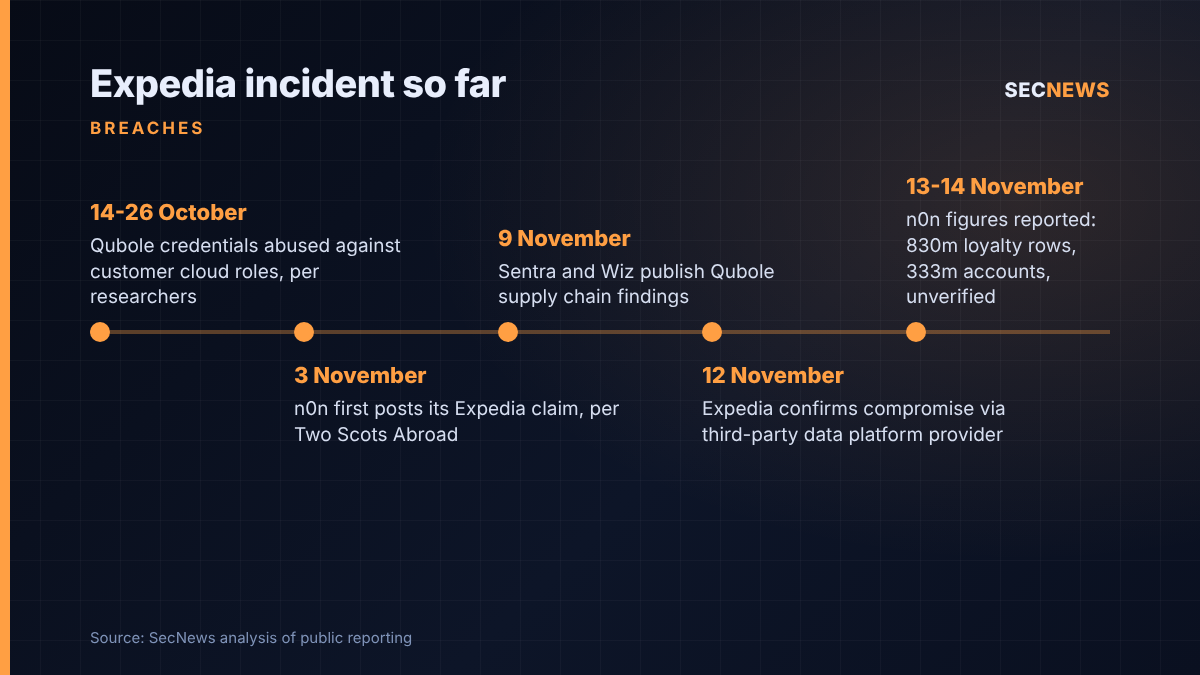
That gap is being filled, loudly, by n0n. According to Forbes and Security Affairs, the group now claims more than 830 million loyalty programme rows drawn from 35 schemes, 58 million traveller profiles, over 333 million consumer account and credential records, around 72 million “matching” records, nearly 2.5 million card spending records keyed to hashed email addresses, and roughly half a million guest stay records. It also says it obtained working logins to Expedia’s big data environment, plus some source code. None of this has been independently verified, and one security commentator quoted by Forbes described the claim as a pressure tactic.
Two Scots Abroad reports that n0n first posted the claim on 3 November, that leak-site monitors logged the listing on 9 November, and that an archive which surfaced on 12 November may be a sample, with some files appearing historical.
The technical picture
Expedia’s wording, a compromised data platform vendor whose trusted access reached several organisations, closely matches the Qubole incident documented on 9 November by Sentra and Wiz, with Mandiant also involved. Skift said only that Expedia’s account is consistent with that case. Forbes and Security Affairs go further and attribute the Expedia link to the Wiz and Sentra reporting, but Hospitality.today notes that neither research firm has named Expedia as a victim, and Expedia has not said whether the two events are connected. Treat the link as reported, not confirmed.
BleepingComputer and Sentra report that between 14 and 26 October stolen Qubole credentials were used to assume cloud roles customers had granted the vendor, many long dormant, before secrets and data were pulled in bulk. Two Scots Abroad describes Qubole as a former Expedia supplier, which would fit that pattern of forgotten access.
On the n0n side, the most concerning claimed element is not the loyalty data but the 333 million account records said to pair account identifiers and email addresses with password-like tokens. Security Affairs notes these appear to be hashed, which is not the same as safe: the strength of the hashing scheme decides whether those values can be cracked offline. Expedia Group runs more than 200 booking sites, including Hotels.com, Vrbo, Orbitz, Travelocity and Hotwire, so a shared account store would put a broad customer base in scope.
Why it matters for UK organisations
Expedia, Hotels.com and Vrbo are household names in the UK, and British travellers and accommodation providers are heavy users. None of the reporting so far says whether UK residents’ data was involved, and Expedia has made no UK-specific statement. If UK customers are affected, UK GDPR expects the controller to report a qualifying breach to the Information Commissioner’s Office within 72 hours of becoming aware of it, and to tell individuals without undue delay where the risk to them is high.
The more immediate UK risk is fraud. A dataset that links email addresses to loyalty balances, home airports and stay history is ideal raw material for convincing messages about refunds, points or “problems” with a reservation. Hotels and holiday let owners listed on Expedia platforms should expect guests to receive fake messages that quote real booking details.
The wider lesson applies far beyond travel. Any UK organisation that has trialled an analytics or data tool in its cloud estate probably has a trust relationship nobody remembers creating, and a supplier compromise can turn that leftover into a direct path to your data.
Expert view
In my experience, third-party cloud access is one of the least reviewed areas in an otherwise mature environment. When we test AWS and Azure estates, the integrations granted to vendors during a proof of concept are routinely still there years later, often with read access far wider than the original project needed.
Expedia’s statement is notable for what it leaves out. Confirming the access route while staying silent on data types is understandable early in a forensic investigation, but it leaves customers relying on a criminal group’s marketing for detail. Extortion crews inflate numbers routinely; equally, a vendor compromise with bulk data pulls, as in the Qubole case, is precisely the scenario in which large figures can turn out to be true. The honest position for defenders is that the scale is unknown and planning should assume meaningful exposure until Expedia says otherwise.
Nor should “contained” be read as “over”: stolen credentials stay dangerous until rotated, and related phishing will run for months.
What to do now
- Audit vendor trust relationships in your cloud accounts. List every cross-account role and every third-party application with access, identify an owner for each, and remove anything tied to a supplier you no longer use. This maps directly to the Cyber Essentials user access control requirement to remove unneeded accounts.
- Constrain what remains. Limit vendor roles to the specific resources they need and, where the provider publishes fixed address ranges, add network conditions to role trust policies.
- Get your logging in order before you need it. Make sure cloud audit trails, key usage logs and object access logs are enabled and retained long enough to answer the question “what did this identity read?”
- Brief staff and customers on travel-themed phishing. Remind people to check bookings only through official apps or by typing the address, and never through links in unsolicited messages.
- Individuals with Expedia Group accounts should set a unique password, turn on multi-factor authentication where offered, and watch for unexpected changes to bookings or loyalty points. Reused passwords should be changed everywhere they appear.
- Accommodation partners should review user accounts on extranets, property management and booking systems, remove former staff and unused tools, and ask their Expedia contact whether partner or guest data is in scope.
Bottom line
Expedia’s confirmation moves this from an unverified boast to a real supply chain incident, but the company has yet to say what was lost. The reported Qubole connection, unconfirmed though it is, is a timely reminder that forgotten vendor access is a breach waiting to happen. Check your own cloud trust relationships this week rather than waiting for a supplier to tell you they have been compromised.
Sources
- Skift: Expedia Confirms Cyberattack Through Third-Party Vendor
- Forbes: Russian Cyberattackers Hit Expedia, Claiming Nearly A Billion Traveler Records Exposed
- Security Affairs: Extortion Group Claims Theft of Nearly One Billion Expedia Traveler Records
- Hospitality.today: Hackers say they hold 333 million Expedia records after a breach through an outside vendor
- Two Scots Abroad: 830 Million Loyalty Rows Claimed: Expedia Admits a Supplier Was Breached
- Sentra: Inside the Qubole Supply Chain Attack
- BleepingComputer: Hackers exploit trusted AWS access to breach multiple cloud environments