Swiss chipmaker SEALSQ has agreed a non-binding letter of intent over Australian quantum security specialist QuintessenceLabs, pairing post-quantum silicon with enterprise key management and quantum randomness. For UK organisations working to the NCSC’s post-quantum deadlines, it is another sign that the supplier market is consolidating while buyers are still drawing up their plans.
What happened
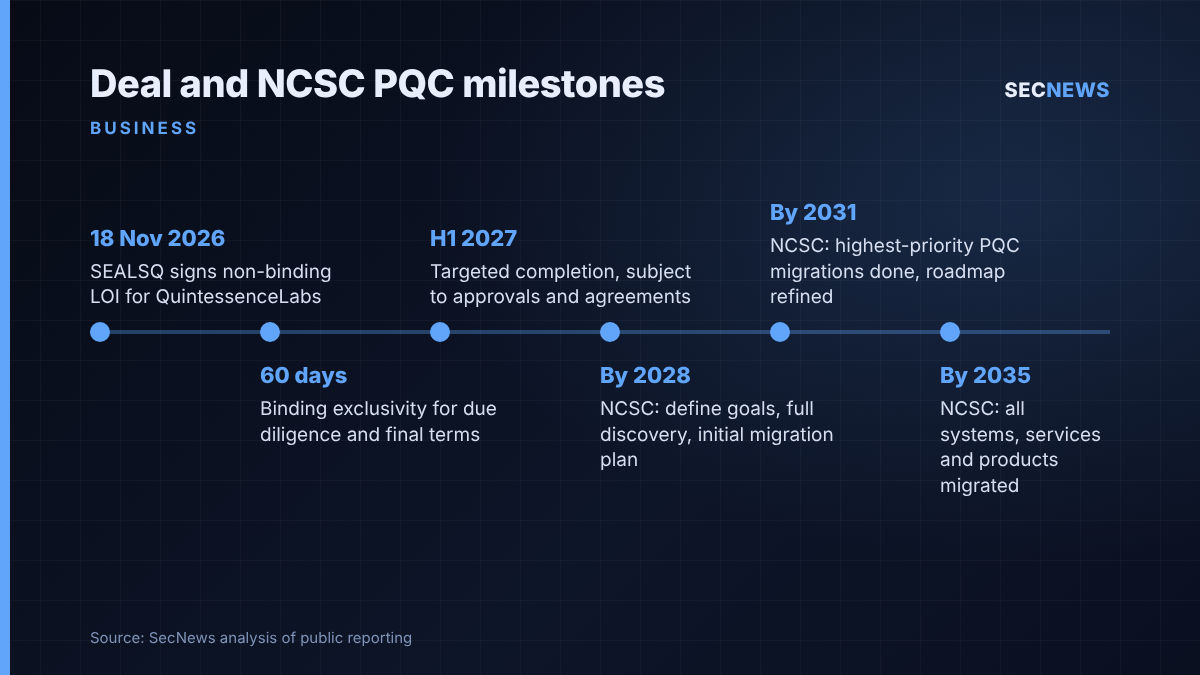
On 18 November 2026, Nasdaq-listed SEALSQ Corp (LAES), based in Geneva, said it had signed a letter of intent with QuintessenceLabs Pty Ltd that opens exclusive talks to acquire all of the Australian company’s equity. The letter is non-binding: there is no definitive agreement, no published price, and the deal may never close.
What is binding is a 60-day exclusivity window, during which SEALSQ will run confirmatory due diligence and the two sides will try to agree final terms. According to SEALSQ’s announcement, the consideration would be a mix of cash and SEALSQ shares, with the split still under negotiation. The shares issued at completion would be priced above SEALSQ’s recent trading level, subject to a post-closing adjustment, and further shares could follow under an earn-out. The company itself warns that existing shareholders would be diluted.
Completion is targeted for the first half of 2027, conditional on due diligence, board and regulatory approvals and signed definitive agreements. SEALSQ’s forward-looking statements list regulatory approvals, including any foreign investment approvals that may be required, among general risks to the deal, without saying which apply. Seeking Alpha reported a rise in SEALSQ shares; Investing.com showed them up 8.29%.
The detail
The two businesses sit at different layers of the cryptographic stack. SEALSQ sells secure chips, PKI and device provisioning, with a range that includes its QS7001 hardware security platform and a strategy built around quantum-resistant cryptography in silicon. QuintessenceLabs, founded in 2008 by Dr Vikram Sharma, works further up the estate: quantum random number generation (qStream), entropy management (qRand), key and policy management (qCrypt), discovery of cryptographic assets across an organisation, and research into continuous-variable quantum key distribution (QKD).
QuintessenceLabs is not a fledgling. Capital Brief has reported that Westpac has backed it since 2015 and that its customer list includes the US Department of Homeland Security and JP Morgan. In April 2025, Quantum Computing Report covered an A$20m round led by the Australian government, which put in A$15m through its National Reconstruction Fund as part of a push for sovereign quantum capability.
SEALSQ chairman and CEO Carlos Moreira described the aim as a way to “connect trust embedded in silicon” to enterprise-wide key generation and management. The announcement lists intended synergies: quantum randomness feeding key generation on SEALSQ hardware, qCrypt sitting alongside SEALSQ’s PKI and hardware roots of trust, joint tooling for finding vulnerable cryptography and prioritising upgrades, and cross-selling into finance, government, defence, telecoms, energy and critical infrastructure. SEALSQ stresses these are objectives, not existing products.
Why it matters for UK organisations
The NCSC has set three milestones for moving to post-quantum cryptography (PQC). By 2028, organisations should define their migration goals, complete a full discovery exercise across the estate and produce an initial plan. By 2031, they should have done their highest-priority migrations and refined that plan into a full roadmap. By 2035, migration of all systems, services and products should be finished. The guidance targets large organisations, CNI operators and bespoke IT, but applies to all.
Discovery is the near-term job, and it is precisely what QuintessenceLabs sells, so UK buyers shortlisting inventory, key management and hardware security suppliers should take note. A vendor chosen in 2026 may sit under a different owner, with a different roadmap and support model, by the time your 2031 migrations are due.
There is also a policy gap to watch. The NCSC’s paper on quantum networking technologies is unusually direct about QKD. It says that “The NCSC will not support the use of QKD for government or military applications” and recommends PQC as the primary mitigation. For other sectors, it advises against relying on QKD alone for generating and distributing keys, notes that QKD offers no authentication of its own, and says QKD should not count as evidence of data-in-transit security under the Cyber Assessment Framework. Quantum random number generation falls outside that QKD stance, but expect sales pitches that blur the two.
Expert view
In my experience, the quantum security market sells a vision faster than most organisations can absorb it. When we assess cryptographic hygiene for clients, the recurring problem is rarely a shortage of exotic technology. It is that nobody can say with confidence where keys live, which certificates are about to expire, which appliances hard-code RSA and which suppliers own the crypto inside a managed service. Tools that answer those questions matter more today than any quantum channel.
So the interesting part of this deal, if it happens, is the combination of cryptographic discovery and key lifecycle management with hardware roots of trust. Done well, that could give buyers one view from the device to the key management server, which is what crypto-agility actually demands. Done badly, it is another bundle where the quantum label does the selling and integration is left to the customer.
I would also sound a note of caution about the structure. This is a non-binding letter with no disclosed price, paid partly in shares of the buyer, with an earn-out and regulatory approvals still to clear. That is normal at this stage, but nothing is certain. UK procurement teams should treat it as a prompt to ask questions, not to change course.
What to do now
- Get your 2028 discovery work moving. Build an inventory of where asymmetric cryptography is used: TLS endpoints, VPNs, PKI, code signing, HSMs, identity providers, OT and embedded devices. This complements the Cyber Essentials secure configuration and security update management controls, which already require you to know what you run.
- Map supplier exposure. List which vendors and managed service providers own cryptographic functions on your behalf, and ask each for a written PQC roadmap with dates. The NCSC notes that many organisations will depend on providers to carry out this assessment for the services they deliver.
- Check change-of-control terms. For key management, HSM or crypto-discovery contracts, confirm what happens to support, data portability and pricing after an acquisition.
- Insist on crypto-agility. Prefer products that run classical and post-quantum algorithms side by side and swap suites by configuration, not replacement.
- Do not treat QKD as compliance evidence. If a supplier proposes QKD, read the NCSC paper first, require quantum-resistant authentication alongside it, and remember it will not count towards CAF data-in-transit outcomes.
- Brief the board on budget. The NCSC warns that PQC migration could be costly and spans several leadership cycles, so get it into multi-year planning rather than treating it as a one-off project.
Bottom line
SEALSQ’s move on QuintessenceLabs is a signal of consolidation, not a done deal: the letter is non-binding, the price is unknown and approvals are outstanding. For UK organisations the practical message does not change. The NCSC’s 2028 discovery milestone is close, the policy line on QKD is firm, and the best protection against an unsettled supplier market is a clear inventory of your own cryptography and contracts that let you move if a vendor changes hands.
Sources
- SEALSQ: SEALSQ Signs a LOI to Acquire QuintessenceLabs
- The Quantum Insider: SEALSQ Signs Letter of Intent to Acquire QuintessenceLabs
- Investing.com: SEALSQ signs letter of intent to acquire QuintessenceLabs
- Seeking Alpha: SEALSQ signs LOI to acquire QuintessenceLabs; LAES shares gain
- Capital Brief: How Australia’s first quantum startup survived for 16 years
- Quantum Computing Report: Australian Government Leads $20M AUD Round in QuintessenceLabs
- NCSC: Timelines for migration to post-quantum cryptography
- NCSC: Quantum networking technologies