A 24-year-old from Dundee, reported to be a leading figure in Scattered Spider, has been jailed for six years in the United States over an SMS phishing and SIM-swap scheme that netted at least $11.6m in cryptocurrency. The sentence closes a five-defendant case, but the techniques behind it are still hitting help desks and SOCs across the UK.
What happened
On Tuesday 17 November a US federal court in California handed Tyler Robert Buchanan, 24, a 72-month prison term, federal prosecutors in Los Angeles announced on 18 November. The Dundee man admitted in April to conspiracy to commit wire fraud and aggravated identity theft.
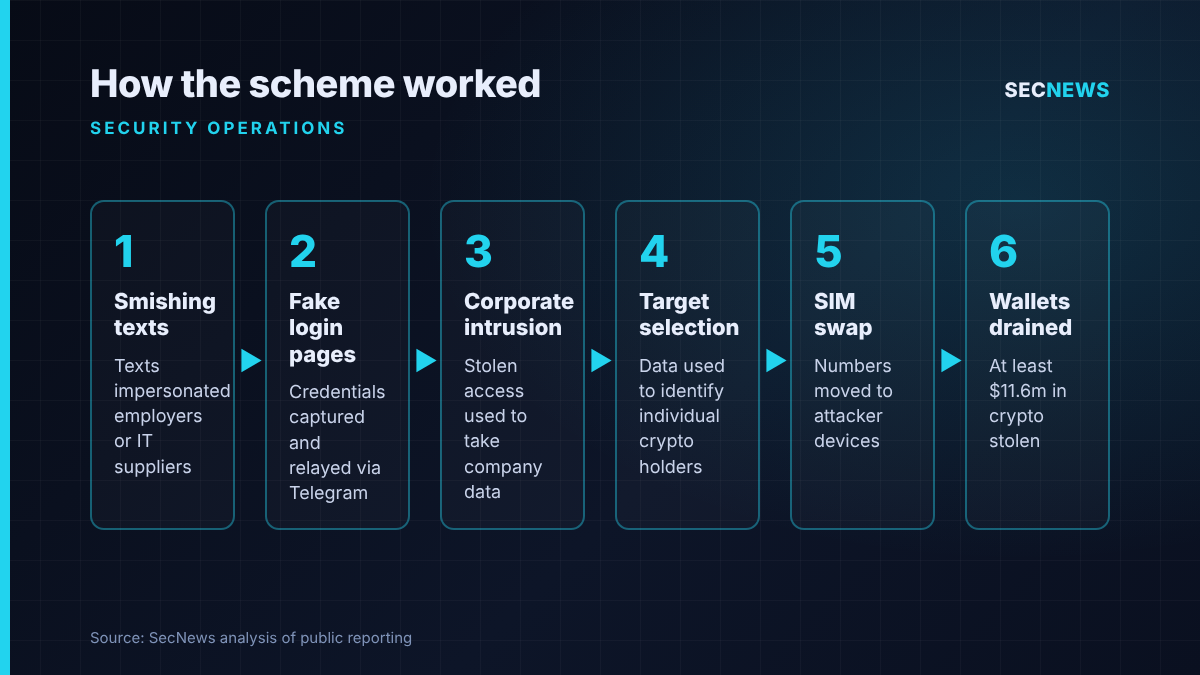
The case covers a campaign that ran from September 2021 to April 2023. Over that period the crew fired off hundreds of phishing texts to staff at a dozen or more firms spanning telecoms, technology, outsourcing, gaming, cloud communications and cryptocurrency, each linking to a convincing copy of the employer’s login page. Captured credentials flowed into a Telegram channel that Buchanan ran with an accomplice.
The group then used data taken from those corporate intrusions to identify individual cryptocurrency holders, hijacked their mobile numbers through SIM swaps and drained their wallets. The losses, put at $8m when he pleaded, now stand at $11.6m or more; restitution will be decided at a hearing on 11 December. Prosecutors told the court the thefts had “severe, life-altering consequences for many victims”.
Buchanan was detained in Spain in 2024 (reports differ on whether this was in May or June) and has been in US custody since April 2025. According to the Justice Department, a device recovered from his Scottish home in April 2023 held victims’ names and addresses, and a file containing one victim’s wallet recovery phrases and account credentials. His sentencing completes the case: co-defendant Noah Michael Urban is serving ten years, two others received 45 months each and a fifth was given two years.
The technical picture
The conduct described in court relied on people and processes rather than software flaws, which is why it scaled and why it still matters to defenders.
It started with smishing. Messages impersonated the victim’s own employer or a contracted IT or outsourcing supplier, and arrived on mobiles that sit outside most email security stacks. The phishing pages harvested usernames, passwords and personal details, and relayed them to the operators through Telegram.
With staff credentials in hand, the group logged into employee accounts and company systems and pulled out data. That data was the real prize: it let them work out which individuals held cryptocurrency and how to reach their accounts. The final step was a SIM swap, persuading a mobile carrier to move a victim’s number to a device the attackers controlled, so that SMS one-time codes landed with the criminals rather than the account holder.
The wider group, tracked under names including Octo Tempest, UNC3944, 0ktapus and Muddled Libra, has been linked by the FBI to MFA fatigue (push bombing), social engineering, phishing and SIM swapping. BleepingComputer notes it has worked with ransomware operations including BlackCat/AlphV, Qilin and RansomHub since early 2023. The five defendants were charged in November 2024 over attacks on targets including Twilio, Mailchimp, Coinbase and LastPass, according to The Record.
Why it matters for UK organisations
This is a US prosecution, but the defendant is Scottish and the playbook is one UK organisations know painfully well. SecurityWeek notes that Thalha Jubair and Owen Flowers, also linked to Scattered Spider, were jailed by a UK court earlier in 2026 over the Transport for London attack.
When a wave of incidents hit UK retailers in 2025, the NCSC acknowledged press speculation that Scattered Spider was involved and that help desks had been talked into resetting passwords and MFA. Its published advice to the whole economy, not just retail, was pointed: review how the help desk verifies staff before resets (especially for privileged users), watch for risky sign-ins, scrutinise Domain Admin, Enterprise Admin and cloud admin activity, and make sure the SOC can flag logins from unusual sources such as residential VPN ranges.
Jailing one member does not dismantle a loose collective that organises through Telegram and Discord. The techniques are cheap and transfer easily to new crews, so UK SOCs should treat this as a live threat model, not a closed chapter.
Expert view
When we run social engineering exercises against UK organisations, the help desk is still the soft underbelly more often than the firewall. Agents are measured on closing tickets quickly and politely, and a flustered ‘senior manager’ locked out before a board meeting exploits exactly that pressure. Attackers who have already stolen personal details from a smishing page can answer the standard verification questions without breaking a sweat.
The second lesson is about SMS. Organisations have spent years rolling out MFA, but plenty still accept text message codes for staff, for admin recovery or for customers. This case shows why that is fragile: whoever can talk the mobile operator into moving the number receives the code. In my experience, the gap is rarely the absence of MFA; it is the weakest fallback path that MFA quietly permits.
Finally, detection. Smishing bypasses the email gateway, so the first signal is often a successful login from somewhere odd, a new MFA method being registered, or a help-desk ticket that looks routine. If the SOC cannot see help-desk actions alongside identity telemetry, it will miss the moment the attack becomes an intrusion.
What to do now
- Harden help-desk resets. Require strong identity proofing for password and MFA resets, such as a video call with photo ID, a call-back to a number from the HR record, or manager approval. Apply the strictest rules to privileged accounts (Cyber Essentials: user access control).
- Retire SMS as an MFA factor for staff. Move to phishing-resistant methods such as FIDO2 security keys or passkeys, and remove SMS and voice from account recovery paths, particularly for administrators.
- Alert on identity changes. Feed help-desk ticketing logs into the SIEM and correlate resets with new MFA registrations, sign-ins from new devices or anonymising infrastructure, and privilege changes within a short window.
- Act on risky sign-ins. Use Microsoft Entra ID Protection or equivalent risk signals, enrich source IPs, and investigate logins from residential proxy and VPN ranges, as the NCSC recommends.
- Watch for MFA fatigue. Enable number matching, limit push prompts and alert on repeated denied or ignored prompts for the same user.
- Brief staff on smishing. Tell employees the IT team will never text them a login link, and give them a fast, blame-free way to report suspicious messages to the SOC.
- Rehearse the scenario. Run a tabletop or purple team exercise that starts with a help-desk impersonation call and tests whether the SOC spots and contains the resulting session.
Bottom line
Buchanan’s sentence ends the US case against five alleged Scattered Spider members, but it does not end the tactics. Smishing, help-desk manipulation and SIM swapping need no zero-days, only a weak verification step. UK organisations that remove SMS fallbacks, make resets hard to abuse and give their SOC visibility of identity changes will be much harder targets for the next copycat crew.
Sources
- BleepingComputer: British Scattered Spider hacker sentenced to 6 years in prison
- SecurityWeek: Last of Five Defendants Sentenced in US Scattered Spider Hacking Case
- The Record: British hacker gets 6 year sentence for $11.6M crypto theft scheme
- Decrypt: Scattered Spider Hacker Sentenced to 6 Years Over $11.6M in Stolen Crypto
- NCSC: Incidents impacting retailers – recommendations from the NCSC