Japan has officially confirmed that a Russian man it detained in Osaka has been handed to Germany as an alleged core member of the Qilin ransomware operation. It is a rare arrest at the centre of the group behind the Synnovis attack on London hospitals, but defenders should not expect the threat to ease.
What happened
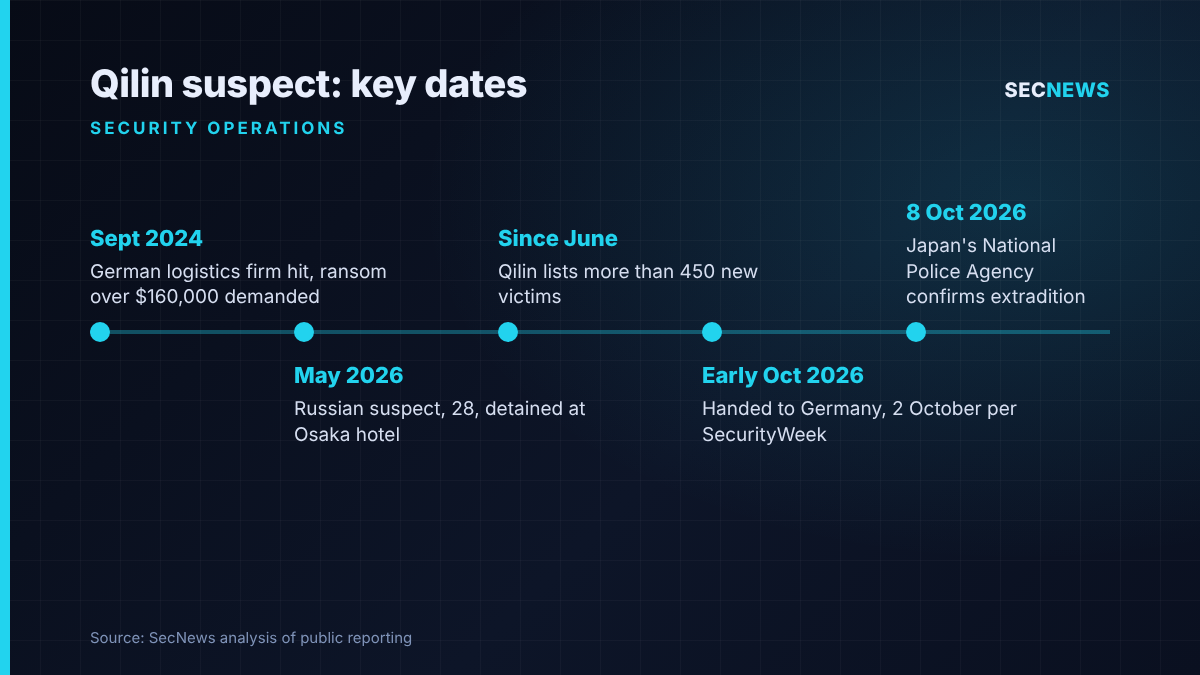
On Thursday 8 October 2026, Japan’s National Police Agency publicly confirmed the arrest and extradition of a 28-year-old Russian national accused of involvement with Qilin, the ransomware-as-a-service (RaaS) operation also tracked as Agenda. Japanese officials did not name the man. Japanese media had reported the arrest earlier in the week, citing internal sources, so Thursday’s statement turned a leak into an official account.
According to the agency’s statement, as reported by BleepingComputer, Germany had already obtained an arrest warrant linked to a ransomware incident in Germany. When the suspect entered Japan as a tourist, German authorities worked with Japan’s Ministry of Justice and the Tokyo High Public Prosecutors Office, using a provisional detention warrant under Japan’s extradition law to hold him, before arranging the transfer.
SecurityWeek reports that the German case concerns a September 2024 intrusion at a logistics company, in which data was encrypted and a ransom of more than $160,000 in cryptocurrency was demanded. The Record says only that the warrant relates to an attack on a German company, and German law enforcement did not respond to its request for comment.
The timeline is not fully settled. All three outlets agree the arrest took place in Osaka in May. SecurityWeek says the suspect was handed to German authorities on 2 October, and BleepingComputer describes the extradition as happening earlier this month. The Record, citing the Japanese outlet Nippon, says he was sent to Germany in June, although Nippon’s own 8 October report places it in October. Until German prosecutors comment, treat the exact handover date as unconfirmed.
The technical picture
Qilin, first seen in August 2022, runs a familiar double-extortion model. Affiliates gain access, steal data, encrypt systems, and then threaten to publish what they took if the victim refuses to pay. Core members build and maintain the encryptor, the leak site and the negotiation infrastructure. Affiliates do most of the hands-on intrusion work and take a share of any payment.
The group’s initial access methods are well documented and ordinary. Reporting this year links it to edge devices: SecurityWeek notes that in June Qilin exploited CVE-2026-50751, a critical authentication bypass in Check Point VPN and firewall products, and BleepingComputer also associates the group with known Palo Alto VPN flaws. Once inside, the usual steps follow. Operators harvest credentials, escalate to domain administrator, stage and exfiltrate data, then deploy the encryptor across as many hosts as possible, often going for virtualisation platforms and backups first.
Its victim list is long. The Record attributes to Qilin the spring 2026 attack on Germany’s Die Linke party, last year’s disruptive incident at Japanese brewer Asahi, and an August claim against the US Bureau of Alcohol, Tobacco, Firearms and Explosives. BleepingComputer puts the group’s known targets at more than 2,350 organisations across 62 countries.
The May arrest did not slow the operation. BleepingComputer counts more than 450 new victims on Qilin’s leak site since June. In July 2026 alone, researchers cited by The Record counted 127 reported Qilin attacks, placing it second among ransomware groups.
Why it matters for UK organisations
For the UK, Qilin is not an abstract foreign gang. SecurityWeek and The Record both link it to the 2024 attack on pathology provider Synnovis, which disrupted services at several London NHS hospitals and became one of the most damaging ransomware incidents this country has seen. Any arrest touching the group’s core is welcome news for the NHS and for the wider UK public sector.
The case also shows how enforcement now works. Germany built the case, Japan used its extradition law to detain a tourist, and the suspect ended up in German custody. Western agencies have used a similar pattern against other ransomware suspects: identify an individual, wait for them to travel, and work with whichever country they visit. For Russian-based operators, a holiday abroad is now a real risk.
Still, UK defenders should not read this as a reduction in threat. The leak-site figures above show the brand kept operating after the arrest. Affiliates can move to other RaaS programmes within days, taking their access, tooling and playbooks with them. One person in custody does not close the edge devices, weak credentials and flat networks those affiliates rely on.
Expert view
In my experience, arrests like this matter more for what they reveal than for what they stop. A core member in German custody may give investigators source code, infrastructure details, wallet addresses and affiliate identities. That is how earlier disruptions led to decryptors and follow-on arrests. If that happens here, victims with encrypted data from older Qilin incidents could benefit. It is worth keeping copies of encrypted files and ransom notes rather than wiping them.
The operational lesson is less exciting. When we test UK organisations, the routes Qilin affiliates are known to use still work far too often: unpatched VPN appliances, remote access without phishing-resistant multi-factor authentication, service accounts with domain-wide rights, and backups that a domain administrator can delete. None of that changes because someone was detained in Osaka.
There is also a detection point. RaaS affiliates work across several brands, so building detection around a ransomware name is fragile. Detection built around behaviour lasts longer. That means unusual remote logins to edge devices, new domain admin group members, mass credential access from LSASS, large outbound transfers to cloud storage, and hypervisor or backup consoles being accessed at odd hours. Those indicators catch a Qilin affiliate and its successor alike.
What to do now
- Patch and harden edge devices first. Confirm that Check Point, Palo Alto and other VPN and firewall appliances are fully updated, including for CVE-2026-50751, and review their logs for unexpected logins since June. This maps to the Cyber Essentials security update management control.
- Enforce phishing-resistant MFA on all remote access. Cover VPN, remote desktop gateways and cloud admin portals. This supports the Cyber Essentials user access control.
- Protect backups from domain admins. Keep at least one immutable or offline copy with separate credentials, and test restores on a schedule.
- Hunt for behaviour, not brands. Alert on new privileged group membership, credential dumping, remote management tools appearing on servers and bulk data egress.
- Restrict administrative accounts. Remove standing domain admin rights and separate hypervisor and backup administration from day-to-day accounts, in line with the Cyber Essentials user access control.
- Retain evidence from past incidents. If you were hit by Qilin, keep encrypted data and ransom notes and keep in contact with the NCSC and law enforcement in case decryption keys emerge.
Bottom line
Japan’s confirmation shows that international cooperation can reach the centre of a major ransomware operation, and the group that disrupted London hospitals has lost an alleged core member. But Qilin kept publishing victims after the May arrest. For UK defenders, the useful response is to close the edge-device, credential and backup gaps its affiliates rely on, whatever name they work under next.
Sources
- The Record: Japan confirms arrest of Russian Qilin operative, extradition to Germany
- SecurityWeek: Qilin Ransomware Suspect Arrested in Japan, Extradited to Germany
- BleepingComputer: Germany arrests alleged core Qilin ransomware member after extradition
- Nippon.com: Germany Arrests “Qilin” Hacker Group Member Extradited from Japan