The International Monetary Fund has put a major cyber incident on its shortlist of three shocks that could tip resilient markets into turmoil. For UK financial firms, the report lands just as supervisors move from setting operational resilience rules to checking that firms can actually live within them.
What happened
On 13 October 2026 the IMF published its October Global Financial Stability Report at the IMF and World Bank Annual Meetings in Bangkok. Its core message is that markets have absorbed repeated shocks well, but resilience is not the same as safety. The Fund identifies three near-term events that could abruptly tighten financial conditions: a correction in AI-related asset prices, a further jump in government bond yields, and a serious cyber attack on the financial system.
The AI and bond strands will dominate the economics coverage; the cyber strand belongs on risk committee agendas. Athanasios Vamvakidis of the IMF’s Monetary and Capital Markets Department told the launch briefing that the cyber risks are “known and very much unknown”, according to AFP, and said strengthening resilience before the next shock arrives should be the priority. Caio Ferreira, from the same department, added that the threat is sharper in emerging markets where spending on prevention has lagged.
The detail
Three cyber findings stand out.
The first is the collapse of patching time. As reported by Reuters, the Fund found that in more than 70% of cases so far this year, software providers had almost no window to issue a fix before a vulnerability was being exploited. That figure is 20 percentage points worse than a year ago. The old rhythm of advisory, test cycle and monthly change window no longer protects internet-facing systems.
The second is concentration. The IMF points to a growing dependence on a small number of critical technology providers, which means one compromise or outage can hit many institutions at once. A severe incident, it warns, could disrupt market infrastructure and spread quickly through lost confidence.
The third is AI on both sides of the fight. The report says frontier models can make attacks more sophisticated, while also acknowledging that the same technology can strengthen defence. The Fund’s view is that the risk of a successful attack on a critical institution or market infrastructure is getting worse, and that the impact could be severe because rapid digitisation has widened the attack surface.
The policy ask is short: build cyber security capacity, and supervise third-party technology vendors more strictly.
Why it matters for UK organisations
None of this will surprise UK supervisors. The IMF is describing, globally, the problem the Bank of England, PRA and FCA have been writing rules for since 2021.
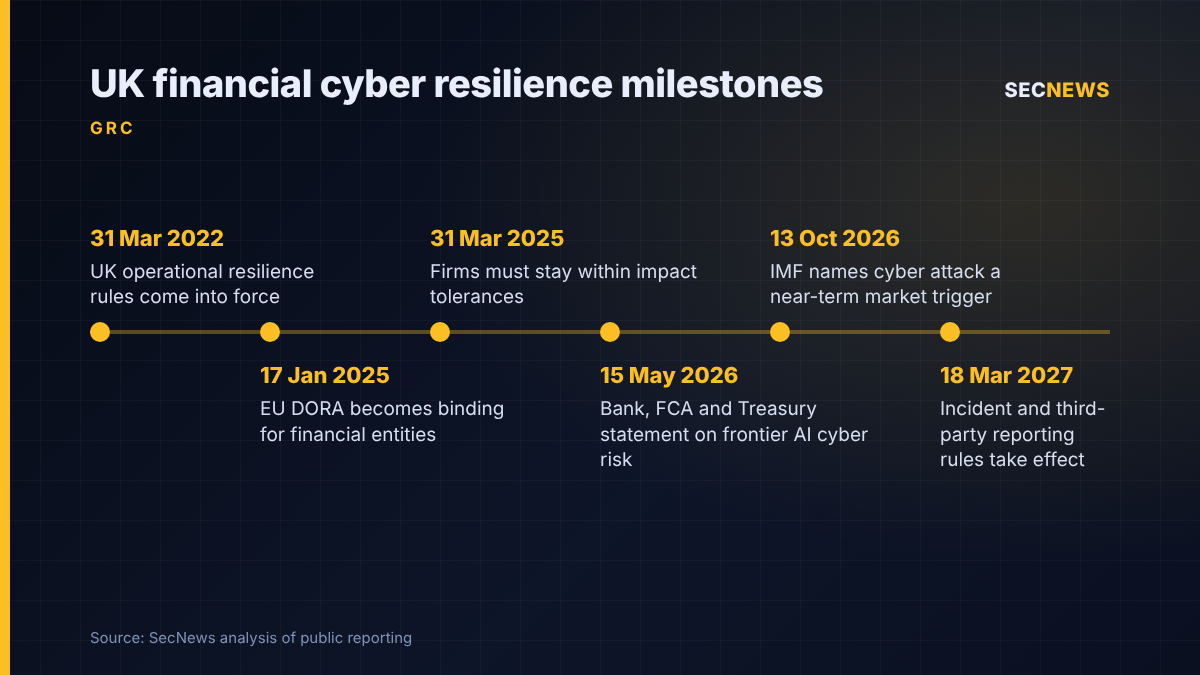
The UK operational resilience framework, published in March 2021 and in force from 31 March 2022, required in-scope firms to identify their important business services, set impact tolerances, and map and test those services. The transition ended on 31 March 2025, when firms had to show they could stay within tolerance. A cyber attack on a shared provider is the obvious scenario to test against.
The reporting layer is next. Final rules from the FCA (PS26/2), the PRA (PS7/26) and the Bank of England, issued on 18 March 2026, cover operational incident reporting and notification of material third-party arrangements, including an annual register. Those requirements take effect on 18 March 2027, so firms have roughly five months left to get their data and processes in order.
Concentration risk is the target of the critical third parties regime, under which the three authorities jointly oversee services that designated providers supply to the UK financial sector. The FCA is explicit that this oversight does not dilute a firm’s own accountability: if your cloud or software supplier fails, the regulator will still ask what you did about it. Firms with EU operations also sit under DORA, binding since 17 January 2025, which brings its own oversight of critical ICT providers.
The authorities have already joined the dots between AI and cyber risk. In a joint statement on 15 May 2026, the Bank of England, FCA and HM Treasury said current frontier models have cyber capabilities beyond those of a skilled practitioner, and expected firms to find and fix vulnerabilities faster and at scale, including in third-party and open-source components. Outside finance, the Cyber Security and Resilience Bill, still before Parliament, is the parallel vehicle for essential services.
Expert view
When a body like the IMF puts cyber in the same sentence as sovereign debt, boards listen in a way they rarely do for a security team’s risk register. The danger is that it gets filed under “macro” and ignored.
The patching statistic is the part I would put in front of a board. In my experience, most financial firms measure patching against internal targets that assume days or weeks of grace. If attackers are moving before a fix even exists, the question changes from “how quickly do we patch?” to “what happens to this service while we cannot patch?” That is an operational resilience question, not a vulnerability management one, and it should drive network segmentation, compensating controls and tested fallback plans for edge devices and remote access gateways.
On third parties, the common gap is between contract and reality. Firms have exit plans and audit clauses on paper, but few have tested what an important business service looks like when a key supplier is compromised rather than simply offline. Those are very different failure modes. A compromised provider may still be up and running, and pushing malicious updates, which is far harder to detect and contain than an outage.
What to do now
- Assume zero-day exposure on the perimeter. For every internet-facing system supporting an important business service, document the compensating controls you would rely on before a patch exists. This maps directly to the Cyber Essentials controls for firewalls, secure configuration and security update management.
- Test a compromised supplier, not just an absent one. Add scenario tests where a critical provider is breached and remains connected, and check you can isolate it within your impact tolerance.
- Prepare for the March 2027 reporting rules now. Build the material third-party register and incident classification workflow ahead of the deadline, and use it to expose concentration you did not know you had.
- Tighten supplier access. Review remote access, privileged accounts and update channels used by vendors, applying the Cyber Essentials user access control requirements and multi-factor authentication throughout.
- Brief the board in its own language. Use the IMF report and the May 2026 joint statement to frame cyber as a resilience and financial stability issue, and ask for investment in legacy system replacement where unsupported technology sits under critical services.
Bottom line
The IMF has not uncovered a new threat, but it has confirmed that cyber risk now sits alongside debt and asset bubbles as a systemic concern. For UK firms the rules are already written: impact tolerances, third-party oversight and incident reporting. The test is whether those frameworks hold up when exploitation outpaces patching and a shared supplier becomes the point of failure.
Sources
- IMF Media Center: Global Financial Stability Report, Annual Meetings 2026
- Reuters (via Investing.com): IMF cites AI slowdown, spiking yields as looming global market risks
- AFP (via Kuwait Times): IMF warns of AI market correction and cyber threats to financial system
- The Guardian: Threat of AI share crash puts world financial stability at risk, says IMF
- FCA: Operational resilience
- Regulation Tomorrow: FCA, PRA and BoE issue policy statements on operational resilience
- Bank of England: Joint statement on frontier AI models and cyber resilience
- ENISA: EU financial entities cybersecurity upgrade, DORA is now alive and kicking