Bank of America has disclosed that it took on roughly 1,000 extra contractors to remediate software flaws surfaced by AI models such as Anthropic’s Mythos. It is the clearest sign yet that the real expense of AI-driven bug discovery lands on the teams who have to fix what the machines find.
What happened
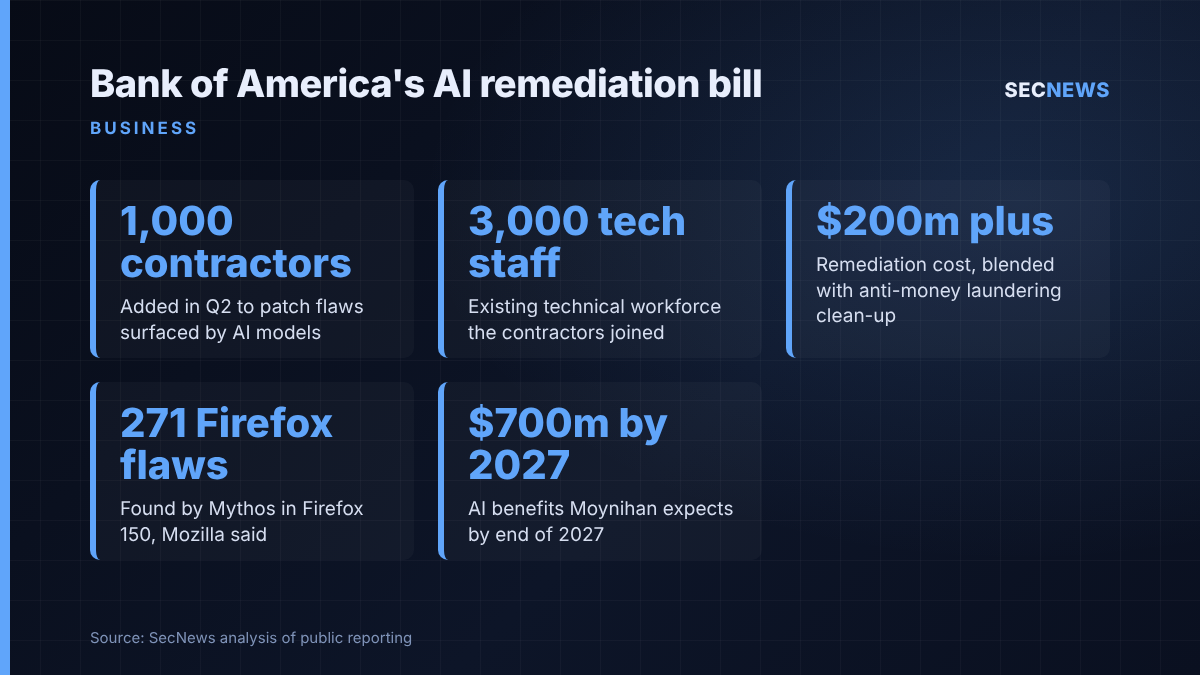
Brian Moynihan, chairman and chief executive of Bank of America, used the bank’s third-quarter results on Wednesday 14 October 2026 to put a number on a problem many security leaders have been describing only in general terms. Speaking on the earnings call and in a separate CNBC interview, he said the bank had added around 1,000 contractors during the second quarter to patch vulnerabilities flagged by advanced AI models, Mythos among them. According to RuntimeWire’s account of the CNBC interview, the work spans both the bank’s own code and software supplied by vendors.
The contractors sit alongside an existing technical workforce of about 3,000, The Register reported, and they are still in place. Moynihan indicated the extra capacity is a response to an initial surge of findings rather than a permanent change, and that he expects the associated costs to fall over time.
On cost, he offered a figure of “a couple of hundred million plus”. That number needs careful handling: it bundles the Mythos-related remediation together with clean-up work arising from the anti-money laundering (AML) orders the bank received the same week, and Moynihan did not split the two. Nobody outside the bank can therefore say how much of it is purely the price of fixing AI-discovered flaws.
The disclosure came on a difficult day for the lender. Its shares fell more than 8 per cent after it reported a 17 per cent drop in profit, driven largely by a $1.21bn settlement with the US Financial Crimes Enforcement Network.
The detail
Mythos is Anthropic’s security-focused model, unveiled in early April 2026 and kept out of general availability. Access has been limited to vetted organisations through Anthropic’s Project Glasswing, which began with around 50 partners and was widened in June to about 200 in more than 15 countries. CryptoBriefing reports that major US banks used a preview to scan internal systems at scale, and that a single scan flagged over 23,000 possible problems, the bulk of them low or moderate in severity; the bank has not confirmed that figure.
The model’s capability is not seriously in dispute, though how far it outstrips skilled humans is. Mozilla said Mythos identified 271 flaws in Firefox 150, while its chief technology officer, Bobby Holley, remarked that none of them was beyond what “an elite human researcher” could have found. The difference, in other words, is speed and volume rather than some new class of bug.
That distinction is exactly why the staffing figure matters. Discovery has been automated; triage, root-cause analysis, code changes, regression testing, change approval and vendor chasing have not. Moynihan also told analysts that around 130 AI projects are under way across the bank, that he expects them to return two to three times their cost over time, and that AI should deliver $250m to $300m of benefit in 2026, rising to about $700m by the end of 2027. The bank has separately removed around 3,000 roles, including a 5 per cent cut in managers, without saying how much AI contributed.
Other bank chiefs have sounded similar warnings. JPMorgan Chase’s Jamie Dimon has been widely reported as pointing to a potential tenfold increase in cyber risk linked to Mythos.
Why it matters for UK organisations
Early Mythos access was concentrated among large US firms, but Mythos-class capability will not stay confined to one programme or one vendor. When comparable tools reach UK estates, or reach attackers, the same backlog will appear here, and it will collide with obligations that already exist.
The PRA and FCA operational resilience rules require firms to keep important business services within defined impact tolerances. A sudden queue of thousands of findings across core banking, payments and supplier code is precisely the sort of event that tests whether a firm can prioritise and remediate without breaching those tolerances or destabilising change management. Firms with EU operations face the same question under DORA’s ICT risk and third-party provisions.
The vendor element is the part I would flag hardest. A large share of any bank’s attack surface is software it does not own. If AI scanning surfaces flaws in supplier products faster than suppliers can ship fixes, contracts, service levels and exit plans suddenly matter a great deal more. The UK’s critical third parties regime for financial services points in the same direction.
There is also a labour market angle. If one US bank needed around 1,000 extra people, UK firms should assume that skilled remediation engineers, application security specialists and experienced change managers will be in short supply and expensive at precisely the moment they are needed.
Expert view
In my experience, the finding is rarely the hard part of a security engagement. When we test a large estate, the report is delivered in weeks; the fixes often take quarters, because each one needs an owner, a test window and sign-off from people who are already busy. Bank of America’s number is simply that reality, scaled up by a machine that never gets tired.
What concerns me is the temptation to treat AI discovery as a pure efficiency win. Running a scanner that produces 20,000 issues without the capacity to triage them does not make you more secure; it can make you less secure, because genuinely critical items drown in noise and the organisation becomes legally and reputationally exposed for knowing about flaws it has not fixed. Boards should ask not “are we using AI to find bugs?” but “can we fix what it finds, and how fast?”
The firms that benefit will be those that invest in the unglamorous plumbing: asset ownership, patch pipelines and supplier accountability.
What to do now
- Measure your fix capacity before you scale discovery. Know your current mean time to remediate by severity and how many findings per month your teams can genuinely close.
- Prioritise by exploitability and business impact. Rank findings against internet exposure, known exploitation and the important business services they support, not raw severity scores alone.
- Tighten patch management. Cyber Essentials expects high and critical updates to be applied within 14 days; treat that as a floor, and automate deployment wherever possible.
- Review supplier contracts. Add clear vulnerability notification and fix timelines, and the right to receive and act on findings in vendor code.
- Plan for surge capacity. Pre-agree arrangements with trusted partners now, rather than competing for contractors when a backlog arrives.
- Govern the tools. Control who can run AI scanners against which systems, and how results are stored, because a findings database is itself a high-value target.
Bottom line
Bank of America has shown that AI-scale vulnerability discovery comes with a human bill, measured in contractors and in costs reaching the hundreds of millions, even if that headline figure is blended with AML work. UK organisations should budget for remediation, not just detection, before these tools arrive on their own networks.
Sources
- The Register: Bank of America had to bring in 1,000 contractors to patch all the bugs Mythos identified
- RuntimeWire: Bank of America added 1,000 contractors to patch AI-exposed software flaws
- CryptoBriefing: Bank of America hires 1,000 contractors to patch flaws exposed by Anthropic’s Mythos
- BankInfoSecurity: Anthropic Expands Mythos to Global Critical Infrastructure