Fortinet beat Wall Street’s expectations for its third quarter and raised its billings forecast again, yet its shares fell by roughly a quarter in after-hours trading. The reasons behind the sell-off matter to every UK organisation running FortiGate firewalls, because they concern hardware prices, support contracts and how long appliances stay in service.
What happened
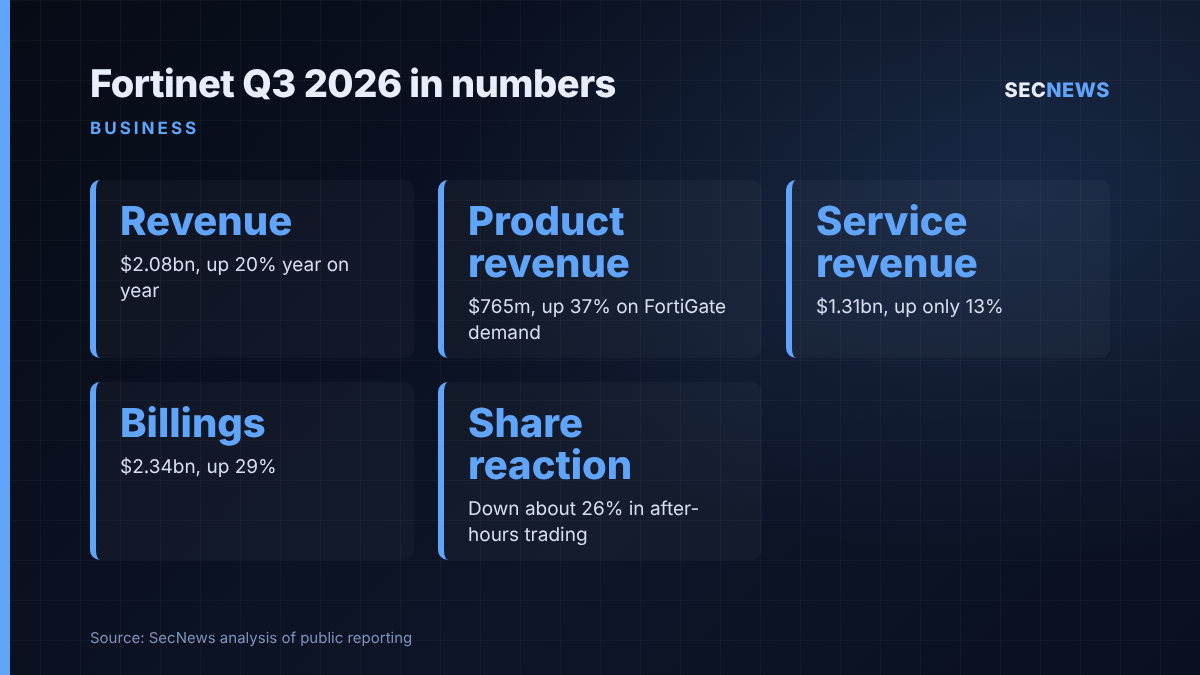
On the evening of 28 October 2026, UK time, Fortinet published results for the quarter to 30 September. Revenue was up 20% year on year at $2.08bn, ahead of the roughly $2.06bn analysts had pencilled in. Product revenue, which mostly reflects FortiGate firewall sales, grew 37% to $765m. Billings rose 29% to $2.34bn, and adjusted earnings came in at 91 cents a share against a consensus of 86 cents. Free cash flow was $865m.
Founder and chief executive Ken Xie said broad demand had allowed the company to lift its billings outlook “for the third time this year”. Full-year revenue guidance went up to between $8.125bn and $8.215bn.
Investors still sold heavily. SiliconANGLE reported that the stock fell about 26% in extended trading, and that Palo Alto Networks, CrowdStrike and Zscaler each dropped between 6% and 7% after hours too.
The detail
Investors worried about the shape of the growth, not its scale.
Services fell behind hardware. Service revenue, which covers FortiGuard subscriptions, FortiCare support and cloud services, grew just 13% to $1.31bn. Fortinet also trimmed its full-year services forecast to between $5.15bn and $5.17bn, down from the $5.18bn to $5.22bn range it gave three months ago. Chief financial officer Christiane Ohlgart put the gap down to timing. In her account, large new enterprise customers and big expansion deals often switch services on in stages, and enterprise agreements that roll several existing contracts into one can slow how quickly revenue is recognised. She pointed to 26% growth in service billings as a sign of revenue still to come.
Growth slowed. SiliconANGLE noted that sales growth had been 26% as recently as the second quarter. It added that the shares had more than doubled this year before the report, and cited Benzinga’s view that investors appeared “hung up on revenue growth and guidance”. A stock priced for acceleration had little room for a quarter where growth eased.
Costs are rising. Ohlgart explained that first-half gross margins had been helped by stock bought before component prices went up, while Fortinet had already raised its own list prices. That cushion is now running out. On the call, Xie said lead times for some components had lengthened and that the company’s long-standing policy is to hold product gross margin steady, raising prices when its costs go up. Ohlgart admitted there is a limit to how far prices can rise, given customers’ own budget constraints. Fourth-quarter operating margin guidance sits below the third quarter’s record of about 38%.
One analyst on the call asked directly whether customers are “sweating” their appliances for longer to avoid paying higher hardware prices. Xie rejected the idea that this would become a trend. He argued that kit kept running for five, seven or ten years struggles to support newer functions, and that AI-driven threats will push buyers to upgrade instead.
Why it matters for UK organisations
FortiGate is one of the most common perimeter platforms I come across in British estates, from councils and schools to manufacturers and managed service providers. A share price is not a security control, and a 26% fall says nothing about the quality of FortiOS. The forces behind the sell-off will reach UK procurement.
First, hardware prices. If Fortinet keeps product margins flat while component costs rise, UK buyers should expect firmer appliance pricing and less room on discounts. Anyone with a refresh due in 2027 should budget for that now.
Second, the pressure on services. A vendor that has told investors services growth will improve next year has every reason to push hard on subscription renewals, bundles and enterprise agreements. That can leave organisations paying for licences they never switch on.
Third, and most important from a security point of view, appliance lifecycles. The analyst’s question about sweating assets goes to a real risk. When budgets are tight, extending the life of an edge device looks like an easy saving. In my experience, firewalls and VPN gateways that have gone past end of support are among the most dependable ways into a network, and edge devices remain a favourite target for both ransomware crews and state-backed groups.
Expert view
Strip out the stock market reaction and Fortinet’s numbers describe a market still spending heavily on network security. Billings growth of 29% does not suggest a vendor losing customers. What the market is questioning is whether this year’s hardware surge, partly driven by price rises and customers moving to higher-end models, can be repeated, and whether recurring revenue will catch up.
For defenders, the balance between product and services matters more than it might seem. On a FortiGate, the value lies largely in the subscriptions: threat intelligence feeds, IPS signatures, web filtering, sandboxing and firmware support. When we test environments, a common weak point is a capable appliance whose security services have lapsed or were never fully licensed, leaving an expensive box doing little more than stateful filtering. If Fortinet’s own customers are activating services slowly after large purchases, some of them are running with gaps.
Nor is this a vendor in trouble: it generated $865m of free cash in one quarter. Its products will remain in UK networks for years, which is exactly why buyers should take control of their contracts and lifecycle plans rather than leave them to the next renewal quote.
What to do now
- List every Fortinet appliance you own. Record model, FortiOS version, end-of-order and end-of-support dates, and which FortiGuard services are licensed and actually enabled. This supports the Cyber Essentials firewall and security update management controls.
- Retire unsupported kit. Cyber Essentials requires in-scope software to be supported and patched. A firewall past end of support is a certification problem as well as a security one, so do not let budget pressure keep it running.
- Budget for higher hardware prices. If a refresh is due in the next 18 months, get quotes early and consider fixing prices where your reseller allows.
- Check what you pay for against what you use. Before any renewal or enterprise agreement, confirm that every licensed service is configured and producing value, and drop the ones that are not.
- Keep patching edge devices fast. Apply FortiOS fixes for internet-facing interfaces within 14 days at most, as Cyber Essentials requires for high and critical vulnerabilities, and quicker where exploitation is reported.
- Ask your MSP about its exposure. If a provider runs your firewalls, ask how pricing changes and its own renewal terms will affect your contract.
Bottom line
Fortinet’s sell-off is a story about investor expectations, not a broken security product. Even so, the pressures behind it, namely rising component costs, a vendor keen to grow services revenue and customers tempted to keep old hardware running, will reach UK buyers. Organisations that know exactly what they have, what it costs and when support ends will handle the next renewal far better than those that wait for the quote.
Sources
- SiliconANGLE: Fortinet plunges 26% after-hours and takes Tenable with it as Gen Digital rises
- Fortinet (via GlobeNewswire/Yahoo Finance): Fortinet Reports Strong Third Quarter 2026 Financial Results
- The Motley Fool: Fortinet (FTNT) Q3 2026 Earnings Call Transcript
- TradingKey: Fortinet (FTNT) Q3 2026 Earnings Call: Billings Rise 29%, Full-Year Guidance Raised