London start-up CodeWall has come out of stealth with $4m (reported in the UK as roughly £3m) of pre-seed money led by Osney Capital. It wants to replace the penetration test most firms commission once or twice a year with AI agents that probe your perimeter all the time, and that puts it head to head with the UK testing industry.
What happened
On 14 October 2026 CodeWall, a London cyber security start-up, revealed itself publicly alongside a $4 million pre-seed round, which Startupmag reported as £3m. Osney Capital, the specialist UK cyber investor, led the round, with InReach Ventures, Antler and a group of angel investors also taking part. The money will go on extending where its agents can operate, building retest and remediation workflows, and hiring in London.
Founder and chief executive Paul Price used to be a cyber security consultant at the London advisory firm Schillings, according to TechMarketView. He first drew attention in March, when CodeWall published research claiming its agent had reached McKinsey’s Lilli AI platform and could both read and modify its live database within two hours. McKinsey said forensic work showed no sign that client data was touched. The company also says its agents found weaknesses this year in platforms run by Boston Consulting Group and Bain & Company. So far the only customer it has named publicly is Axos Financial.
Price says the goal is to shift attack simulation “from a periodic assessment into a permanent capability”. Paul Wilkes, a partner at Osney Capital, said the firm backed the idea of handing each company “an attacker of its own”.
The detail
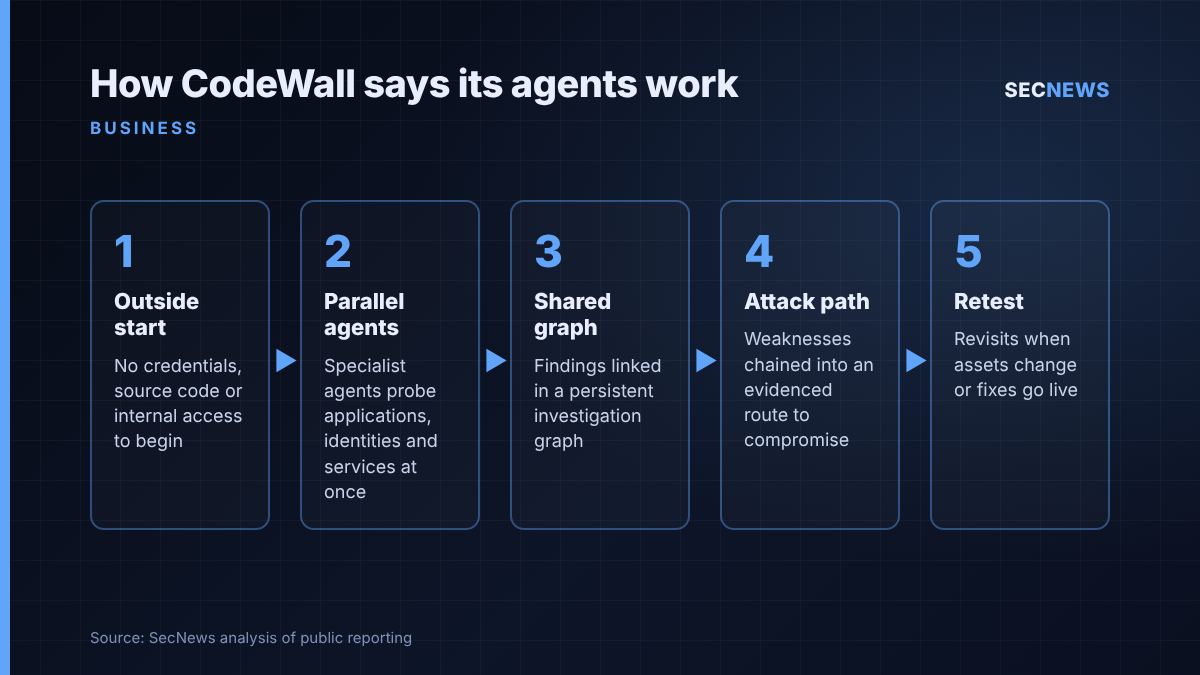
CodeWall’s pitch is all about starting from the outside. In the company’s description, its agents begin with no credentials, no source code and no internal foothold, just as a real external attacker would. Several specialist agents run side by side and record discoveries in a shared, persistent investigation graph that links findings together. For example, a weak API on one application might expose an identity, and that identity might in turn reach a data store. The output is meant to be an evidenced route to compromise rather than a list of issues.
The company also says the platform goes back and retests whenever new assets appear, applications change or fixes go live, always within an authorised scope. Unite.AI pointed out that CodeWall has not published enough implementation detail to judge how the graph handles conflicting findings or checks each step. It also noted that the launch does not make clear whether the remediation workflows actually change production systems or only recommend fixes. Neither the company nor its investors have published any independent benchmark against human-led testing.
The market is already crowded. TechMarketView named London and Amsterdam-based Hadrian, which raised $40m this month for external exploitability testing, and Lancaster University spin-out Mindgard, whose £22m August round funds continuous red teaming of AI systems. Across the Atlantic, XBOW has raised $120m this year and Horizon3.ai $250m.
Why it matters for UK organisations
There are two angles here for UK buyers. The first is the funding picture. Osney Capital is a UK-focused cyber fund, and a London pre-seed round in automated offensive testing shows that British investors expect AI-driven attack simulation to become a category in its own right, not just a feature inside vulnerability scanners.
The second angle is the UK testing services market. For most of my career, pen testing has been sold in consultant days: scope it, book the team, get a report, file it until next year. TechMarketView argues that business model will come under pressure as tools take over more of the discovery work. That is broadly right for commodity external work; judgement and accountability are harder to automate.
The regulated end of the market will also move more slowly. NCSC’s CHECK scheme for government systems and the Bank of England’s CBEST framework for financial services both rely on qualified human testers working to defined standards. Until those schemes say how platform-led testing fits in, organisations in scope will still need accredited people on assessments, whatever an agent finds in between.
Expert view
I have no problem with the basic premise. Annual testing is a snapshot of an estate that changes weekly. When we test, the most damaging findings almost always come from chaining several medium-severity issues together, and that is exactly the reasoning CodeWall says its graph is built to automate. If agents can reliably rebuild those chains between formal engagements, defenders gain something real.
Still, a launch announcement is not evidence. The McKinsey research makes a striking headline, but it is the company’s own account. Every claim about speed or depth comes from CodeWall, and it has named only one customer. Before signing anything, buyers should ask for reproducible findings from their own environment, false positive rates, and a clear account of what the agents are and are not allowed to do.
Governance is the other concern. Continuous autonomous testing means an automated system is attacking your production estate on a schedule nobody watches minute by minute. In my experience, the incidents that come out of testing are rarely caused by bad intent. They come from scope drift, a fragile legacy system, or a payload that behaves differently in production. Rules of engagement, kill switches and evidence handling matter more, not less, once a machine is doing the probing. My view is that these platforms will end up alongside skilled human testers rather than replacing them, handling breadth while people handle depth.
What to do now
- Know your external attack surface first. No testing platform helps if you cannot list your internet-facing assets. Keep an up-to-date asset inventory, which also underpins the Cyber Essentials firewall and secure configuration controls.
- Keep formal assurance where it is required. If you fall under CHECK, CBEST, PCI DSS or contractual testing obligations, treat automated platforms as an addition to accredited testing, not a replacement, until regulators say otherwise.
- Write rules of engagement before any trial. Agree permitted targets, prohibited actions, testing windows, an emergency stop procedure and who can authorise each step.
- Ask hard questions about evidence. Find out where findings, screenshots and any data an agent touches are stored, who can see them and how long they are kept, and get it in the contract.
- Measure retesting, not just discovery. The real value is confirming that a fix closed the whole path. Track how quickly validated attack paths are fixed and retested, and tie that to your patch management process, another Cyber Essentials control.
- Check vendor resilience. In a crowded, early-stage market, ask about funding runway, data portability and exit arrangements before you build a programme around one supplier.
Bottom line
CodeWall’s round is small by industry standards, but it is a clear sign that UK investors expect AI agents to take over a large share of routine external testing. UK organisations should welcome more frequent validation, judge every vendor on evidence from their own environment rather than launch claims, and keep accredited human testing wherever regulators and contracts still require it.
Sources
- CodeWall: CodeWall Emerges from Stealth with $4M to Give Every Enterprise an Attacker of Its Own
- TechMarketView: CodeWall raises $4m to automate offensive security testing
- IT Brief UK: CodeWall raises USD $4 million to test cyber defences
- Unite.AI: CodeWall Raises $4M Pre-Seed to Bring Autonomous Attack Agents to Enterprise Security
- Startupmag: CodeWall raises £3m from Osney Capital and InReach Ventures
- Pulse 2.0: CodeWall Emerges From Stealth With $4 Million Pre-Seed Funding Led By Osney Capital