From Monday, staff in Sweden’s Government Offices will no longer be able to open the web versions of ChatGPT or Claude on their work computers. Officials say staff were using AI services that had no contract behind them, and warn that this could have consequences for information security.
What happened
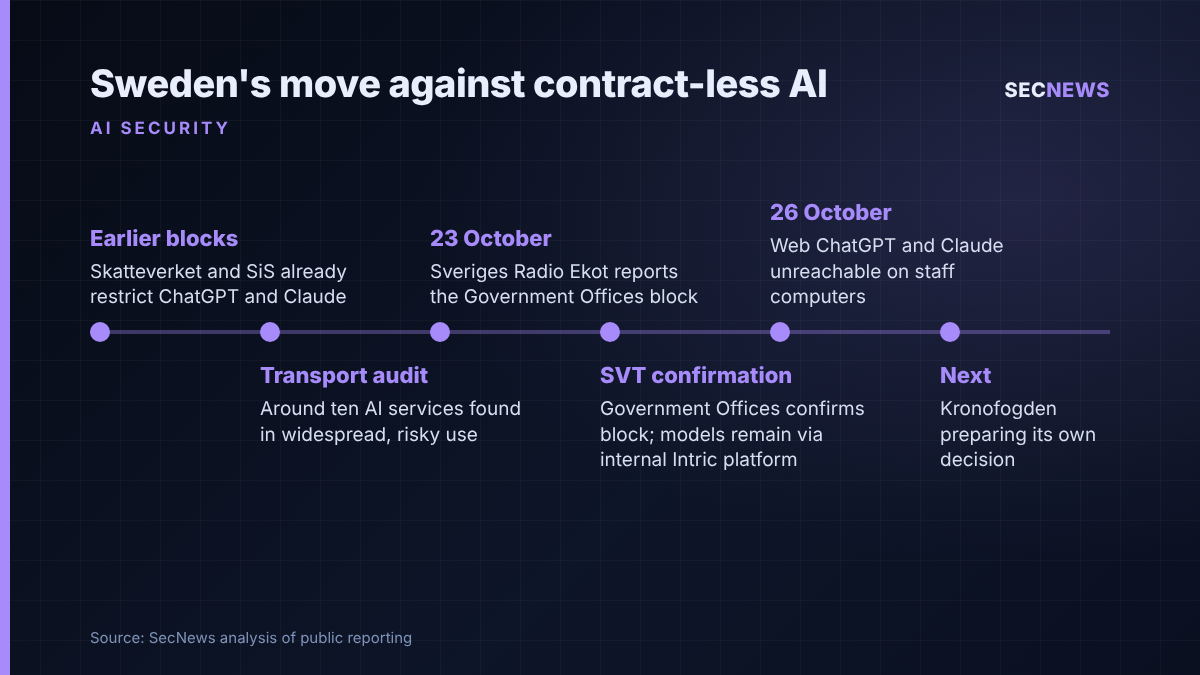
Sweden’s Government Offices, the Regeringskansliet, supports the Prime Minister’s Office and every ministry. It will block browser access to ChatGPT and Claude on staff machines from 26 October 2026. Sveriges Radio’s news programme Ekot broke the story on Friday 23 October, and the Government Offices then confirmed the change in an email to the public broadcaster SVT. Staff are being sent to Microsoft Copilot instead. According to internal information seen by Ekot, Copilot passed an internal review and then had its security settings tightened.
The justification came in an intranet post by Mikael Wettercrantz, who leads digitalisation at the Government Offices and declined to be interviewed by Ekot. Decrypt quotes him citing “several examples of problematic use” involving publicly available AI services, both in what staff entered and in how they treated the answers. Running such tools with no contract, he warned, carried consequences for information security.
This is not a ban on AI. The Government Offices told SVT that employees can still use the underlying ChatGPT and Claude models through Intric, an internal platform. The press office has not said how many people that covers or on what terms, and it declined to detail the Copilot changes on security grounds.
Other Swedish bodies got there first. According to SVT, Skatteverket, the tax authority, and SiS, which runs secure youth homes, already block these services, while Kronofogden, the enforcement authority, is weighing a decision. Decrypt adds that auditors inside the Transport Administration counted roughly ten AI services in widespread, risky use. OpenAI and Anthropic have not commented.
The detail
The block is about the contract, not the model. Text pasted into a consumer chatbot is governed by the provider’s standard terms on retention, processing location and training use, and the organisation has no negotiated say. An enterprise agreement plus administrator-controlled settings changes that. Copilot came with both; the web chatbots, as staff used them, came with neither.
The line is blurrier than it looks. Microsoft lets some Copilot features call Anthropic’s Claude models, with Anthropic as a subprocessor. MadRobot, citing Microsoft documentation, reports those models fall outside Microsoft’s EU Data Boundary and are disabled by default for European and UK tenants. The Government Offices has not said whether it has enabled them, so officials may yet reach the same models under a different contract.
The European Parliament went further in February, switching off AI features on work devices altogether. Sweden has instead sanctioned Copilot and closed off the consumer web versions of its rivals.
Why it matters for UK organisations
In my experience, almost every UK organisation, from Whitehall and the NHS to councils and financial services, has this problem. Staff reach for whichever chatbot they use at home, rarely asking whether a contract sits behind it. Sweden’s reasoning echoes what many security teams suspect: the risk lies less in the model than in the absence of an agreement, logging and administrative control.
Under UK GDPR, letting personal data flow into a service with no processing terms is a compliance risk as well as a security one. Pasting a case note or customer complaint into a consumer chatbot is effectively a disclosure to a third party on its own terms, raising processor and international transfer questions and possibly an incident assessment. Sweden’s concern about how answers were handled matters too: unchecked output in official correspondence is an integrity risk, not only a confidentiality one.
The default-off model setting is also a reminder for UK Microsoft 365 administrators that approving one AI product does not settle which models and data paths sit behind it. Someone must own that configuration and revisit it as vendors add features.
Expert view
The Swedish approach is broadly right, and more realistic than an outright ban. When we test organisations, blanket prohibitions on useful tools rarely survive deadlines; staff drift to personal phones and home laptops, where visibility is worse. An approved route that works, followed by blocks on the alternatives, shrinks shadow IT without driving it underground.
There are caveats. Domain blocking is blunt: it misses mobile devices, unmanaged hardware, browser extensions and AI built into other software. Continued model access through an internal platform needs named users, logging and clear data classification rules. A permissively configured approved tool leaks as readily as an unapproved one, so the policy’s value rests on Copilot settings the Government Offices has, understandably, kept quiet.
Governments are increasingly choosing AI by contract and by fit with platforms they already run, rather than by model quality. For defenders that is welcome, because it pulls AI inside existing identity, data loss prevention and audit controls.
What to do now
- Find out what is already in use. Check proxy, DNS and CASB logs for traffic to consumer AI services. The Swedish Transport Administration’s audit reportedly found about ten, so do not assume your own number is small.
- Provide an approved option before you block anything. Agree enterprise terms that cover retention, processing location and training use, and configure the tool centrally. Then block the unsanctioned web services. This is the Cyber Essentials application allow-listing principle applied to AI.
- Own the configuration. Review which models, connectors and subprocessors your approved platform enables, including settings that are off by default but could be switched on later. Treat changes as you would firewall rule changes (Cyber Essentials secure configuration).
- Classify what may go in. Publish a short, plain-English rule on which data classifications and personal data may be used with which AI tools, and tie it to your UK GDPR records of processing.
- Cover output, not just input. Require human review of AI-generated text before it goes into decisions, correspondence or code.
- Close the side doors. Extend controls to managed mobile devices, browser extensions and embedded AI features. Use access control and user privilege management to limit who can connect new AI apps to corporate data.
Bottom line
Sweden has not turned against AI, only against AI with no contract behind it. UK organisations should make the same move deliberately, before an incident forces it: offer a governed option, block the rest, and keep auditing the settings behind the approved tool.
Sources
- SVT Nyheter: AI-tjänster spärras på Regeringskansliet
- Decrypt: Sweden’s Government Offices Block ChatGPT and Claude, Keep Microsoft Copilot
- Notebookcheck: Sweden’s government blocks ChatGPT and Claude, keeps Copilot
- MadRobot: Sweden’s government is blocking ChatGPT and Claude on staff computers from Monday