Jack Stockdale, Darktrace’s co-founder and founding chief technology officer, has stepped back to a part-time role. The Cambridge firm has split his job between a new chief product officer and a new chief technology officer, and says securing enterprise AI and agents is a key focus alongside its core platform.
What happened
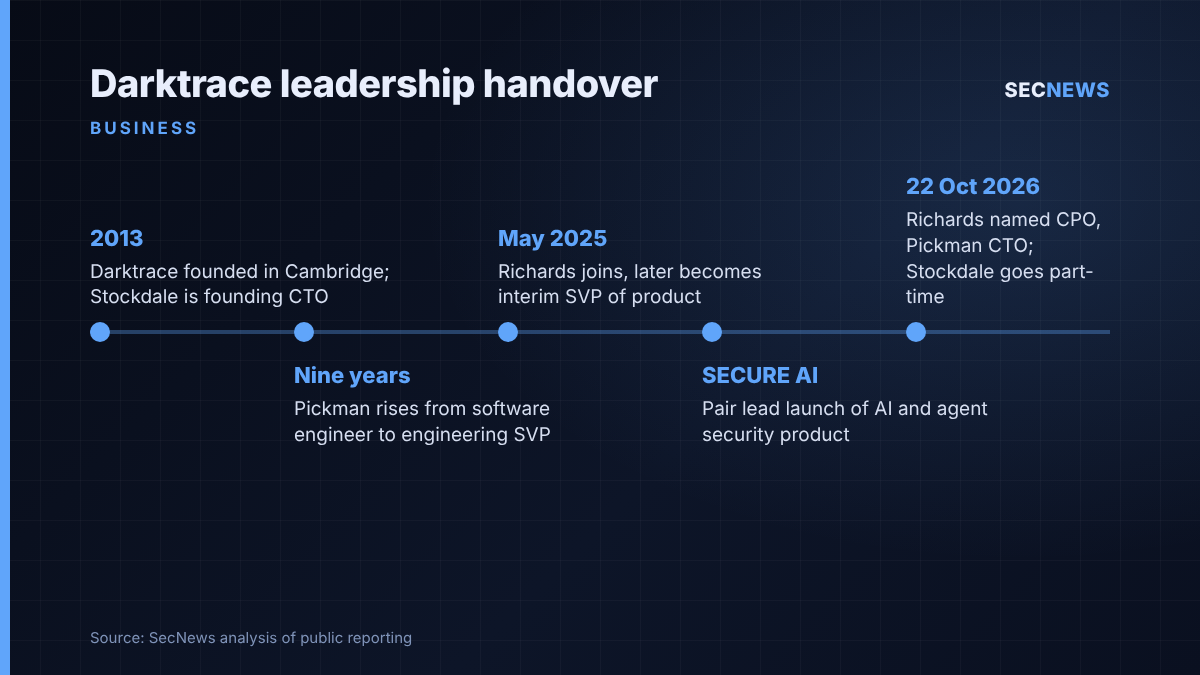
On 22 October 2026 Darktrace announced two senior appointments. Issy Richards is now chief product officer and Stephen Pickman is now chief technology officer. According to the company, both sit on the executive leadership team, report straight to president and chief executive Ed Jennings, and work from Cambridge, where Darktrace was founded in 2013.
The appointments are a succession as well as an expansion. Darktrace says the pair take over from co-founder Jack Stockdale, who now works part-time and is no longer involved in daily management. He will keep contributing to strategic product direction. Darktrace’s own profile of Stockdale describes him as its founding CTO, responsible for the Bayesian models and machine learning algorithms behind the platform. His Cambridge team was recognised by the Royal Academy of Engineering’s MacRobert award committee in 2017 and 2019.
Darktrace also says it is adding staff across its R&D centres worldwide to support that work.
The detail
Richards joined Darktrace in May 2025 and was most recently interim senior vice president of product. Before that she spent close to ten years in senior roles at UK AI software businesses, including Ocado Technology and Faculty AI. At Ocado she led the teams that built and launched its smart grocery platform, and she helped grow the technology organisation, including three new AI and robotics research centres in the UK.
Pickman is a nine-year Darktrace veteran. He started as a software engineer, later led product development and most recently ran engineering as a senior vice president. He led development of Darktrace / EMAIL and built several proofs of concept that later became part of the wider product range. As CTO he will run research and development. He says his aim is to keep R&D ahead as customers try to secure people, infrastructure and AI.
Darktrace says the two were central to building and launching Darktrace / SECURE AI, a product meant to help security teams find where AI is used in an organisation, see how people and AI agents behave, and act when something looks risky. Jennings said Richards had “sharpened our strategy” and that Pickman had set the pace for bringing new technology to market quickly. Darktrace says it has nearly 10,000 customers worldwide.
All of the above comes from Darktrace’s own announcement and website. I could not find independent reporting that adds to it, and the company has given no other reason for Stockdale’s change of role.
Why it matters for UK organisations
Darktrace is one of the best-known security vendors to come out of the UK, and many British organisations run its products. When a founding technologist steps back, customers should ask what changes, even if the immediate answer is “not much”.
The announcement says a lot about where Darktrace thinks the money is. The release leads on the pair’s work on the AI and agent security product, rather than the network detection that made the company’s name. In my view that fits the wider market, where many recent security launches have targeted controls for AI agents. A vendor that wants to stay relevant to enterprise buyers needs a credible story there.
For UK buyers, the practical point is simple. If you run Darktrace, or are evaluating it, your account team should be able to explain the product roadmap under the new leadership and what it means for the modules you already pay for. Leadership changes often lead to products being reprioritised, with more investment in some lines and less in others.
The move is also worth noting for UK skills. A Cambridge security company has filled its two top technical jobs from within: one from its own engineering ranks and one executive whose earlier career was in the British AI industry. That is a modest but welcome sign for the UK talent pipeline.
Expert view
This is my reading, not Darktrace’s. Splitting a founder CTO’s job into separate product and technology roles is a normal stage in a security vendor’s life. Early on, one person can hold the vision, the maths and the engineering. At the scale Darktrace now claims, product management and R&D are different disciplines with different pressures. Giving each its own executive is sensible governance, not a warning sign in itself.
Founder departures still deserve attention. In my experience, the risk is less about what a vendor says in a release and more about what happens to engineering culture over the next two or three years. Detection products depend on deep, often undocumented knowledge of why models behave the way they do. Keeping Stockdale on in a part-time role, and promoting someone who has spent nine years in the codebase, suggests Darktrace knows this.
The bigger question is focus. Every vendor is now pitching AI agent security, and much of that market is still immature. When we test environments, the problems we find are usually familiar ones: over-privileged service accounts, poor asset inventories and weak logging. AI agents add new versions of these rather than replacing them. Buyers should judge any AI security product, from Darktrace or anyone else, on whether it fixes those basics for agents. A new dashboard is not enough.
What to do now
- Ask for a roadmap briefing. If Darktrace is in your estate, ask your account manager how the product and R&D split affects the modules you license, and whether any end-of-life or repackaging decisions are coming.
- Check your contract terms. Make sure renewals give you notice of material product changes and a way out if a capability you rely on is withdrawn or moved into a different bundle.
- Do not lean on one detection layer. Behavioural detection is valuable, but it should sit on top of solid basics. Map your controls to Cyber Essentials: secure configuration, user access control, malware protection, security update management and firewalls.
- Inventory your AI agents before buying AI security tools. Know which agents exist, what accounts and data they can reach, and who owns them. Apply least privilege to agent identities just as you would to staff accounts.
- Test vendor claims. When evaluating any AI security product, run a structured proof of concept with defined success criteria and red-team scenarios, rather than relying on demos.
Bottom line
Darktrace has formalised a transition many founder-led security firms go through, handing its founding technologist’s job to a product lead and an engineering lead and pointing both at enterprise AI security. On the evidence published so far, it looks like an orderly succession, not a crisis. UK customers should still use the moment to press for roadmap clarity and to check that their own security basics do not depend on any single vendor’s direction.
Sources
- Darktrace: Darktrace Strengthens Product and Technology Leadership with New Executive Appointments
- GlobeNewswire: Darktrace Strengthens Product and Technology Leadership with New Executive Appointments
- Yahoo Finance UK: Darktrace Strengthens Product and Technology Leadership with New Executive Appointments
- Darktrace: Jack Stockdale profile