A new benchmark from AIR Research Lab says all eight web search APIs it tested for AI agents handed back known-malicious content, with package and install queries the riskiest. The research is self-published and not yet independently verified, but the problem it describes is one every UK team running coding agents should take seriously.
What happened
On 23 November 2026, AIR Research Lab, the research arm of security start-up AIR, published the WebSec Benchmark, an attempt to measure how often the search services AI agents rely on return pages that could push an agent into harmful actions. It appeared on AIR’s blog and a dedicated benchmark site, and in a contributed article on The Hacker News written by the same AIR researchers, Shahar Levy, Shay Lempert and Niv Hoffman.
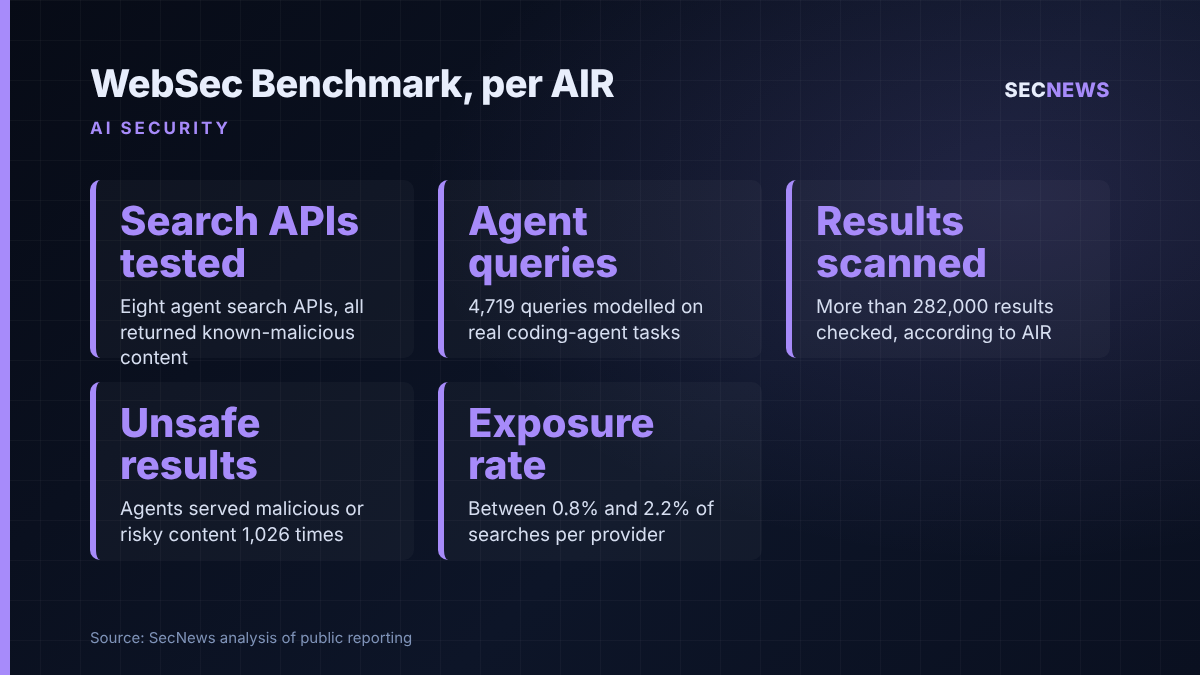
According to AIR, the team sent 4,719 queries modelled on genuine coding-agent tasks to eight search APIs sold for agent use (in alphabetical order, Brave, Exa, Firecrawl, Nimble, Parallel, Perplexity, Tavily and You.com), and inspected more than 282,000 results. Its headline claim is that no provider came back clean. Each returned content already known to be malicious at least once, and AIR counts 1,026 occasions on which agents received malicious or risky material.
Be clear about what this is. Every figure below comes from AIR alone. It is vendor research from a company that sells security for AI agents, and we have seen no independent replication, or any response from the eight providers. Read the numbers as AIR’s findings, not settled fact.
The technical picture
The underlying problem is simple. A stuck developer searches, skims and decides what to trust. A coding agent runs the same search but often acts immediately, installing a recommended package or running a command lifted from a README, frequently with shell access and the developer’s credentials to hand. A poisoned result is therefore more than misinformation: it can be the opening move of a compromise.
AIR says it held everything fixed except the provider. Its starting point, it says, was a corpus of 8,684 logged agent sessions working on real GitHub issues, from which it generated candidate searches, then filtered them with two judge models and added 1,499 package-selection and install queries. AIR stresses that no query named anything malicious, so whatever came back was the engine’s own doing. Each result was fetched twice, posing as an agent and as a normal browser, to catch cloaked content, then put through 17 checks, with researchers reviewing every finding.
On AIR’s figures, 534 searches surfaced known-malicious content, with per-provider rates between 0.8% and 2.2%, or roughly one problem search per 45 to 125. Package and install queries scored worst, which matters because that is the moment before an agent runs code. AIR’s “WebSec Index”, where higher is safer, puts Firecrawl top at 21.59 and Tavily second at 18.59, with You.com last at 5.02.
AIR sorts its findings into six categories: prompt injection hidden in pages or READMEs; typosquatted domains, packages and repositories; hallucinated package and domain names that attackers can register; pages engineered to rank for agent queries; takeover of lapsed domains that still rank; and content that nudges agents towards dangerous steps such as piping downloads into a shell or adding an unvetted MCP server.
The benchmark follows two earlier AIR studies. In SolanaCry, AIR reports that a fake Solana starter repository on GitHub ranked first in search and its install step planted a remote access tool linked to NetSupport Manager activity. In Web Hole, AIR says about 2,000 everyday developer queries produced 36 results on unregistered domains that anyone could buy.
Why it matters for UK organisations
UK development teams have adopted agentic coding tools quickly, and many let them search, install dependencies and run builds with little supervision. Organisations have spent years locking down registries, pinning dependencies and hardening CI pipelines. If an agent can take an install command from a search result and execute it before anyone looks, those controls are bypassed at the front door.
AIR offers some arithmetic: at a 1% rate, agents making 5,000 searches a day would meet known-malicious content around 50 times daily. That is an illustration, not an observed incident count, but small percentages become large numbers once agents run at machine pace across an engineering function.
There is a procurement angle too. Teams usually choose an agent search provider on cost, latency and answer quality. If AIR’s ranking is broadly right, that choice is also a security decision, and one that rarely features in supplier risk assessments. Regulated firms, already scrutinised on third-party risk, should check whether agent search services are even on their supplier register.
Expert view
None of these techniques are new. Typosquatting, dependency confusion, expired-domain takeover and SEO poisoning have fuelled supply chain attacks for years. What has changed is the victim. A human brings some scepticism to an odd domain or a curl-to-shell one-liner; an agent chasing a goal often does not, and may hold broad local permissions while it works.
In my experience, the weakest point is rarely the clever exploit; it is the trusted automation nobody watches. When we test developer environments, over-privileged service accounts and unchecked scripts are the most productive routes in, and coding agents fit that pattern neatly. I would treat an agent with shell access as a privileged user that reads untrusted input all day.
The league table warrants caution, though. One vendor’s index, built on its own detectors and weightings, is a signal rather than a definitive ranking, and providers may dispute it. The durable lesson does not depend on who scored best: if every provider returned some malicious content, no choice of API removes the need for controls on what agents do with results.
What to do now
- Treat search results as untrusted input. Web content an agent reads, including READMEs, should be filtered or reviewed before it can drive actions.
- Block download-and-execute patterns. Turn off auto-approval for commands piping remote content into a shell and require human sign-off for installs from unvetted sources (Cyber Essentials: secure configuration).
- Gate package installs. Confirm a package exists, check its age and look it up in malware databases such as OSV; brand-new or unpublished names should fail.
- Constrain agent privileges. Run agents in sandboxed or ephemeral environments without standing production credentials (Cyber Essentials: user access control, malware protection).
- Use domain reputation. Factor domain age and registration history into egress filtering.
- Log what agents read as well as what they run. The originating page is often the hardest evidence to recover.
- Add agent search providers to supplier reviews. Ask how they filter malicious and lapsed-domain results.
Bottom line
AIR’s WebSec Benchmark is self-published vendor research, and its rankings need independent scrutiny before anyone treats them as definitive. The core message is harder to dismiss: for teams running coding agents, web search is now part of the software supply chain and deserves the same controls as any other route by which untrusted code reaches your systems.