A CyberScoop journalist with no background in vulnerability research used two free AI models to find a real flaw in a WordPress plugin with more than 40,000 installs, and the Patchstack Bug Bounty Program validated it within about a day. The case is a useful snapshot of where crowdsourced disclosure is heading, and of the pressure it puts on triage teams and on vendors with no disclosure policy.
What happened
On 23 November 2026, CyberScoop published a first-person account by reporter Greg Otto describing how he found a cross-site request forgery (CSRF) weakness in WPIDE, a file manager, code editor and PHP snippet tool for WordPress developed by XplodedThemes. Otto says he has a working understanding of the industry but cannot read code like an engineer. The whole exercise, from choosing a target to filing a report, took him roughly six hours.
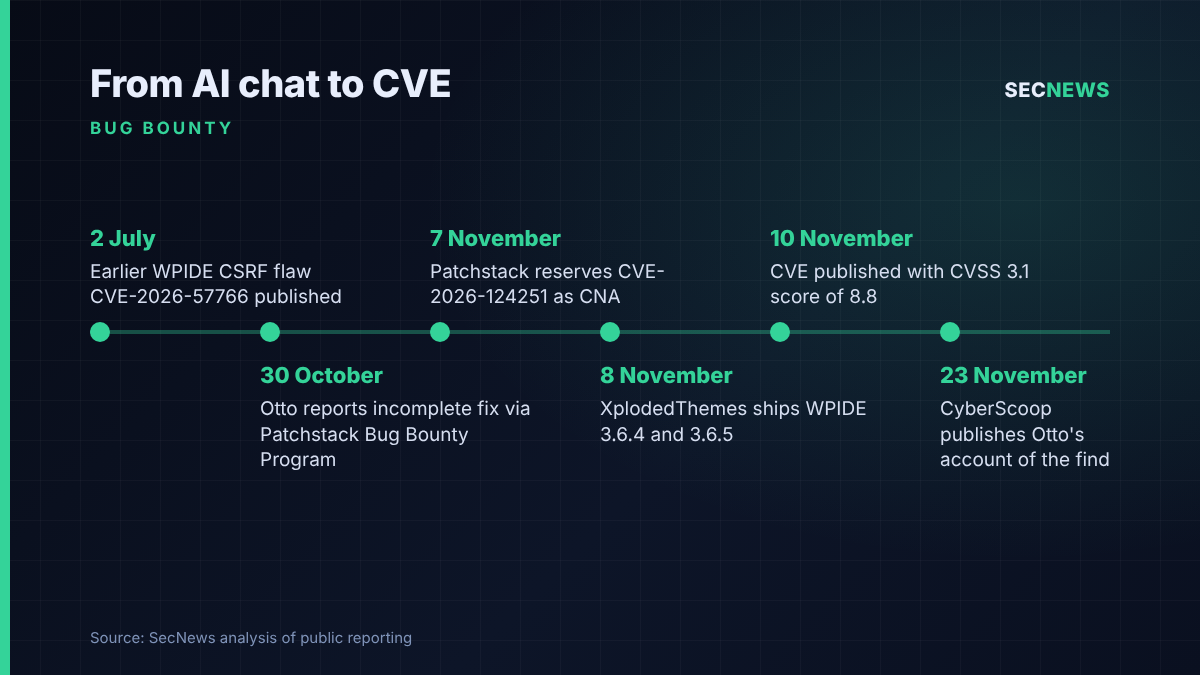
The timeline is documented in the CVE record, Patchstack’s database and the plugin’s changelog. Otto reported the issue on 30 October. Patchstack’s team reproduced it, and XplodedThemes released versions 3.6.4 and 3.6.5 on 8 November, with the changelog crediting Otto and noting an extra hardening step suggested by Patchstack. Patchstack, acting as the CVE Numbering Authority, reserved CVE-2026-124251 on 7 November and published it on 10 November with a CVSS 3.1 score of 8.8. The official CVE record credits the finder as “Greg Otto | Patchstack Bug Bounty Program”.
Neither CyberScoop nor Patchstack says whether a payout was made, so I will not speculate on one.
The technical picture
This was not a new class of bug so much as an unfinished repair. WPIDE had already been the subject of an earlier CSRF advisory, CVE-2026-57766, published in July 2026 and covering versions up to 3.5.6. According to CyberScoop’s technical write-up, the attempted fix only enforced WordPress nonce checks on the plugin’s main admin page, leaving seven submenu pages unprotected. A later rewrite in version 3.6.2 kept the same narrow gate, so the gap survived three releases.
The practical consequence is serious on paper. An attacker needs no account of their own, but must persuade a logged-in administrator to visit a page they control. Because WPIDE includes a feature for saving and running PHP snippets, a forged request can end in code running on the server, which amounts to full site takeover. That is why the base score lands at 8.8, with user interaction as the main brake on it. Patchstack’s own entry rates the real-world priority as low and considers exploitation unlikely, which is a reminder that CVSS and practical risk are not the same thing.
The AI side is just as instructive. Otto began with Google’s Gemini, which helped him pick a target category: popular but not heavily scrutinised software, where a find would matter without risking anything critical. When Gemini’s guardrails stopped cooperating, he switched to GLM-5.3-Flash, an open-weight model from Chinese developer Z.ai, which, he says, within minutes told him he was looking in the wrong place, compared two plugin versions to locate the earlier fix, and wrote proof-of-concept tests. It also drafted his submission for Patchstack. Crucially, all testing ran against a copy of WordPress on his own laptop, not against anyone’s live site.
Why it matters for UK organisations
WordPress underpins a large share of UK small business, charity and public sector websites, often built by agencies and then left to run with a long tail of plugins. File managers and code editors inside the dashboard are exactly the kind of component that turns a single administrator mistake into a compromised server. If your estate includes WPIDE, this is a straightforward update, but the wider lesson is about the plugin population as a whole.
The economics of discovery have shifted. If a non-specialist can find a credible bug in an afternoon, so can thousands of others, including people who will never report anything. Patchstack’s database notes that WPIDE has no vulnerability disclosure policy of its own. This time a platform stood in the middle, reproduced the issue and got a fix shipped in about nine days. Many smaller vendors have no such intermediary, and reports either vanish or arrive in public first.
There is also a legal dimension for UK readers. Testing systems you do not own or have permission to test can fall foul of the Computer Misuse Act 1990, whatever your intentions. Otto’s approach of testing only his own local install is the safe pattern. Anyone in the UK tempted to try the same against real websites without permission should understand the risk they would be taking.
Expert view
In my experience, incomplete fixes are some of the most rewarding findings in any engagement. A developer patches the exact case that was reported, the advisory goes out, and everyone moves on. Comparing the before and after versions of a patch is a standard technique for testers, and attackers have used it for decades. What has changed is that a language model can now do that diffing and reasoning for someone who has never heard the term.
I would not read this as proof that skilled researchers are obsolete. Otto needed judgement to pick a sensible target, to keep his testing legal and to resist submitting until he had something reproducible. Patchstack still needed humans to confirm it. But the floor has dropped sharply. Maintainers and triage teams have spent this year complaining about floods of low-quality AI reports, and here is the other side: genuine bugs from newcomers that still have to be triaged with the same care.
When we test web estates, the plugins nobody remembers installing are usually where the trouble is.
What to do now
- Patch WPIDE. Move to version 3.6.5 or newer. If you cannot update straight away, deactivate the plugin. This maps to the Cyber Essentials security update management control.
- Check for tampering if you ran an affected version. Review the plugin’s saved snippets and uploads folder for anything unexpected, look for unfamiliar files under wp-content, and rotate administrator passwords.
- Audit plugin inventory. Remove code editors, file managers and snippet runners from production sites unless there is a clear need. Fewer high-privilege plugins means a smaller attack surface (Cyber Essentials secure configuration).
- Protect administrator sessions. Use separate browsers or profiles for WordPress admin work, enforce multi-factor authentication and limit the number of administrator accounts (user access control).
- Publish a disclosure route. If you develop or maintain software, add a security.txt file and a simple vulnerability disclosure policy, following the NCSC’s guidance. Plan for more reports, many of them AI-assisted, and budget triage time accordingly.
- Set boundaries for staff curiosity. If employees want to experiment with AI-assisted bug hunting, require them to work only on systems they own or are authorised to test.
Bottom line
A journalist, two free AI models and six hours produced a validated, patched CVE in a plugin running on tens of thousands of sites. The disclosure worked because a bug bounty platform reproduced the report quickly and the developer acted. The uncomfortable question for UK organisations is how many similar flaws are being found by people who will not report them, and whether your own sites and suppliers would know what to do with a report if one arrived.
Sources
- CyberScoop: I’ve never hunted for a software vulnerability before. AI helped me find one in six hours.
- CyberScoop: WPIDE ≤ 3.6.4 – CSRF Nonce Bypass Leading to Unauthenticated RCE (CVE-2026-124251)
- CVE Program: CVE-2026-124251 record
- Patchstack: WordPress WPIDE plugin <= 3.6.4 Cross Site Request Forgery (CSRF) vulnerability
- WordPress.org: WPIDE – File Manager & Code Editor changelog