Attackers are now exploiting CVE-2026-90436, a critical bug in the long-retired Apache Axis 1.x SOAP library, against Atlassian Confluence Data Center. Any UK organisation still running a self-hosted Confluence 9.x or older with the legacy remote API switched on should treat this as an emergency change.
What happened
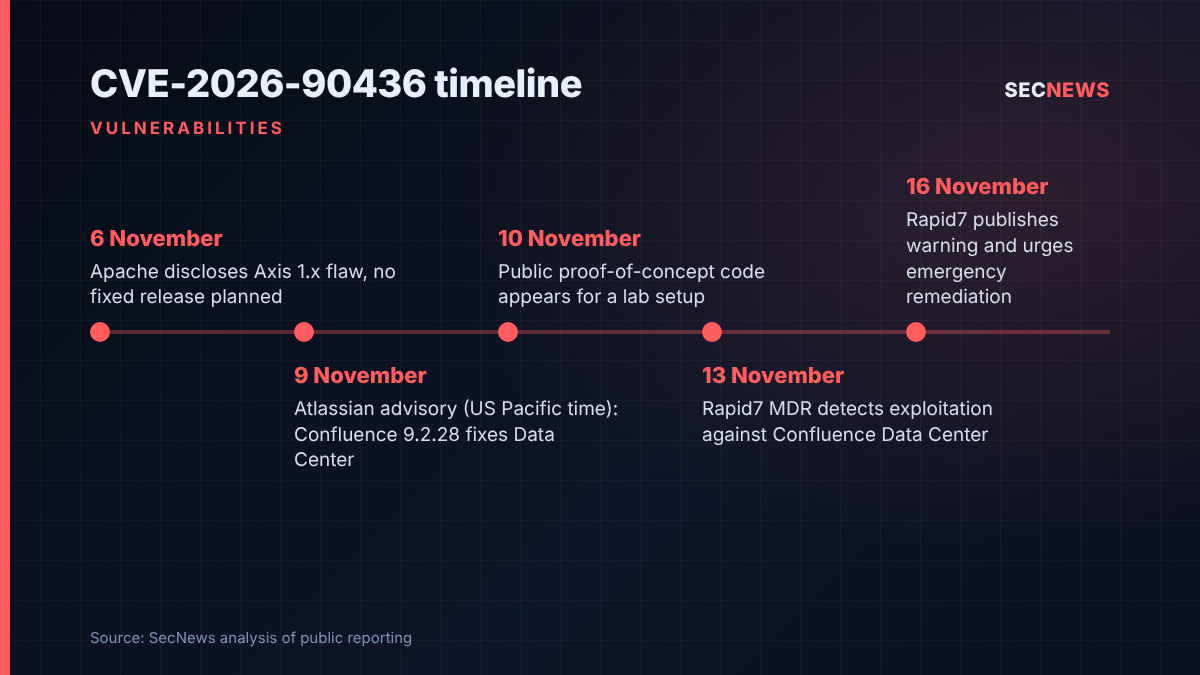
On 16 November, Rapid7 said its managed detection and response team had seen CVE-2026-90436 being exploited against a Confluence Data Center server in a customer’s environment on 13 November. The flaw sits in Apache Axis 1.x, a Java library for building SOAP web services that has been end of life for years. Apache disclosed it on 6 November. CISA’s scoring gives it 9.8 out of 10.
The Apache advisory only covered the library. It soon emerged that some commercial products still bundle Axis 1.x, and Confluence Data Center is one of them. Atlassian lists Confluence Data Center 1.x to 9.x as affected where the “Remote API (XML-RPC & SOAP)” option is switched on, with 9.2.28 as the fixed release. Confluence 10.x dropped the feature entirely and Atlassian Cloud is not affected. Atlassian’s advisory is dated 9 November (US Pacific time), and the vendor rates the issue critical with a CVSS 4.0 score of 9.3.
Rapid7 also linked the same CVE to the recent wave of attacks on N-able N-central, saying exploitation reported there “strongly correlates” with the Axis bug. Rapid7’s advice is blunt: fix exposed systems as an emergency, outside normal patching cycles.
The technical picture
CVE-2026-90436 is an unsafe reflection weakness (CWE-470). According to a technical write-up by Tuskira, which summarises Apache’s advisory, Axis 1.x takes a class name supplied inside a SOAP fault and instantiates that Java class, all before it has decided whether to trust the message. If a suitable class is on the application’s classpath, this can lead to remote code execution. No credentials are needed.
Two details make this worse than a typical library bug. First, Apache says the vulnerable code runs before any per-service handlers, so authentication configured on an individual Axis service gives no protection. Second, there will be no fixed Axis 1.x release. Apache’s fix exists only as an upstream code commit. Its options are to move to another SOAP engine, such as Axis2, or to rebuild 1.x with that patch applied. That leaves every vendor that bundles the old library to ship its own fix.
In Confluence, the vulnerable code is reachable through the legacy XML-RPC and SOAP remote API. Rapid7 notes that fresh installs have shipped with this option disabled ever since Confluence 3.0. In practice, though, long-lived on-premises deployments that have been upgraded repeatedly often carry old settings forward, especially where a script or integration once depended on them. The Tuskira write-up says public proof-of-concept code aimed at a lab setup has existed since 10 November. It also says the CVE was not in CISA’s Known Exploited Vulnerabilities catalogue as of the 13 November release.
Rapid7 has published four IP addresses linked to the Confluence attacks. It has not said what the attackers did after getting in, and it warns that finding none of those addresses in your logs does not mean you were not hit.
Why it matters for UK organisations
In our experience, Confluence Data Center is common among UK central government suppliers, financial services, universities and engineering firms. Many of them chose self-hosting deliberately, for data residency or sovereignty reasons, and so have not moved to Atlassian Cloud. Those are exactly the estates most likely to be running 9.x or older.
A Confluence server is rarely just a wiki. It holds architecture diagrams, runbooks, credentials pasted into pages, and connections to Jira and directory services. Remote code execution on that host gives an attacker a strong foothold and a great deal of reconnaissance material in one go.
The bigger issue is Axis 1.x itself. It has turned up in two very different commercial products in a fortnight, and Tuskira notes that Debian still ships it as a system package. Other Java applications may well embed it without saying so in their documentation. For UK organisations, that is a supply chain question as much as a patching one. Software bills of materials (SBOMs) exist precisely to expose this kind of risk, where one obsolete component sits unseen inside third-party software.
Expert view
In my experience, the “off by default” reassurance is the part of an advisory that most often gives false comfort. When we test mature on-premises Confluence estates, it is common to find legacy features that someone enabled years ago for a migration or a reporting script and never turned off. Default settings describe a fresh install, not a server that has been through a decade of upgrades.
The end-of-life library angle should also worry anyone responsible for procurement. Apache stopped maintaining Axis 1.x long ago, yet it was still shipping inside current commercial software this month. Vendors have been quietly carrying technical debt that only surfaces when someone finds a bug in it. I would expect more vendors to announce that they are affected as researchers and attackers scan for other products that expose Axis endpoints.
Finally, the speed matters. Apache disclosed this on 6 November, and Rapid7 saw attacks against Confluence a week later. That gap is now normal, and a monthly patch cycle cannot keep up with it on internet-facing services.
What to do now
- Find your Confluence Data Center and Server instances, including forgotten test and departmental servers, and record their versions.
- Upgrade to 9.2.28 or a supported 10.x release. This maps directly to the Cyber Essentials security update management control, which expects high and critical fixes within 14 days. Given active exploitation, aim for days, not weeks.
- If you cannot patch immediately, disable “Remote API (XML-RPC & SOAP)” via the General Configuration and Further Configuration screens. Rapid7 says no restart is needed, but check which integrations break before and after.
- Take Confluence off the open internet where you can, putting it behind a VPN, zero trust access proxy or IP allowlist. This is the Cyber Essentials firewall control in action.
- Hunt for compromise on any server that had the remote API enabled. Search logs for Rapid7’s published IP addresses. Look for shells, download tools or cryptominers started by the Java process, and for new scheduled tasks, services and unexpected outbound connections.
- Look for Axis 1.x elsewhere. Use software composition analysis, SBOMs or a simple file search for axis.jar on application servers, and ask your software suppliers directly whether their products bundle it.
- Rotate secrets stored in or reachable from any Confluence host you cannot rule out as compromised, including service account passwords and API tokens.
Bottom line
CVE-2026-90436 combines no authentication, a library with no upstream fix, and confirmed attacks against one of the most widely deployed collaboration platforms in UK organisations. If you run self-hosted Confluence below version 10, check that remote API setting today, patch to 9.2.28 or later, and assume compromise if the setting was on. Then start asking which other products in your estate are quietly carrying Axis 1.x.
Sources
- Atlassian: CVE-2026-90436: Remote Code Execution in Confluence Data Center
- Rapid7: Rapid7 Detected Exploitation of CVE-2026-90436 against Atlassian Confluence Data Center, N-able N-central also Exploited
- Tuskira: CVE-2026-90436 Apache Axis 1.x flaw: no fixed release, exploitation reported
- SecurityOnline: CVE-2026-90436: Confluence Data Center RCE Actively Exploited, Patch Now
- Cyber Daily: Patch now! Hackers targeting critical vulnerability impacting Atlassian, N-able products
- Capable: What’s new in Atlassian: week of 16 November 2026