A ransomware crew called AuditTeam has spent most of 2026 breaking into organisations with a home-built framework dressed up as penetration testing software, then billing victims for an “audit”. Kaspersky’s research shows how far criminal tooling has come, and why UK defenders and buyers of security testing should take note.
What happened
On 18 November 2026, Kaspersky’s GReAT researchers published details of AuditTeam, a ransomware operation that has hit dozens of organisations since January. Kaspersky’s own telemetry places victims in seven countries and territories: Russia, Italy, Finland, Senegal, the Philippines, Hong Kong and mainland China. The group’s Tor leak site claims further victims across Asia, Europe and South America, including Spain, Ukraine, Japan and Argentina. No UK victims have been named.
The tooling was first spotted on 10 March 2026 during an intrusion at a Hong Kong organisation. Commit history on a GitHub account tied to the operation points to a start date of 5 January, and the first leak-site listing appeared on 21 February. Kaspersky warns the campaign may not be over.
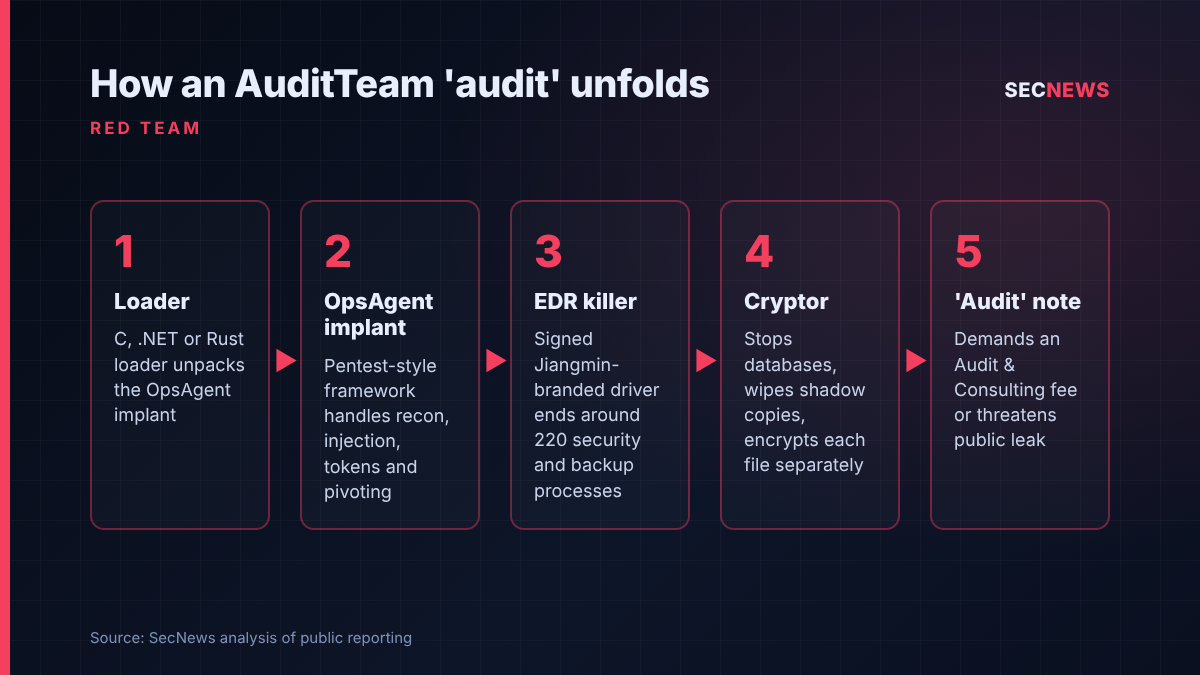
The twist is the branding. AuditTeam claims to be educating companies about security. Its ransom note is formatted like an audit log, aimed at senior executives and legal teams, and offers a choice labelled “remediation” or “public transparency”. Pay the “Audit & Consulting fee” and the group promises to delete stolen data and supply a report on the weaknesses it exploited. Refuse, and it threatens to publish everything and contact the victim’s customers, partners and regulators.
The technical picture
The engine behind these so-called audits is OpsAgent, a previously undocumented modular framework built to resemble a legitimate testing tool. Securelist’s write-up compares version 5.2.8 of the main implant with Cobalt Strike for breadth of features: file and process handling, code injection, token theft, privilege escalation, keylogging, screenshots, SOCKS proxying and chaining infected hosts together for lateral movement. Heavier jobs, such as credential dumping, are streamed in from the command server into separate helper processes, keeping the core implant small.
Loaders evolved through the year, from obfuscated C and .NET variants that injected into msiexec.exe to a Rust loader that runs the payload inside its own process, avoiding the cross-process activity many endpoint tools watch for. The implant itself was also rewritten in Rust, gaining interactive shells and the ability to switch from HTTP polling to a persistent WebSocket channel over TLS.
Two add-on modules make it a ransomware kit. The first is an EDR killer that installs a kernel driver masquerading as a Beijing Jiangmin (KV series) antivirus component. The driver carries a valid signature, which helps it load, and the module then ends around 220 named processes spanning security products, monitoring tools such as Sysmon, Splunk and Wazuh, backup software including Veeam, and database engines. This is the familiar “bring your own vulnerable driver” approach. The second module is the cryptor, which halts database and backup services, wipes shadow copies and encrypts each file with its own key. The note never mentions encryption, yet the cryptor is what drops it, so anyone reading it has already lost their files.
Command and control runs through Amazon CloudFront subdomains, which makes IP blocking impractical. Older builds read an encrypted server address from a public GitHub page; that repository vanished in November, but the newest Rust samples have the lookup disabled, so its removal may not have severed the channel.
Kaspersky also sees signs that a large language model helped write the code, such as near-identical scaffolding across injection commands. Leonid Bezvershenko of GReAT said tools of this range once needed “a dedicated engineering team to build”. That is an assessment from code patterns, not evidence of an AI-driven intrusion.
Why it matters for UK organisations
The lack of UK names should not be mistaken for safety. Victims are spread across continents and sectors, and nothing in the tooling is regional. The techniques, signed-driver abuse to blind detection, cloud-fronted command channels and deliberate backup destruction, are exactly what UK incident responders already see.
The “audit” framing has a particular sting here. UK boards are under growing pressure to evidence testing, from Cyber Essentials Plus and CHECK work in government to the NCSC’s new CyAS scheme for red teams serving critical national infrastructure. A note written in the language of findings and consulting fees is designed to make payment feel like procurement. It is not. Unauthorised access remains an offence under the Computer Misuse Act 1990 whatever the intruder calls it, the NCSC continues to advise against paying, and a data theft is still likely to be reportable to the ICO regardless of any promise to delete.
Expert view
In my experience, the line between offensive security tooling and criminal tooling has always been thin; several commercial command-and-control products have ended up in incident reports. What stands out with OpsAgent is the deliberate theatre. When we test, the work starts with a signed scope, named contacts and agreed rules of engagement. There is no such thing as an unsolicited audit, and a report that arrives after your files are encrypted is not a pentest.
The bigger lesson is technical. Driver abuse is now a standard way for red teams to silence endpoint agents, and attackers have reached the same conclusion. If your detection assumes the EDR will always be there to raise the alarm, a 220-entry kill list says otherwise. You need to spot the moment an agent goes quiet while the host stays online.
The AI angle deserves calm attention. If assistants help mid-tier gangs build frameworks comparable to commercial tooling, the gap between “advanced” and “commodity” threats keeps narrowing, and defensive planning should assume capable tools in less skilled hands.
What to do now
- Block rogue drivers. Enable Microsoft’s vulnerable driver blocklist and, where practical, application control policies that stop unexpected kernel drivers loading (Cyber Essentials secure configuration).
- Alert on new drivers and silent agents. Treat any new kernel driver install, especially kvcore.sys, and any endpoint whose security agent stops reporting as high priority.
- Hunt with the published indicators. The Securelist report lists hashes, file paths, CloudFront domains and an IP address; search logs back to January 2026.
- Remove standing admin rights. Loading a driver needs administrative privilege, so tight user access control directly limits this technique.
- Keep backups offline. The cryptor targets backup services and shadow copies; hold immutable or offline copies and test restores into a clean environment.
- Brief the board. Make sure executives and legal staff know an “audit report” offer is extortion, and that it goes straight to the incident response plan, the NCSC and Action Fraud.
- Know your real testers. Use contracted, accredited providers (CREST, CHECK or CyAS where relevant) and tell the SOC the scope and timing of authorised work, so look-alike tooling is never waved through.
Bottom line
AuditTeam is ransomware with a consultant’s vocabulary and a toolkit styled on the testing trade. Strip away the branding and the threat is familiar: signed-driver abuse, cloud-hosted command channels and backup destruction. Organisations that block rogue drivers, notice when their EDR falls silent and can restore from offline copies will be well placed, whatever the attackers call their invoice.
Sources
- Securelist (Kaspersky): The forced audit: how AuditTeam’s OpsAgent framework masks ransomware as consulting
- Kaspersky: Kaspersky uncovers AuditTeam ransomware campaign spanning Europe, Asia and Africa
- Cyber Security News: AuditTeam ransomware gang poses as security auditors and uses AV drivers to kill EDR processes
- Gridinsoft: AuditTeam ransomware calls its ransom an audit fee