
Claroty has found more than 65,000 consumer gadgets, from Nintendo Switches to Tesla cars, connected to the same networks as industrial controllers and medical equipment. For NHS trusts and UK manufacturers, the findings are a prompt to check what is really plugged into production networks, and whether anyone is watching it.
What happened
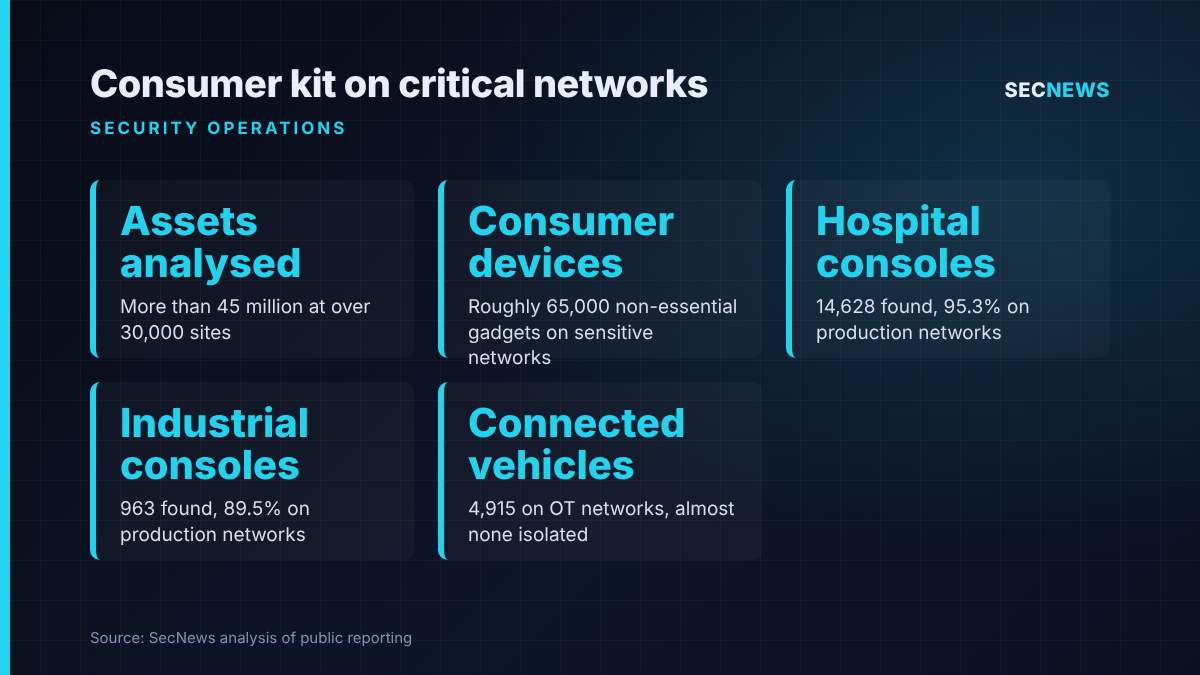
On 17 November 2026, operational technology (OT) security firm Claroty published research titled Game Over for Consumer Tech Risk in Critical Infrastructure. The study draws on telemetry covering more than 45 million assets at over 30,000 critical infrastructure sites, including hospitals, factories and commercial buildings. Across that estate, Claroty counted roughly 65,000 consumer devices with no obvious operational purpose sitting on networks that also carry programmable logic controllers (PLCs), patient monitors and building management systems.
The breakdown is striking: 16,745 games consoles, 44,059 smart home and entertainment gadgets (Roku sticks, Sonos speakers, smartwatches) and 4,915 connected vehicles, led by Tesla (3,425) and Ford (984).
Healthcare accounted for most of the consoles: 14,628 of them, concentrated in children’s hospitals where they have a genuine patient welfare role. The problem is placement rather than presence. Claroty says 13,939 of those hospital consoles (95.3%) were attached to production networks instead of a guest network, a dedicated IoT segment or a separate VLAN, and 691 were rated high risk. In industrial and commercial settings it found 963 consoles, 89.5% of them on production networks, where it is hard to imagine any business case at all.
The technical picture
None of this is a new vulnerability class. It is an exposure problem: unmanaged, internet-chatty devices placed one hop away from equipment where a compromise has physical consequences. Consumer kit is built for convenience, frequently talks to vendor cloud services outside the organisation’s control, and is patched on the manufacturer’s schedule rather than yours. Claroty notes six critical CVEs affecting the Tesla Model 3, including remote code execution and buffer overflow flaws, and 121 security issues linked to the Ford F-150. Almost none of the vehicles it observed had been isolated onto guest networks.
Cars are instructive. Vehicles fetch updates over Wi-Fi, so staff connect them to whatever network reaches the car park; if that SSID bridges into a flat internal network, a personal car sits alongside a production line. Streaming sticks and smartwatches were mostly on guest networks while consoles and cars were not, which points to inconsistent policy rather than missing guest Wi-Fi.
The attack path is conventional lateral movement: compromise a console, speaker or vehicle head unit, then probe outwards for PLCs, clinical kit and building controls, collecting credentials along the way. Claroty’s own summary is blunt: “the chaos is just one misconfigured VLAN away”. It cites recent attacks on European supermarket refrigeration controllers, where intruders triggered defrost cycles and spoiled stock, as a reminder of how fast an operational foothold becomes physical damage.
For monitoring, each device is also a blind spot: no endpoint agent, encrypted cloud traffic the SOC cannot inspect, and no entry in the CMDB. Any detection strategy that assumes every host on a production segment is known and managed breaks here.
Why it matters for UK organisations
Claroty’s dataset is global and does not break out UK figures, so it would be wrong to assume these exact proportions apply to British hospitals or plants. The patterns will still look familiar. NHS trusts run paediatric wards with consoles and smart TVs, estates teams operate ageing building management systems, and medical devices often share infrastructure with general hospital networks. Manufacturers face the same pressure from staff Wi-Fi, contractors and electric vehicles on site.
The regulatory context raises the stakes. Operators of essential services under the NIS Regulations are assessed against the NCSC’s Cyber Assessment Framework (CAF), and the NHS Data Security and Protection Toolkit now follows a CAF-aligned structure. CAF principle A3 expects all assets relevant to the essential function to be identified, inventoried and kept up to date, with dependencies between IT and OT understood. An unrecorded console on a clinical VLAN is hard to reconcile with that outcome. The Cyber Security and Resilience Bill, still before Parliament, is set to widen the range of organisations held to similar expectations.
Expert view
When we test hospital and industrial networks, the most useful findings are rarely exotic exploits. They are quiet routes: a guest device that can reach an engineering workstation, or an “IoT” VLAN with an any-any rule back into the core. Claroty’s numbers put scale on what testers see routinely.
I would resist the reflex to ban everything. Children in hospital need entertainment, and Claroty’s field CTO Sean Tufts makes the same point, arguing the goal is “closing off unnecessary pathways for malicious actors” rather than stripping out every television. The real failure is governance: nobody owns the decision about where these devices connect, so they end up wherever is most convenient for the person installing them.
In my experience, organisations that handle this well verify segmentation rather than assume it. Diagrams describe intent; only testing and passive traffic analysis show what is reachable. Bear in mind too that these figures come from a vendor selling asset discovery tooling. That does not make them wrong, but it is another reason to measure your own estate rather than extrapolate.
What to do now
- Find out what is really connected. Use passive network monitoring, switch and wireless controller tables, DHCP logs and NAC data to build an inventory of every device on OT, clinical and building networks. Flag consumer manufacturers (games console, streaming, speaker and vehicle vendors) for review. This maps directly to CAF A3 asset management.
- Give legitimate consumer devices a proper home. Place patient entertainment, meeting room screens and staff devices on dedicated guest or IoT segments with internet-only access and no route to production. Enforce this with firewall policy, not just separate VLANs.
- Close the car park gap. Ensure staff and visitor Wi-Fi reachable from parking areas is isolated from internal networks. Vehicles have no place on corporate SSIDs.
- Block unknown devices from production. Apply network access control or port security on OT and clinical segments so unrecognised MAC addresses or device types are denied or quarantined by default.
- Verify segmentation regularly. Test reachability from guest and IoT segments into OT zones as part of penetration testing and after any network change. Review firewall rules for broad permits between zones.
- Monitor for new and unusual devices. Alert your SOC when a previously unseen device type appears on a production segment, or when an IoT device starts scanning or talking to internal hosts. This supports CAF objective C on detection.
- Map to Cyber Essentials. Firewalls and secure configuration cover the boundary and segmentation rules; remember that bring-your-own devices accessing organisational services can fall within Cyber Essentials scope, so define and document where personal devices may connect.
Bottom line
Claroty has not found a clever new attack; it has found tens of thousands of everyday gadgets in places where a compromise can halt a production line or disrupt patient care. The fix is unglamorous but achievable: know your assets, segment by purpose, enforce it and keep checking. If you cannot say what is on your clinical or OT networks today, start there.
Sources
- Claroty: Game Over for Consumer Tech Risk in Critical Infrastructure
- Help Net Security: Game consoles and Teslas are slipping past OT network segmentation
- Facilities Dive: Consumer devices connected to work-related networks pose risk: Claroty
- IT Brief: Consumer gadgets found on critical infrastructure networks
- NCSC: Cyber Assessment Framework, Principle A3 Asset Management