Cisco and IBM will build Anthropic’s tightly controlled Claude Mythos vulnerability-hunting model into their commercial security products, so customers get its findings without ever touching the model itself. For UK buyers this marks the point at which frontier AI bug-finding starts to move from a gated research programme to a line item in existing vendor contracts.
What happened
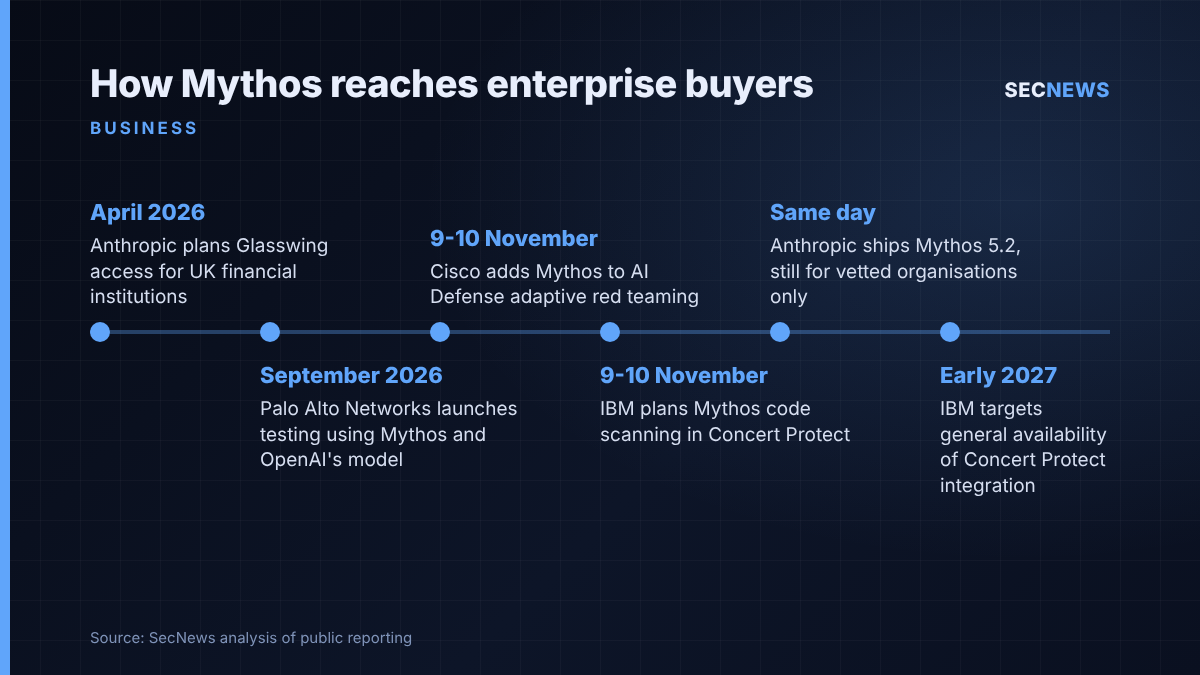
Of the two announcements, Cisco’s came first, at its Cisco Live APJC event in Melbourne on 10 November 2026 (still Monday 9 November in the UK). It said the adaptive red teaming engine in Cisco AI Defense will be able to draw on Claude Mythos, Anthropic’s restricted cyber reasoning model, to plan tests and generate attack ideas against a customer’s own systems. The feature is “coming soon” for a select group of enterprises, with no dates committed. According to The Register, Cisco will make it available under customers’ existing AI Defense licences at no additional cost.
IBM followed with a statement of intent to add Mythos to IBM Concert Protect, its exposure management product. Mythos would scan code repositories that the customer chooses, and its findings would feed into Concert Protect’s existing vulnerability workflow. IBM is aiming for general availability in early 2027, while cautioning that plans could change.
On the same day Anthropic shipped version 5.2 of Mythos and its sibling model Fable. The Register reports that Anthropic claims output up to 30% faster than 5.1 while cutting the price to $8 for each million input tokens and $40 for each million generated, with a “fast mode” at twice that. Mythos itself remains available only to vetted organisations.
The detail
The commercial structure matters more than the press release language. Until now, Anthropic has rationed Mythos through Project Glasswing and other controlled schemes, because a model that is unusually good at finding and reasoning about exploitable flaws is as useful to an attacker as to a defender. The Cisco and IBM deals keep that rationing in place at the model level but open a new sales channel: the customer buys a security product, and the product calls Mythos on their behalf.
Cisco has been explicit about the guardrails. Customers get no free-form prompt access. Each engagement has a fixed job and objectives set by a human, runs only against targets the customer has registered and is authorised to test, cannot reach out to arbitrary internet infrastructure, is cryptographically tied to a named operator, is logged for audit and can be halted at any time. Cisco describes product-level controls sitting alongside programme-level safeguards and monitoring.
IBM’s pitch is different and arguably closer to classic vulnerability management. Mythos would hunt for weaknesses that signature-based scanners miss, such as logic flaws and possible zero-days with no CVE record. Concert Protect’s “Proof of Exploitability” feature would then assess whether a viable attack path exists using code, configuration and infrastructure context, and Red Hat Lightwell would help produce fixes, including backported open-source patches, that developers review and approve through pull requests. IBM’s own framing is that the bottleneck has moved from discovery to triage and repair.
That framing is backed by Glasswing’s own record. The Next Web reports that the programme flagged more than 10,000 potentially serious flaws in its first month, of which only 97 had been patched by then. It also notes that Cisco and IBM are not alone: Palo Alto Networks began offering continuous testing in September that draws on both Mythos and OpenAI’s cyber model, and IBM joined OpenAI’s equivalent programme in June.
Why it matters for UK organisations
The UK has been close to the Mythos story from the start. The AI Security Institute had early access and reported that the model was a step up from previous frontier systems at simulating multi-step cyber attacks. Bank of England Governor Andrew Bailey called for regulators to assess the threat quickly, and in April Anthropic said it would extend Glasswing access to UK financial institutions. Most UK organisations, however, were never going to get onto a vetted access list.
Partner distribution changes that. A large share of UK enterprises, public bodies and managed service providers already buy from Cisco or IBM, which means Mythos-grade testing could arrive through a renewal conversation rather than a special application. Three consequences follow.
First, finding bugs in your own code is about to get much cheaper, while fixing them will not. Second, assurance teams will need to judge AI findings that may have no CVE identifier or public advisory to anchor them. Third, once defenders can buy this capability, organisations that decline it are accepting that well-resourced attackers with comparable tools may find their flaws first.
Expert view
In my experience, the hardest part of any penetration test is rarely the discovery. It is getting a client to fix what we find within a sensible window, and that remains true whether the finding comes from a consultant, a scanner or a frontier model. IBM is right to put exploitability validation and remediation at the centre of its offer. More findings without better prioritisation just means a bigger backlog.
The Cisco controls are sensible and reflect how responsible red teams already work: defined scope, named testers, an audit trail and a stop button. I would still want to see the rules of engagement written into the contract, not just the product documentation. Buyers should ask who at the vendor can see the findings, where test data and code are processed, and how long both are kept.
From a market perspective, this is Anthropic choosing to sell through incumbents rather than compete with them. That should reassure risk committees nervous about bolting an unfamiliar AI supplier into the estate, but it also means vendor concentration risk grows. If several of your security tools quietly depend on the same model, a change in its access terms, pricing or behaviour hits them all at once.
What to do now
- Map your exposure to the vendors involved. If you run Cisco AI Defense or IBM Concert, ask about eligibility, timelines, data handling and whether Mythos use is opt-in.
- Fix your remediation pipeline before you scale discovery. Under Cyber Essentials’ security update management control, high and critical fixes are expected within 14 days. Check whether your development and change processes can actually meet that for a sudden influx of new findings.
- Prepare to triage findings without CVEs. Agree how you will rate and track flaws with no public identifier, and who can accept residual risk.
- Treat AI red teaming as formal testing. Record scope and authorisation as you would for a commissioned penetration test.
- Tighten access control around the tools themselves. In line with Cyber Essentials user access control, restrict who can launch engagements, enforce MFA and review the audit logs.
- Record AI supplier dependency in your risk register. Note where several products rely on the same underlying model, and include it in third-party risk reviews.
Bottom line
Anthropic has found a way to commercialise Mythos without handing out the model, and Cisco and IBM have found a premium feature to sell into their existing customer base. For UK organisations the opportunity is real, but the value will be decided by remediation discipline, not by how many bugs a model can find.
Sources
- The Register: Anthropic’s super bug-finding Mythos model is going into Cisco and IBM products
- Cisco Newsroom: Cisco Unveils Frontier AI Red Teaming and Agent Observability to Secure the Agentic Enterprise
- Cisco Blogs: Cisco AI Defense to Add Anthropic’s Claude Mythos for AI Red Teaming
- IBM: IBM plans to bring Anthropic’s Claude Mythos cyber reasoning into IBM Concert
- The Next Web: Cisco adds Anthropic’s Claude Mythos to AI Defense for red teaming
- The Next Web: IBM plans to bring Anthropic’s Claude Mythos to enterprise customers
- The Paypers: Anthropic to extend Project Glasswing access to UK financial institutions