Rails has shipped security releases fixing 21 issues, led by a critical Active Storage flaw that lets an unauthenticated user write files on the server just by uploading an image. UK teams running Rails with ImageMagick should patch this week, check their image policies and, in some cases, rotate every secret the application can see.
What happened
On 4 November 2026 the Ruby on Rails core team released versions 8.1.4.1 and 8.0.5.2, describing them as security updates and urging everyone to upgrade as soon as possible. Maintainer Mike Dalessio’s announcement lists 21 advisories: one critical, four high and the rest medium or low.
The critical issue, tracked as GHSA-f3w6-w445-fwh9, sits in Active Storage, the Rails component that handles file attachments. Rails gives it a CVSS score of 9.8. According to the advisory, an attacker with no account at all may be able to write arbitrary files to a server running an affected application, and where attachments are stored using the Disk service, read any file the application process can read. That includes secret_key_base and stored credentials for other systems, which the advisory warns could lead on to remote code execution or lateral movement.
At the time of writing the flaw has no CVE identifier, and neither the advisory nor press coverage reports exploitation in the wild. The researcher RyotaK reported it via HackerOne. Rails received one attack chain and warns that others may exist.
There is also a deadline in the small print: security support for Rails 8.0 ends on 7 November 2026, and anything older than 8.0 is already unsupported and gets no fix.
The technical picture
The root of the problem is the way ImageMagick decides how to handle a file. It inspects the content and selects a “coder” to process it, and some coders do far more than decode pixels, acting on other files referenced from within the image. Active Storage placed no limits on which coders an uploaded file could reach, so the only safeguard was whatever ImageMagick security policy happened to be installed on the server.
Crucially, the vulnerable code path is Active Storage’s image analyser, which runs automatically when a file is attached. No thumbnail or preview is needed; accepting the upload is enough. The Hacker News, citing the fix commit, reports that the route ran through ImageMagick’s scripting coder, MSL, which can read and write files named in its script. For defenders, the key point is that this is pre-authentication, low complexity and needs no user interaction.
An application is exposed only when three conditions all hold:
- It uses ImageMagick for Active Storage, via the :mini_magick variant processor. That is the default for applications still on load_defaults 6.1 or earlier, which covers a lot of long-lived codebases.
- The server’s ImageMagick policy does not already block the relevant coders. Rails notes that the default policies shipped by Debian and Ubuntu do not.
- It accepts uploads from untrusted users, such as profile pictures, document uploads or support attachments.
The fixed releases bundle their own restrictive ImageMagick policy, blocking MSL, the Ghostscript coders and delegate, and file or remote references. It covers every ImageMagick command MiniMagick runs, and older mini_magick releases (before 5.1) will refuse to boot with it. A second, high-severity advisory (GHSA-v924-7rp8-4mxh, CVSS 8.8) fixed in the same releases lets an attacker influence which decoder ImageMagick or FFmpeg picks via the upload’s file extension.
Why it matters for UK organisations
Rails remains a common choice for UK start-ups, SaaS providers and digital agencies, and many of those applications carry old configuration defaults forward. An application still on the older :mini_magick default is a marker of exactly that kind of mature, rarely refactored estate. Pair it with an Ubuntu or Debian host and a public upload form and you have the full set.
The secret-reading element raises the stakes. If an attacker obtains secret_key_base, they can typically forge signed cookies and session data, and the stolen database or cloud storage credentials could open the door to personal data. For a UK organisation that turns a patching problem into a potential UK GDPR incident, with the 72-hour clock for reporting to the ICO if a breach is likely to put people’s rights at risk.
The end of 8.0 support also matters for supplier assurance: if you buy a Rails-based service, ask which release it runs.
Expert view
Image processing has been a recurring weak spot for as long as I have been testing web applications. ImageMagick’s breadth is precisely the problem: many coders were never designed for hostile input. When we test upload features, the question I always ask is not “does it accept images?” but “what does the server do with the file in the half-second after it arrives?” This flaw is a textbook answer: automatic metadata analysis, invisible to developers, reachable by anyone.
I would also caution against treating the upgrade as the end of the job. The shipped policy is additive, so a permissive rule already in the server’s policy.xml, including a wildcard allow, can override it. Applications that customise how MiniMagick launches commands, or that use GraphicsMagick, will not benefit from the new policy at all. And because the advisory offers no way to tell whether an application has already been targeted, any team using the Disk service should assume the worst for its secrets until proven otherwise.
Finally, framework lifecycle is a security control. Teams on unsupported Rails versions now depend on manual hardening rather than vendor fixes.
What to do now
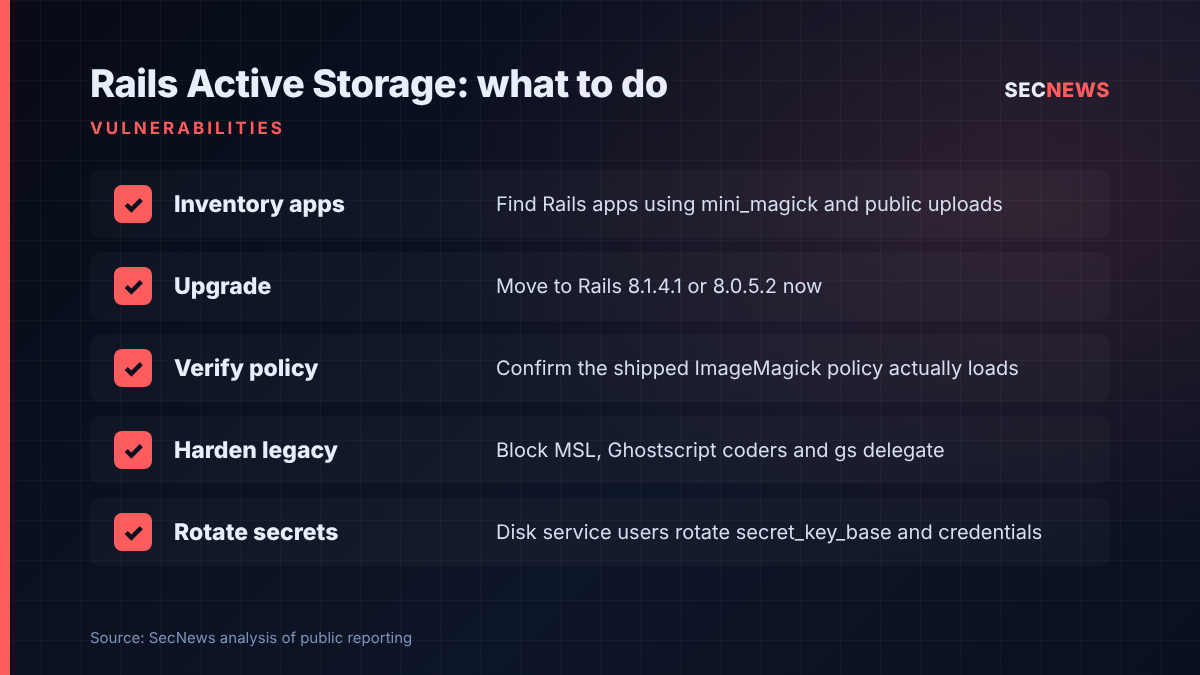
- Inventory. Identify every Rails application you run or buy, its version, its variant_processor setting (or load_defaults value if unset) and whether it takes uploads from the public.
- Patch. Upgrade Rails and mini_magick to the fixed releases. Under Cyber Essentials security update management, a CVSS 9.8 fix should be applied within 14 days; treat this as days, not weeks.
- Verify the policy. Use the check described in the Active Storage guide to confirm the new ImageMagick policy is loaded, and review the host’s own policy.xml for permissive or wildcard rules.
- Harden where you cannot upgrade. For applications on unsupported series, copy the shipped policy rules into the system ImageMagick policy, blocking at minimum MSL, the Ghostscript coders and the gs delegate. This aligns with the Cyber Essentials secure configuration control.
- Rotate secrets. If attachments use the Disk service, rotate secret_key_base, the master key, credentials, storage and database passwords and third-party tokens, and do not keep old values as fallbacks.
- Review logs and suppliers. Look for unusual uploads and unexpected files in writable paths, and ask Rails-based suppliers to confirm patch status.
- Do not ignore the other 20. The releases also fix a Strong Parameters bypass, session handling flaws, cross-site scripting and denial-of-service issues.
Bottom line
This is a pre-authentication, upload-triggered flaw in one of the most widely used web frameworks, and its trigger conditions match the configuration of many older UK applications. Nothing suggests exploitation yet, but with the fix commit public that may change quickly. Patch, confirm the ImageMagick policy actually applies, and rotate secrets if you store attachments on local disk.
Sources
- Ruby on Rails: Rails Versions 8.0.5.2 and 8.1.4.1 have been released
- GitHub: GHSA-f3w6-w445-fwh9, Possible arbitrary file write and read in Active Storage image analysis
- oss-security: Rails security releases 8.0.5.2 and 8.1.4.1
- The Hacker News: Critical Rails Flaw Lets Attackers Write Server Files via Crafted ImageMagick Uploads