Envelop, the cyber reinsurance and analytics specialist, has received final approval from Lloyd’s to turn its special purpose arrangement into a full syndicate from 1 January 2027. The move gives Envelop a bigger platform for its cyber reinsurance in London at a time when prices are falling, and it says something about where cyber insurance for UK businesses is heading.
What happened
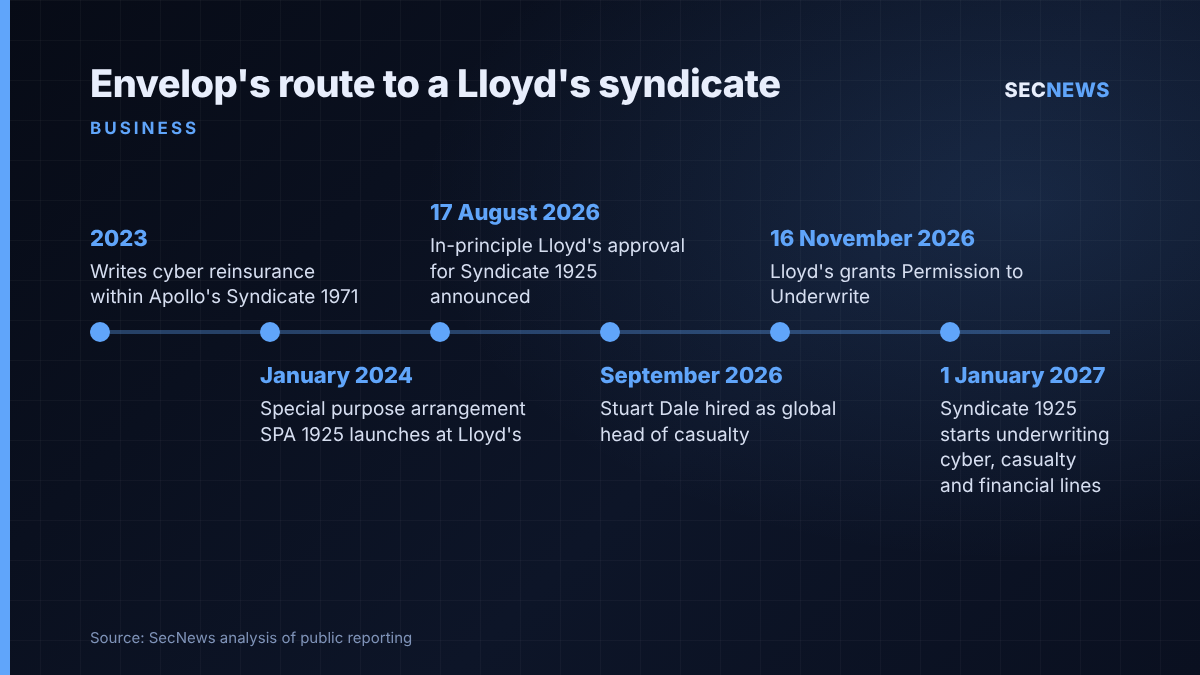
On 16 November 2026 Envelop announced that Lloyd’s had granted Permission to Underwrite to Envelop Syndicate 1925. This was the last regulatory step before the syndicate begins trading on 1 January 2027. It follows the in-principle approval Envelop announced on 17 August, when it said SPA 1925, its Special Purpose Arrangement, would be converted into a standalone syndicate.
Apollo Syndicate Management, part of the Nasdaq-listed Skyward Group, stays on as managing agent. In August its chief underwriting officer, James Slaughter, called the transition recognition of the SPA’s performance. Chris Baddeley, who has been active underwriter of SPA 1925, will hold the same role for the new syndicate. Insurance Business reports that he also becomes Envelop’s global head of cyber.
Cyber treaty reinsurance remains the core of the business. The bigger change is scope: the new syndicate will add treaty business in casualty and financial lines, which Envelop describes as casualty and specialty business in its own announcement. Baddeley said the approval “solidifies the strategy for Envelop within Lloyd’s for 2027”. Envelop Underwriting’s chief executive, Dominic Peters, said the combination of Envelop’s analytics and treaty expertise would encourage more innovative capacity partnerships.
The detail
The route Envelop has taken is a recognised one for specialists entering Lloyd’s. According to Insurance Business, Envelop started in 2023 by writing cyber reinsurance within Apollo’s Syndicate 1971, then launched SPA 1925 in January 2024. A special purpose arrangement reinsures part of a host syndicate’s book, a lower-cost way to build a track record before seeking a standalone syndicate, which brings more scale and flexibility.
Treaty reinsurance covers a whole portfolio of policies rather than single risks. When a UK insurer writes cyber cover for thousands of small and mid-sized businesses, it usually passes a large share of that risk to reinsurers like Envelop. The terms, price and capacity the insurer can buy then shape the premiums, limits and exclusions that end customers are offered. Envelop has built its brand on using data analytics and AI to model cyber risk, set prices and decide where to deploy capital. In August it credited those methods for the SPA’s results.
The timing of the diversification is telling. Insurance Business cites Gallagher Re’s cyber rate index, which showed a 32% risk-adjusted fall at the January 2026 renewals and similar falls in April, as surplus capacity kept pushing prices down. Moving into casualty and financial lines exposes Envelop to a different pricing cycle and makes it less reliant on one class while that class is under margin pressure. In September the firm hired Stuart Dale, a casualty treaty veteran, as global head of casualty.
Competition at Lloyd’s is also rising. Insurance Business reports that Lloyd’s logged more than 50 serious underwriting enquiries during 2025 and saw 13 new syndicates launch on 1 January 2026. Syndicate 1925 is entering a much busier market than the one SPA 1925 joined two years ago.
Why it matters for UK organisations
Most UK businesses will never deal directly with a reinsurer, yet reinsurance shapes the cyber cover they can buy. If there is plenty of reinsurance capacity and it is competing hard for business, primary insurers can offer bigger limits, lower premiums and lighter underwriting questions. If that capacity shrinks after heavy losses, the reverse happens quickly.
An expanded, specialist, analytics-led cyber reinsurer adds to the current buyer-friendly conditions, at least for now. It also shows a change in how risk is judged. Reinsurers that build their business on modelling don’t price portfolios just from what customers say in proposal forms. They want data, and that data increasingly includes outside-in views of an organisation’s internet-facing systems, its patching record and its reliance on shared technology suppliers. For UK policyholders, that means sharper questions that get checked more often.
The move into casualty and financial lines matters too. Cyber exposure doesn’t stay inside standalone cyber policies. It shows up in directors’ and officers’ cover, professional indemnity and other liability classes. A reinsurer that understands cyber and also writes those lines is well placed to spot overlaps, which should mean clearer wording over time.
Expert view
When we test organisations ahead of a cyber insurance renewal, the same gap keeps appearing: the answers on the proposal form describe the intended security state, not the real one. MFA is “enforced” except on a legacy VPN. Backups are “offline” except for the copy reachable from a domain admin account. In my experience, that gap is exactly what claims teams find after an incident, and it is where coverage arguments begin.
The growth of data-driven reinsurers like Envelop makes that gap harder to hide. As capital flows towards underwriters who measure risk instead of just asking about it, the advantage moves to organisations that can show their controls work. A soft market is a good time to lock in better terms, but cheap capacity doesn’t last forever. Cyber is still a young class with real accumulation risk, and an event that hits many policyholders at once could quickly change how reinsurers view their exposure.
Falling rates are good news for buyers today, but security leaders should treat them as a window to strengthen their position, not as a sign that insurers have stopped caring about controls.
What to do now
- Use the soft market to improve terms, not only to cut cost. At your next renewal, ask your broker about higher limits, shorter waiting periods and clearer wording on system failure and dependent business interruption, not just a lower premium.
- Make your proposal form evidence-based. Check every answer against what is really configured. Treat MFA coverage, patching timelines and backup isolation as facts you can prove, not policies on paper.
- Audit your external attack surface before the insurer does. Many underwriters now scan internet-facing systems. Find and close exposed management interfaces, unpatched edge devices and forgotten domains first. This maps directly to the Cyber Essentials firewall and secure configuration controls.
- Prioritise the controls underwriters weight most. MFA on all remote and privileged access (Cyber Essentials user access control), fast patching of critical and internet-facing flaws (security update management) and tested, isolated backups. Make sure you can show evidence for each.
- Map your supplier concentration. List the cloud, software and managed service providers your operations depend on, and check how your policy treats an outage or breach at each one.
Bottom line
Envelop’s Lloyd’s syndicate is a modest structural change with a clear signal behind it. Specialist, analytics-led capital is pushing deeper into the London market just as cyber reinsurance prices soften and providers look to diversify. For UK organisations, cyber cover is likely to stay affordable in the near term, but it will go to buyers who can prove their controls and not just describe them. Use the current conditions to get better terms and close the gaps underwriters are increasingly able to see.