Binance’s post-mortem shows the $6.3bn theft started months before 29 October, with a poisoned developer tool, a staged recruitment process and an internal AI assistant turned against its own engineers. Any UK firm that runs production systems from developer laptops will recognise the playbook.
What happened
We reported on 30 October that Binance had lost roughly $6.3bn from its hot wallet infrastructure. Over the weekend the FBI and US Secret Service attributed the theft to TraderTraitor, the North Korean operation associated with the Lazarus Group, and Pyongyang dismissed the claim as absurd. The new development is Binance’s own incident report, published on Tuesday 3 November, which sets out for the first time how the attackers got from a single engineer’s machine to the exchange’s wallet signing service.
The exchange is blunt about the scale of the operation. “It was not a single isolated breach or a simple phishing incident,” the report says, according to The Register. Chief executive Richard Teng described it as a months-long campaign rather than one mistake. Binance says it has disrupted 57 suspected North Korean attempts this year, with lures ranging from fake interviews to rigged browser extensions.
The technical picture
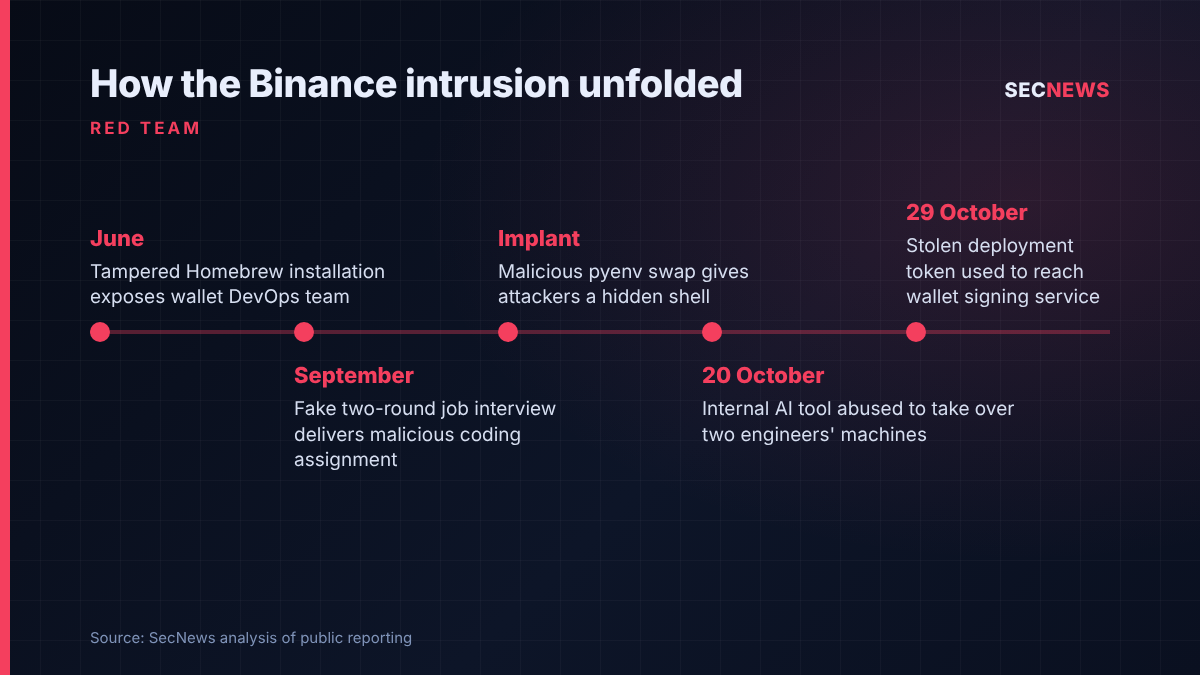
The patience between the four phases is the instructive part.
June: reconnaissance through a poisoned installer. An engineer on the Wallet DevOps team, referred to as Engineer A, went looking for an AI coding tool and ended up with a tampered Homebrew installation. Binance’s security team caught the malware, replaced the laptop and rotated the credentials. By then, though, the attackers had learned who Engineer A was and who worked alongside him on wallet infrastructure. The clean-up removed the implant but not the intelligence.
September: the fake interview. A second engineer was approached on a legitimate job-hunting platform by someone posing as a project director at a company that did not exist. BleepingComputer notes his profile mentioned his Binance experience. The first round was a video call with a fake HR representative, who shared a social media profile full of personal photos to appear genuine. Binance said this was more advanced than social engineering approaches it had previously seen. The second round, with a supposed chief executive, ran over a consumer chat app and ended with a request to download a coding “assignment” from a repository. Setting it up on his work computer ran malicious code.
The implant was quietly clever. According to Binance’s report, as quoted by BleepingComputer and The Register, it swapped the legitimate pyenv executable inside the macOS Homebrew directory for a malicious copy, altered its symlink and launched a shell that obeyed an attacker-controlled server. Endpoint protection did not flag it, and the attackers cleaned up traces as they went.
20 October: lateral movement through internal AI tooling. From the compromised laptop, the attackers turned an internal AI tool into a pivot, taking over two more machines: the machine used by Engineer A and that of a wallet software developer, Engineer C. On Engineer A’s computer they found a container deployment token.
29 October: execution. Working from Engineer C’s machine, the attackers used that token to deploy a container, ran a script and reached the internal wallet signing service, creating transactions that bypassed the normal withdrawal process. According to BleepingComputer, Ethereum’s EIP-7702 authorisation mechanism was also abused so theft could continue after withdrawals were suspended.
Why it matters for UK organisations
None of the reporting names a UK victim, but the methods are not specific to crypto. North Korean recruitment lures have been documented for years under names such as Contagious Interview and Operation Dream Job, and they target developers wherever they live. The UK has a large fintech and digital asset sector, many contract developers who routinely take technical tests from unfamiliar firms, and plenty of engineers holding standing production credentials on their laptops.
The internal AI tool is the detail I would put in front of any UK board. Many organisations have spent the past year wiring assistants into code repositories, ticketing and deployment pipelines, often with broad service permissions so the tool is useful. In this case an attacker on one laptop used that integration as a bridge to colleagues’ machines. An AI assistant with wide reach and weak per-user scoping becomes a lateral movement service you have built for your adversary.
There is also a lesson about incident closure. Binance did the textbook thing in June: detect, reimage, rotate. What it could not undo was the attacker’s knowledge of team structure, which shaped the September approach. Containment that ignores what was learned during an intrusion leaves the door half open.
Expert view
In my experience, the developer endpoint is the most under-tested part of most estates. When we run red team engagements, a developer laptop with package managers, cloud CLIs, cached tokens and SSH keys is often a faster route to production than any internet-facing service. Binance’s chain is that pattern executed by a state with time and money.
What stands out is the absence of a dramatic exploit: no firewall zero-day, no brute-forced VPN. The attackers used trust: in a package manager, in a recruiter, in a coding test and in an internal tool. Each step looked like ordinary work. That is why awareness training alone will not stop this. You need controls that assume a developer will eventually run something hostile, and limit what that one machine can reach.
The deployment token deserves attention too. A long-lived credential sitting on a laptop, able to push a container into an environment that can sign transactions, is a design decision rather than bad luck. Short-lived, approval-gated deployment credentials would have forced the attackers to beat a second person, not just a second device.
What to do now
- Hunt for tampered developer tooling. Check macOS and Linux developer machines for unexpected changes to binaries and symlinks under package manager directories, including Homebrew. This maps to Cyber Essentials malware protection and secure configuration.
- Kill standing deployment tokens. Move to short-lived, workload-bound credentials issued through your CI/CD system, with human approval for anything touching payment, signing or customer data paths. This is user access control in Cyber Essentials terms.
- Scope internal AI tools per user. Make assistants act with the invoking user’s permissions, not a broad service account, log every action they take on other hosts, and alert on cross-device activity.
- Treat technical tests as untrusted code. Give staff a disposable virtual machine or cloud sandbox for recruitment exercises and outside repositories, and make clear that work laptops are off limits for them.
- Separate signing from development. Keep high-value signing services reachable only from hardened administrative workstations, with multi-person approval and transaction limits.
- Close incidents properly. After any developer compromise, assume the attacker now knows your team map and raise monitoring on the colleagues around the victim.
Bottom line
The Binance post-mortem is a detailed public account of how a patient state actor turns one developer’s trust into access to the crown jewels. Most of the techniques were familiar; the patience and the abuse of internal AI tooling were not. UK organisations should read it as a red team report written at someone else’s expense and fix the same weak links before they are tested for real.
Sources
- The Register: North Korean fake job interview led to $6.3B Binance heist
- The Hacker News: Binance Reveals How Fake Job Interviews and AI Tool Abuse Led to $6.43 Billion Theft
- The Record: Binance CEO says ‘months-long campaign’ led to $6.3 billion theft as N. Korea denies responsibility
- The Record: FBI blames N. Korea’s TraderTraitor for Binance theft, urges crypto industry to block transactions
- BleepingComputer: Binance says fake job interview led to $6.3 billion crypto heist