Edinburgh-founded Quorum Cyber has closed its purchase of Zurich-based Ontinue, bringing together two managed security providers built almost entirely around Microsoft’s security stack. For UK customers of either firm, the services stay the same for now, but this is the right moment to look again at contracts, tenant access and how far automated response is allowed to go.
What happened
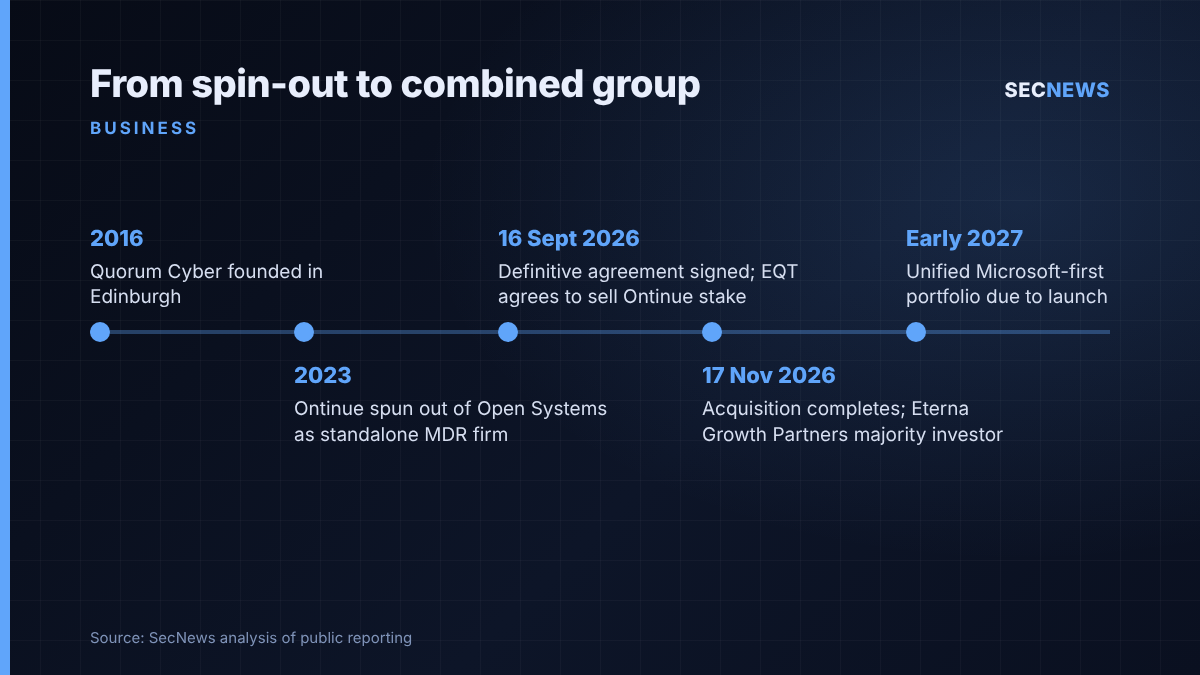
On 17 November 2026, Quorum Cyber said its takeover of Ontinue, an AI-driven managed detection and response specialist, had closed. That is roughly two months after the pair signed a definitive agreement on 16 September, which was subject to the usual closing conditions and approvals.
The price has not been made public. Eterna Growth Partners, a North American private equity house that focuses on mid-market technology and was already Quorum Cyber’s majority backer, now holds a majority stake in the combined group. Ontinue’s previous supporter, EQT, agreed in September to sell its holding. Mintz, Macfarlanes and Schellenberg Wittmer advised Quorum Cyber. Raymond James and Bär & Karrer acted for Ontinue.
Both brands will continue while the businesses integrate. The companies say they will launch a single, combined service portfolio in early 2027, and that their first priority until then is keeping current customers’ service unchanged. Kevin Hanes, Quorum Cyber’s chief executive, described the deal in the press release as follows: “While this transaction is an acquisition, our mindset is that of a merger.”
The detail
Quorum Cyber was set up in Edinburgh in 2016 and has become one of the UK’s better-known Microsoft-centric security service providers. It holds Microsoft Solutions Partner for Security status and every Microsoft Security specialisation, belongs to MISA, the Microsoft Intelligent Security Association, and won Microsoft’s 2025 Security MSSP of the Year award. Startupticker’s report on the September agreement put its customer base at more than 400 organisations.
According to Startupticker, Ontinue started out as the managed detection and response arm of Swiss network security company Open Systems and became a separate business in 2023. EQT Mid Market Europe backed it from an early stage. Startupticker’s September report also says Ontinue has over 250 customers, spanning enterprises, NGOs and institutions in the US and Europe, has made three bolt-on acquisitions and runs its service on a proprietary platform called ION.
The technical idea behind the combination is what both companies call an agentic SOC. In the September announcement, Ontinue’s model was described as AI agents that investigate alerts, make decisions and act at machine speed, within limits each customer sets. Ontinue chief executive Moritz Mann stressed at closing that people keep responsibility for the critical judgements. Quorum Cyber adds threat intelligence, incident response, cyber resilience work and professional services.
When the deal was signed, the planned portfolio named Microsoft Sentinel, Defender XDR, Entra, Purview, Azure, Microsoft 365 Copilot and Security Copilot. The group is aiming at the UK, North America and the German-speaking DACH markets.
Why it matters for UK organisations
This is a homegrown Scottish security business making a cross-border acquisition rather than being bought itself. That is notable at a time when much UK cyber M&A goes the other way. It also adds to the consolidation of the managed security market around a small number of large platforms, Microsoft above all.
For buyers there are three consequences. First, organisations standardised on Microsoft E5 security tooling gain a larger specialist provider in the UK. Second, procurement and risk teams should treat the deal as a change of ownership for a supplier with privileged access to their environment. That access normally covers delegated admin rights in Entra, response permissions in Defender and the ability to query security logs. Third, integrating two SOCs is never invisible. Tooling, escalation routes and detection content all have to be merged.
Data location matters too. Under UK GDPR, any processing of security telemetry by teams in Switzerland, the EU or North America has to be covered by your contract and data processing agreement, not just by marketing statements.
Expert view
In my experience, managed security mergers rarely hurt customers on the day they close. Problems tend to appear six to twelve months later, when platforms are combined, runbooks are rewritten and experienced analysts move on. Running two brands until early 2027 is a sensible way to manage that, but it also means customers are effectively waiting for a portfolio that has not been published yet.
I am cautiously positive about the agentic SOC model. It makes sense to automate triage and routine containment for well-understood alert types, especially given how quickly attackers now move. However, when we test environments run by managed providers, the weak points are usually the trust relationships rather than the detections: standing global admin rights, partner accounts excluded from conditional access, and automation identities with far more privilege than they need. An AI agent that can isolate hosts or disable accounts is a valuable control, and it is also a high-value target. The guardrails each customer sets need to be written down, reviewed and tested, not simply accepted as defaults.
I would also point out the concentration risk. Choosing a Microsoft-first provider means your detection, your response and the platform being defended all depend on one vendor’s ecosystem. That can be a reasonable choice, but make it deliberately, with fallback arrangements for days when that ecosystem is degraded.
What to do now
- Review supplier access (Cyber Essentials: user access control). List every account, granular delegated admin relationship and service principal that Quorum Cyber or Ontinue holds in your tenant. Remove standing privilege wherever just-in-time access will do, and make sure partner accounts are not excluded from conditional access or MFA.
- Read the contract for change-of-control terms. Check assignment clauses, subprocessor lists and data processing agreements, and ask in writing where your telemetry will be stored and which entities and countries will have access to it once integration starts.
- Write down automated response guardrails (Cyber Essentials: secure configuration). Agree which actions the provider’s automation can take on its own, which need human approval, and which assets are excluded, such as domain controllers, OT gateways or executive accounts.
- Ask for an integration roadmap. Request dates for any platform, portal, SLA or escalation changes ahead of the early 2027 portfolio launch, and a named contact for each.
- Test the service. Run a purple team exercise or tabletop over the next two quarters to confirm that detections, escalation calls and incident response retainers still work as contracted.
- Plan for a bad Microsoft day. Make sure you have an out-of-band way to contact your MSSP and to coordinate incident response that does not rely on Teams or Exchange Online.
Bottom line
Quorum Cyber’s completed acquisition of Ontinue creates a larger, Edinburgh-rooted, Microsoft-focused managed security group built around AI-assisted security operations. Customers should not expect disruption this quarter. The real test is the unified portfolio due in early 2027, and the sensible move now is to tighten supplier access, contract terms and automation guardrails before integration starts in earnest.
Sources
- PR Newswire: Quorum Cyber Completes Acquisition of Ontinue, Advancing Its Vision for Microsoft-First Autonomous Cyber Defense
- Unite.AI: Quorum Cyber Closes Ontinue Acquisition to Expand Agentic AI Defense
- Securities.io: Quorum Cyber Closes Ontinue Acquisition as Integration Begins
- Startupticker: EQT sells Ontinue stake to Scottish cybersecurity company
- High Growth Scotland: Edinburgh’s Quorum Cyber agrees to acquire Ontinue