The FBI has published a formal advisory on ARTEX, the open-source AI agent framework that criminals and state-backed crews have turned into an automated intrusion engine. On the same day, Amazon released honeypot data showing what those agents were actually told to do, giving defenders a rare look at the operators’ own instructions.
What happened
On Friday 13 November 2026 the FBI issued FLASH-20261113-001, a TLP:CLEAR alert describing how threat actors are using ARTEX to run intrusions with very little human effort. The framework, written in Go, links specialised AI agents to commercial or self-hosted large language models and lets them work through an attack chain from scanning to data theft. According to the FBI, some intrusions have gone from first contact to privileged access in under three hours, and low-skilled operators can run several campaigns in parallel.
The developer pulled the original GitHub repository in October, but the Bureau says forks, archived copies and a paid edition called ARTEX PRO are still in circulation. The Record noted that the alert lists finance, government, defence, energy, healthcare and legal among targeted sectors.
The same day, Amazon’s threat intelligence team published findings from MadPot, its network of decoy sensors. Sensors posing as LLM inference APIs captured ARTEX requests carrying the agents’ own campaign records. Amazon assesses with moderate confidence that ARTEX was used, and links the activity to several separate China-nexus groups.
ARTEX is not new to readers. Censys counted roughly 1,465 exposed ARTEX consoles in early November, and the framework has been linked to attacks on Asian banks and to the ConnectWise Cloud Backup supply chain compromise. What is new is an official advisory with mapped techniques, indicators and a detailed list of defensive actions.
The technical picture
The FBI maps observed behaviour to MITRE ATT&CK, and very little of it is exotic. Initial access mostly comes from ordinary web application weaknesses: injection flaws, server-side request forgery, insecure direct object references, template injection and endpoints that simply lack authentication.
Once inside, the agents follow a familiar Active Directory and cloud playbook. They plant web shells, abuse Kudu/SCM deployment APIs on Azure App Service, add credentials to OAuth applications and install open-source remote access tools such as vshell and AdaptixC2. To escalate they use Kerberoasting, DCSync and credential dumping from SQL. They move laterally with pass-the-hash, pass-the-ticket, WinRM and Kerberos relay, then exfiltrate through webhooks, residential proxies and tunnelling utilities such as Chisel. Alongside IP addresses, the alert names one domain, the LLM API reseller xcai[.]pro. It also describes network patterns worth watching: outbound calls to model APIs, and bursts of fast sequential requests against portals.
Amazon’s data adds the operators’ side of the picture. In one campaign the agents hunted for AI credentials at scale. They targeted exposed LLM gateways such as LiteLLM and One API derivatives, and AI app builders including Langflow, Dify, RAGFlow and Ollama. They used default admin keys, unfinished installations that nobody had claimed, and known flaws such as CVE-2025-3248 in Langflow and CVE-2026-28797 in RAGFlow. A second campaign tried to pass crypto exchange identity checks using live deepfake video. Amazon says the liveness vendor’s server rejected every recorded attempt.
Two details from the AWS write-up matter for detection. First, the operators told the agents to route all traffic through proxies, so the source IP alone tells you little. Second, the agents were told to prefer enterprise production systems, so this is not just noise aimed at hobby servers.
Why it matters for UK organisations
Neither the FBI nor Amazon names British victims, and Censys did not list the UK among the main console-hosting countries. That should not reassure anyone. ARTEX agents attack whatever they can reach, and the exposures they look for are as common in UK estates as anywhere else: forgotten partner portals, legacy line-of-business apps, open management interfaces and AI tooling that a development team set up quickly.
The advisory lines up closely with the NCSC’s State of the Cyber Nation report from 3 November. That report warned that AI is highly likely to make exploitation of old weaknesses faster and larger in scale within two years. NCSC chief executive Richard Horne said: “For decades, we have collectively got away with doing tech on the cheap.” ARTEX is a working example of that warning. It does not need novel exploits, because it gets through neglected basics at speed.
There is a quieter cost too: a stolen LLM API key means you pay for the attacker’s compute.
Expert view
In my experience, the findings in this alert are the same ones we write up on almost every external test: verbose error pages, an admin panel reachable from the internet, a portal that hands back any record you ask for if you change an ID. The difference is that a person testing by hand gets bored and moves on. An agent does not. It can try every variation, on every exposed host, and chain the results while your on-call analyst is still reading the first alert.
That changes what good detection looks like. Signature matching on a handful of IP addresses will not keep up with a tool that rotates through residential proxies. The signals that last are behavioural. Look for a single session pulling records in strict sequence, a service principal suddenly gaining a new secret, a deployment API being used outside a release window, or a server that has never talked to an LLM provider starting to do so.
The FBI’s evidence advice is also worth stressing. Responders often want to delete suspicious applications immediately. The Bureau explicitly warns against deleting enterprise apps as a first move, and says to keep Entra, Purview and SIEM records before removing anything. I agree with it. You cannot scope what you have destroyed.
What to do now
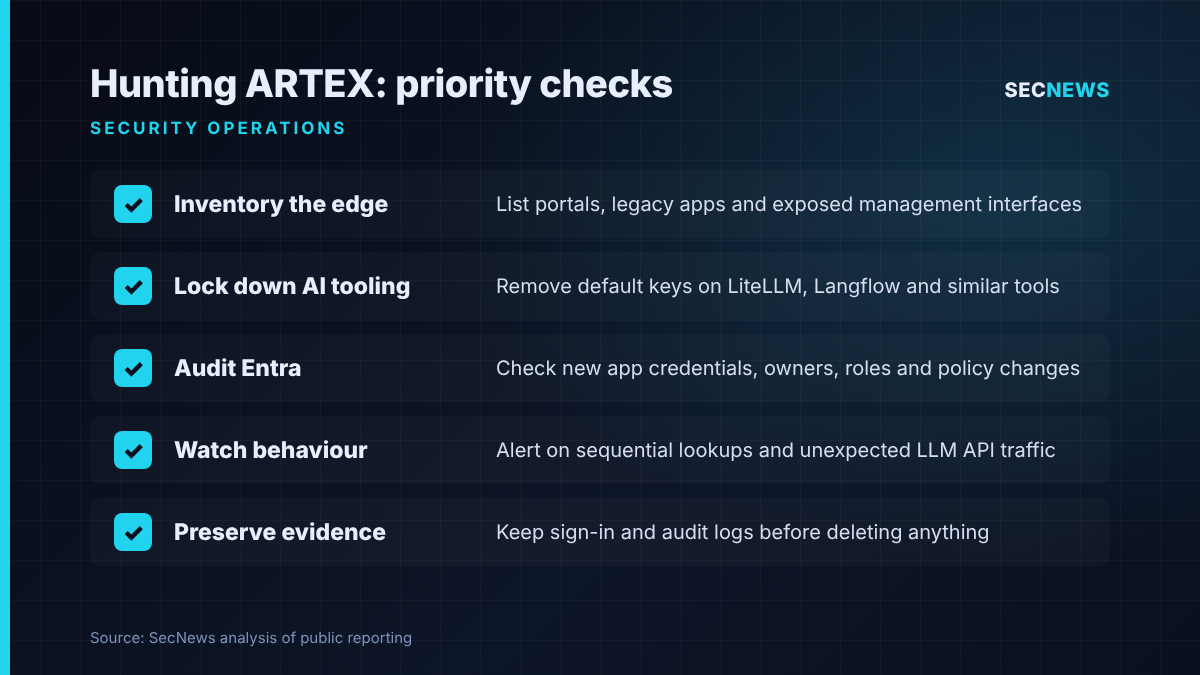
- Inventory your edge. List every internet-facing application, including supplier portals, mobile back ends and legacy services. Restrict cloud admin, Kudu/SCM, hypervisor and backup consoles to trusted networks. This is Cyber Essentials firewall and secure configuration in practice.
- Lock down AI infrastructure. Find any LiteLLM, Langflow, Dify, Ollama or similar instances, remove default keys, require authentication and patch the CVEs Amazon cites. Treat them as production systems.
- Hunt in identity logs. Review Entra for new credentials on applications, new owners, role assignments and Conditional Access changes. Check service-principal sign-ins from unexpected locations. This maps to Cyber Essentials user access control.
- Add behavioural detections. Rate-limit high-impact APIs and alert on sequential record lookups. Flag outbound connections to LLM endpoints or resellers from hosts with no reason to make them, and watch for unexplained AI spend.
- Scrub secrets. Scan repositories, pipelines, container images and client-side JavaScript for keys, and rotate anything exposed.
- Prepare the response. Make sure log retention covers sign-in and audit data, and write evidence preservation into your playbook before containment steps.
Bottom line
The FBI alert and Amazon’s honeypot data confirm that AI-driven intrusion is now an operational fact rather than a forecast. ARTEX succeeds through speed, not cleverness, and it exploits the gaps UK organisations already know they have. Close the exposed interfaces, watch identity and API behaviour rather than IP lists, and keep your evidence before you clean up.
Sources
- FBI: FLASH-20261113-001, Threat Overview of the ARTEX Autonomous Penetration Testing Framework
- AWS Security Blog: Amazon threat intelligence observes threat actors running cybercrime campaigns with ARTEX AI agents
- The Record: FBI flash alert says Artex tool automating cyberattacks at ‘machine speed’
- Censys: ARTEX exposure research
- NCSC: Cyber chief: UK facing AI-powered attacks on critical infrastructure within two years