A newly advertised criminal marketplace uses AI to write a short profile of every infected computer it sells, so buyers can type what kind of victim they want rather than trawl raw stealer logs. Researchers have matched some of its stock to real infections, and the example search on show was for Citrix access to a healthcare provider.
What happened
On 15 November 2026, Hudson Rock’s research arm, Infostealers, published an analysis of an underground shop for infostealer logs. The shop was promoted in a cybercrime forum post dated 14 November. The marketplace is not named in the reporting. Its selling point is that each stolen machine comes with a written summary of who appears to use it, where they seem to work, what software is installed and what valuable data the log holds. Buyers can search those summaries in natural language and narrow results with conventional filters.
The seller’s advert boasts an inventory running to tens of millions of logs and more than a billion accounts, every log analysed by AI, with entry prices of $0.25. Hudson Rock stresses that none of this has been independently verified. The screenshots do, however, show a working interface and a cryptocurrency deposit page.
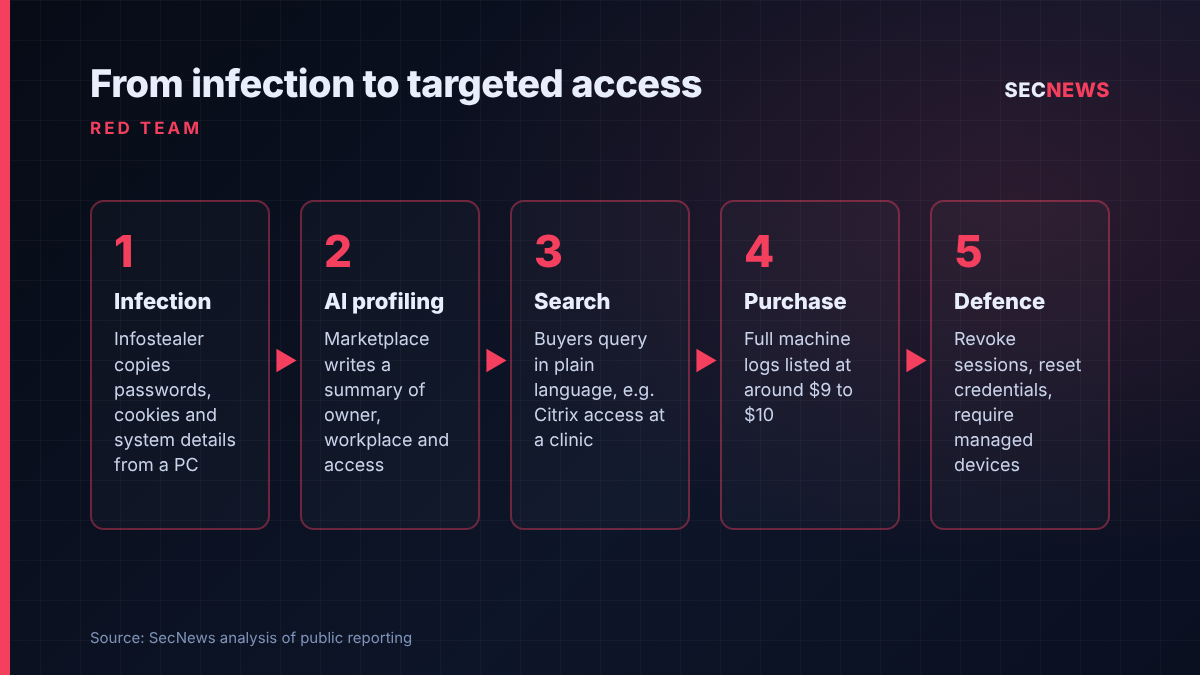
The clearest example was a search for “citrix access to healthcare provider”, which surfaced a $10 item named “The Ophthalmology Clinic Front Desk Dump”. It described a Canadian clinic workstation holding Citrix VPN credentials alongside billing and medical software activity. Other listings described a defence-industry contractor’s home computer priced at $9, a household PC said to belong to a US government worker in Washington, D.C., and a New Delhi machine whose seller claimed it held live Anthropic Claude API session tokens. Hudson Rock could not confirm that last claim.
The technical picture
Infostealer malware copies saved passwords, cookies, autofill data and system details from an infected host and bundles them as a “log”. Logs have traded in bulk for years; the hard part for buyers has always been triage, finding the few dumps that lead somewhere worth going.
This service moves that triage into the shop window. A language model appears to read each log and summarise it, and the summary becomes searchable. Conventional filters sit alongside the AI search, covering location down to city and postcode, ISP, malware family, operating system, seller and price, with further tabs for domain, email, cookie and file lookups. Each listing also carries tags and a score whose method is never explained.
Hudson Rock tested whether the descriptions bear any relation to reality. In the clinic listing’s file preview it spotted a distinctive Firefox profile identifier. The same identifier appeared in a record already held in Hudson Rock’s Cavalier database, where the machine was labelled “Reception”. The redacted password entries in that record included Citrix-related login addresses, and other artefacts showed billing usernames. Hudson Rock’s own analysis agent, Enki, separately concluded that the PC served a reception desk. So at least one listing matches a real infection, and the evidence supports parts of its AI summary.
The researchers are careful about limits: saved credentials do not prove a login still works, and a shared PC may hold traces of several people. Entries linked to uber.com and fbi.gov in the account catalogue show only that the seller holds credentials tied to those domains, not that either organisation was breached.
Why it matters for UK organisations
Nothing in the published screenshots names a UK victim. That should not reassure anyone. The search filters include country, and the service is built to answer exactly the questions an initial access broker or ransomware affiliate asks: which machines can reach a corporate VPN, a virtual desktop gateway or a cloud tenant, and in which sector.
The UK has plenty of what this market sells. Citrix gateways, remote access VPNs and SSO portals front many NHS trusts, local authorities, law firms, universities and managed service providers. Many of those estates still allow access from personal or unmanaged devices. The listings in this report make the point well: a defence contractor’s household PC and a government employee’s family computer are exactly the endpoints a corporate EDR never sees, yet they may hold saved work credentials or valid session cookies.
Session cookies matter most. A stolen cookie for an SSO or SaaS session can let an attacker skip the password and the MFA prompt entirely until the session expires or is revoked. MFA alone does not close this gap.
Expert view
Searchable markets are not new. The US Department of Justice described Genesis Market in 2023 as letting buyers search by location and account type. What changes here is the quality of the search. Filtering by country gives you a pile of logs. Asking for “Citrix access at a clinic” gives you a target. When we scope red team engagements, the slowest phase is usually reconnaissance: working out who has access to what. Doing that sorting for around $10 a machine lowers the skill needed to turn a commodity infection into an intrusion.
I would treat the inventory claims as marketing; asking prices are not completed sales. The verified clinic match is what matters, because it shows the summaries come from real logs and can be at least partly accurate.
In my experience, the organisations that struggle with stealer-led intrusions are not the ones without MFA. They are the ones that cannot answer a basic question quickly: if this person’s home PC was compromised last month, which of our sessions, tokens and saved credentials were on it, and have we revoked them? Most of the work is identity hygiene.
What to do now
- Restrict remote access to managed devices. Require device compliance or certificate-based checks before Citrix, VPN or SSO sessions are granted. This maps to the Cyber Essentials secure configuration and user access control themes, and reduces the value of logs taken from personal machines.
- Shorten and bind sessions. Cut session lifetimes for remote access and admin portals, and use token protection or conditional access features that tie sessions to a device where your identity provider supports them.
- Build a revocation playbook. When an infostealer infection is confirmed, reset credentials from a clean device and revoke every active session and refresh token for that user, not just the password. Hudson Rock’s own guidance follows the same sequence: scope, contain, then check for abuse.
- Monitor for your domains in stealer data. Use a reputable threat intelligence feed to spot employee and supplier credentials tied to your domains, and treat hits as incidents rather than curiosities.
- Hunt for odd sessions. Review sign-in logs for sessions from unfamiliar infrastructure or impossible travel, especially on gateway and SSO platforms, and test how quickly your team can kill a hijacked session.
Bottom line
This marketplace does not introduce a new exploit. It makes stolen data easier to search, and that matters just as much. With AI turning anonymous stealer logs into searchable victim profiles, the gap between a home PC infection and a targeted intrusion into a UK organisation’s Citrix or SSO estate gets smaller. Defenders should assume their staff and suppliers are already listed somewhere, and make sure a stolen password or cookie stops working quickly.
Sources
- Infostealers (Hudson Rock): Inside the AI-powered marketplace turning infected computers into searchable profiles
- Cyber Security News: Hackers Use AI-Powered Marketplace to Find Infected Computers With Corporate VPN and Cloud Access
- GBHackers: Hackers Can Search Compromised Computers by Job Title and Company in New AI-Powered Marketplace