Anthropic will publish details of serious flaws it reports to vendors 30 days after notification, a third of the industry’s customary 90-day window. Every software supplier and open-source project in the UK that could receive one of its reports should check whether its intake and patching processes can keep up.
What happened
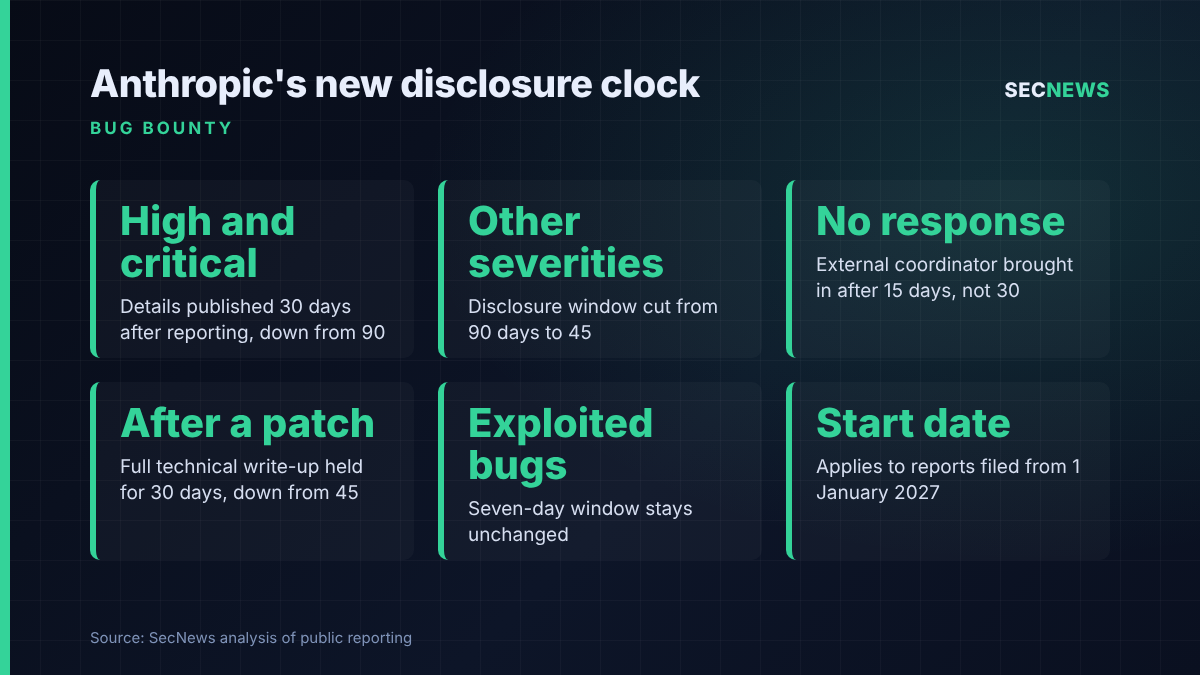
On 16 November 2026, Anthropic’s Frontier Red Team published a revised coordinated vulnerability disclosure (CVD) policy that sharply shortens the time vendors get before bug details go public. For high and critical severity issues, the window falls from 90 days to 30. Lower-severity bugs get 45 days. The shorter clocks start with reports filed from 1 January 2027; cases already open by then keep their original dates.
Two smaller changes come with it. If a maintainer does not acknowledge a report, Anthropic now intends to bring in an external vulnerability coordinator after 15 days rather than 30. Once a fix ships, it will hold back full technical write-ups for 30 days, down from 45. The seven-day window for bugs already being exploited in the wild stays as it is.
There is also a backlog clean-up. Some high and critical reports were filed more than 90 days ago, are past their current deadline and have still not been made public. Anthropic says it is contacting the maintainers of those projects to give them a final 30 days. After that, the reports will appear on its public disclosure dashboard.
The detail
Anthropic’s reasoning is simple. Disclosure norms, including its own, were written for a world where fixes moved at human pace and two people rarely found the same bug independently. The company says neither is true any more. Models can help write patches, and the odds of a second model independently landing on the same flaw keep rising. Anthropic says rediscovery rates are already climbing. If a bug can no longer be assumed to stay private for three months, a three-month embargo offers users far less protection than it once did.
The scale of what Anthropic is reporting makes this more than a policy footnote. Its dashboard snapshot of 2 November covers the previous twelve months. Over that period it lists 5,087 vulnerabilities reported across 680 open-source projects. Maintainers had acknowledged 3,635 of them, but only 629 were recorded as fixed upstream. The gap between reported and fixed is exactly the pressure a shorter clock will expose.
The policy has carve-outs. Flaws in software that is hard to deploy, with critical infrastructure given as the example, and flaws that need a change to a specification or RFC will get remediation timelines agreed with the vendor. The new rules do not apply to AI-generated findings that no human has reviewed, such as output from Anthropic’s OSS Scanner service. Anthropic says reports will keep including practical guidance and, where possible, a patch, and it will agree a manageable pace before sending any project a large batch.
Anthropic is not acting alone. Earlier this month Google Project Zero dropped its “90 + 30” approach and set a stepped path down to a 30-day deadline by January 2028. Anthropic’s move gets to 30 days for serious bugs a year sooner.
Why it matters for UK organisations
Most UK organisations will never receive a report from Anthropic directly. Their suppliers will, and so will the open-source components buried in almost every product they run. When a dependency’s 30-day clock expires, technical details become public whether or not your vendor has shipped an update. The time between “advisory published” and “attack attempted” can already be a matter of hours for some products.
For UK software vendors, this links directly to the government’s Software Security Code of Practice, which expects suppliers to run a vulnerability disclosure process and fix issues promptly. A VDP that takes a fortnight to triage a report, then another month to schedule a fix into a release train, will now regularly miss deadlines set by an outside party. Missing them in public is a reputational problem, and possibly a contractual one.
Public sector bodies and firms that run their own VDPs, often modelled on the NCSC’s vulnerability disclosure toolkit, should expect a knock-on effect. As large research teams move to shorter windows, independent researchers and bug bounty hunters will cite them as the new normal. Arguing for 90 days will be harder when the biggest finders are moving away from it.
Expert view
I have spent a lot of my career on the receiving end of disclosure emails, both as a tester reporting issues and as an adviser helping clients handle them. The honest truth is that 90 days was rarely spent fixing. Much of it went on finding an owner, reproducing the bug, debating severity and waiting for a release. A 30-day deadline does not leave room for that drift, and I think that is the point.
The rediscovery argument is the one that should worry defenders. In my experience, the comfort of an embargo always rested on the idea that the reporter was the only person who knew. When several groups with similar tools are pointing them at the same popular codebases, that assumption breaks. A private bug that a model found last month is plausibly in someone else’s hands this month.
There is a fair concern for small open-source projects. A volunteer maintainer handed a dozen critical reports with a 30-day deadline is under real strain. Anthropic’s promises to include patches and pace large batches matter here. The industry should hold it to them and watch whether the escalation-to-coordinator step actually helps or just moves the problem.
What to do now
- Measure your real fix time. Pull the dates for your last ten externally reported vulnerabilities and work out how long each took from receipt to a released fix. If the median is over 30 days for high and critical issues, start there.
- Tighten intake. Make sure your security.txt file and VDP contact actually reach someone who can act within days, not weeks. Set an internal target to acknowledge reports within a few working days, well inside the new 15-day escalation trigger.
- Map your open-source exposure. Keep an up-to-date software bill of materials so that, when an advisory for a dependency goes public, you know within hours whether you ship or run it.
- Shorten patch cycles for critical flaws. This maps to the Cyber Essentials security update management control, which already expects critical and high-risk updates within 14 days of release. Treat that as a ceiling, not a target, for internet-facing systems.
- Press your suppliers. Ask key vendors how they will meet 30-day external deadlines and how quickly they will notify you when one of their components is affected.
- Plan for exceptions early. If you run operational technology or other hard-to-patch systems, agree with suppliers now how extended remediation timelines will be requested and documented.
Bottom line
Anthropic’s 30-day window is a sign that the economics of finding bugs have changed faster than the processes for fixing them. Google is moving the same way on a slower schedule, and others are likely to follow. UK organisations that still treat 90 days as breathing space should assume that time has gone, and fix their intake, inventory and patching before January.
Sources
- Anthropic: Responding to AI-enabled vulnerability discovery
- Help Net Security: Anthropic vulnerability disclosure deadline drops to 30 days for serious bugs
- Anthropic Frontier Red Team: Coordinated vulnerability disclosure dashboard
- Google Project Zero: Policy and Disclosure: 2026 Edition
- Help Net Security: Google Project Zero will disclose bugs after 90 days, fixed or not