The nginx project and F5 have fixed five serious memory flaws, collectively branded NGINX2Root, the worst of which, researchers say, lets an unauthenticated attacker run code on unpatched servers with HTTP/2 enabled. Researchers have also chained it with an unpatched Linux kernel bug to take over the underlying host, so UK teams running nginx should patch and restart now rather than wait for the next maintenance window.
What happened
On 18 November 2026 the nginx project published nginx 1.31.9 (mainline) and nginx 1.30.7 (stable), and F5 issued matching updates for NGINX Plus. The headline issue, CVE-2026-123007, is a memory corruption bug in HTTP/2 flow control that the nginx security advisories page lists as affecting every release from 1.9.5 to 1.31.8. That code path has been in the product since 2015.
Security start-up Xint, which named the set NGINX2Root, says it reported the bugs to F5 through HackerOne in mid-October. Wiz Research says several teams, including its own, Rapid7 and Xint, found the same HTTP/2 problems independently. Earlier write-ups from Xint and Luxembourg’s CERT, CIRCL, described the open source release as scheduled for 19 November (Xint’s timeline uses Korean time), but the nginx.org news page and changelog show both fixed versions shipping on 18 November.
Nobody has yet reported attacks in the wild. However, SecurityOnline reports that a Rapid7 researcher has put a proof of concept for CVE-2026-123007 on GitHub, and Wiz says it built working lab exploits of its own that it is holding back. The nginx project fixed an unrelated set of flaws in mid-October; this round is more serious.
The technical picture
NGINX2Root covers five distinct CVEs, each a separate route in, so turning off one feature does not close them all.
- CVE-2026-123007: an arithmetic error in HTTP/2 flow-control accounting that leads to an invalid memory copy. Wiz says it achieved code execution on a server doing nothing more exotic than serving static files over HTTPS, with no backend and no third-party modules.
- CVE-2026-123633: a use-after-free in HTTP/2 when nginx is proxying to a backend and runs short of worker connections.
- CVE-2026-121810: a comparable use-after-free in HTTP/3 (QUIC) proxying.
- CVE-2026-123634: a use-after-free in the DNS resolver, reachable where upstream names are built from the request and subrequests such as mirror are in use.
- CVE-2026-113425: memory reuse after release in the authentication code of the mail proxy.
Successful exploitation gives the attacker the privileges of an nginx worker process, not root. Xint closed that gap by pairing the HTTP/2 bug with a previously unknown use-after-free in the Linux kernel’s SCTP networking code, a flaw it says dates back to kernel 4.15 in 2018. In its testing the chain reached root on the host even when nginx was running inside a Docker container. CIRCL noted that the kernel bug had no CVE identifier on 18 November, and Xint is withholding most of the detail until a kernel fix exists.
Two further points stand out. First, Wiz and CIRCL both say ASLR does not save you, because the published techniques include ways round it. Second, the 1.31.9 changelog lists ten security fixes in total, including a TLS 1.3 request-body infinite loop (CVE-2026-118899) and a stream module certificate verification issue, so this is a broad hardening release rather than a single fix.
Why it matters for UK organisations
nginx sits in front of a huge proportion of the UK’s web estate: public sector portals, e-commerce, SaaS platforms, API gateways and Kubernetes ingress layers. Wiz describes it as the most widely used open source web server, behind more than 225 million websites worldwide. Xint’s Shodan analysis found 56.7 million internet-facing nginx hosts, and of the 11.94 million that reported a version, 98.9 per cent fell inside the range affected by CVE-2026-123007. Banners are a poor guide, since distributions routinely backport patches while leaving the advertised version untouched, but the scale is clear.
The less visible risk is embedded nginx. Load balancers, appliances, container base images and vendor products often ship their own copy, which your package manager will not fix; those need vendor updates, and some vendors will be slow.
For organisations working towards Cyber Essentials, this falls squarely under security update management: a critical, remotely exploitable flaw with a fix available should be applied within 14 days, and for internet-facing services I would treat that as a ceiling, not a target.
Expert view
When we test web estates, nginx is usually treated as plumbing. It gets installed, configured once and then forgotten while attention goes to the application behind it. NGINX2Root is a reminder that the front door itself can be the weakness. A compromised reverse proxy sees every request and every session cookie that passes through it, and it usually has network paths into backends that an external attacker would otherwise never reach.
I would not overstate the immediate threat. Wiz describes reliable exploitation as hard, needing memory disclosure, heap grooming and per-build tuning, and SecurityOnline reports that the public proof of concept targets a specific build and needs a very large volume of HTTP/2 traffic. But history says the gap between “hard” and “packaged in a commodity toolkit” is getting shorter. Attackers will go for the most common distribution builds first, and that is exactly what most UK organisations run.
In my experience, teams will underestimate the kernel element. Containers do not isolate you from a host kernel bug, and many organisations have never checked whether SCTP, a protocol almost nobody uses on a web server, can be loaded on demand.
What to do now
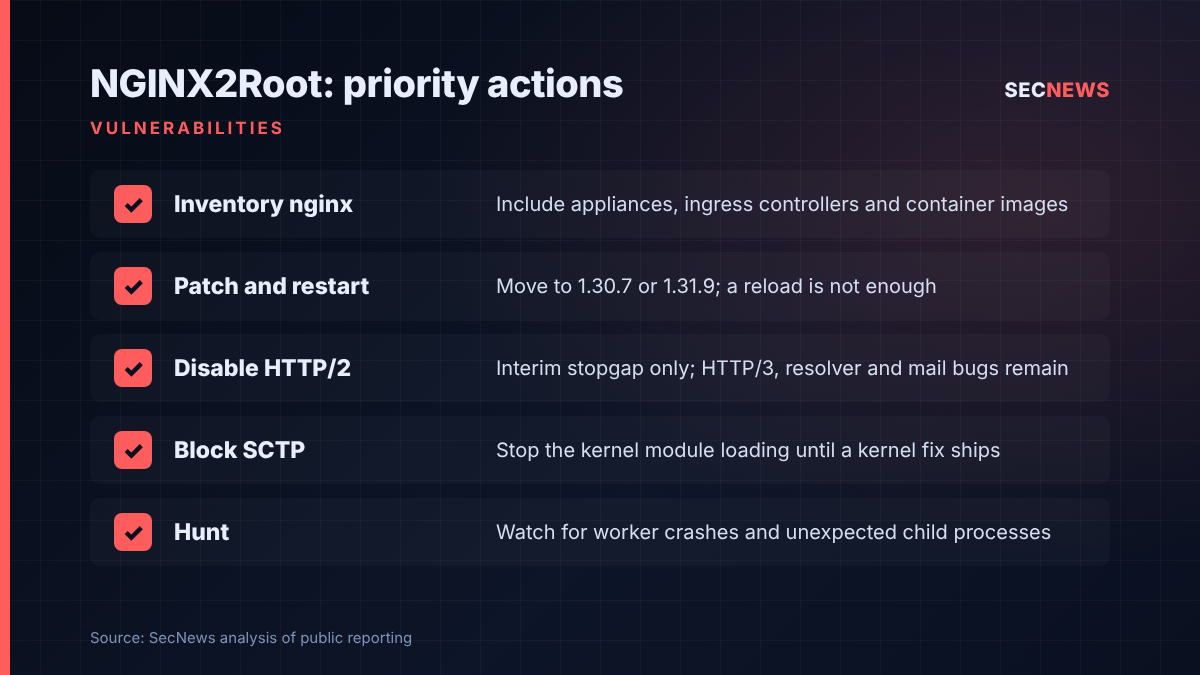
- Inventory first. Find every nginx instance, including those inside appliances, ingress controllers and container images. Check the build against your distribution or vendor advisory, not just the output of the version command.
- Patch and restart. Move to nginx 1.30.7 or 1.31.9, or the relevant NGINX Plus release named in F5’s advisories. Xint and CIRCL both stress that a configuration reload does not replace the running binary, so do a full restart or a supported live binary upgrade (Cyber Essentials: security update management).
- Interim mitigation. If you cannot patch immediately, disable HTTP/2 on exposed listeners and confirm externally that it is no longer negotiated. Be aware this does not cover the HTTP/3, resolver or mail proxy bugs, and may break gRPC services.
- Reduce the other attack paths. Disable QUIC where it is not needed, use fixed upstream groups rather than request-derived proxy targets, and keep any mail proxy off the internet (Cyber Essentials: secure configuration, firewalls).
- Block SCTP. On hosts that do not need it, stop the SCTP kernel module from loading until a kernel fix is released. Check the host kernel even if nginx runs in containers.
- Hunt. Look for nginx workers spawning unexpected processes, abnormal worker crashes or core dumps, and long-lived HTTP/2 connections carrying large inbound volumes with few logged requests.
Bottom line
NGINX2Root centres on a decade-old flaw in one of the most widely deployed pieces of internet infrastructure, with a proof of concept reportedly public and a route to full host compromise. Exploitation is not trivial yet, which gives defenders a short head start. Use it: find every nginx you own, patch and restart it, and lock down SCTP while the kernel fix catches up.
Sources
- nginx.org: nginx security advisories
- nginx.org: Changes with nginx 1.31.9
- Xint: NGINX2Root, new remote code execution vulnerabilities in nginx require urgent patching
- Wiz: Unauthenticated remote code execution in NGINX, CVE-2026-123633 and CVE-2026-123007
- CIRCL: TR-105 NGINX2ROOT, remote code execution in NGINX and potential host compromise
- SecurityOnline: NGINX2Root (CVE-2026-123007), NGINX RCE explained
- F5: NGINX ngx_http_v2_module vulnerability CVE-2026-123007