Broadcom has issued an emergency fix for a critical vCenter Server flaw that hands an unauthenticated attacker an administrator session. Google’s Mandiant says a suspected Chinese espionage group had been using it quietly since early September, so patching alone will not tell you whether you were already a victim.
What happened
On 19 November 2026 Broadcom published VMware security advisory VMSA-2026-0009, rated critical overall. Its headline fix is CVE-2026-123890, a flaw that lets attackers skip authentication in the VMware Directory Service (vmdir), which sits inside every vCenter Server appliance. Broadcom scores it 9.8 on CVSS v3.1 and says anyone with network reach to vCenter could abuse it. There is no workaround.
The advisory itself is silent on exploitation, but Mandiant and Google Threat Intelligence Group (GTIG) published research the same day showing the bug had been used as a zero-day for more than two months. They attribute the activity to Armory Castle, a suspected China-nexus espionage cluster previously tracked as UNC5221 and known to some vendors as Warp Panda. Mandiant says it has investigated multiple intrusions involving the flaw. No victims have been named.
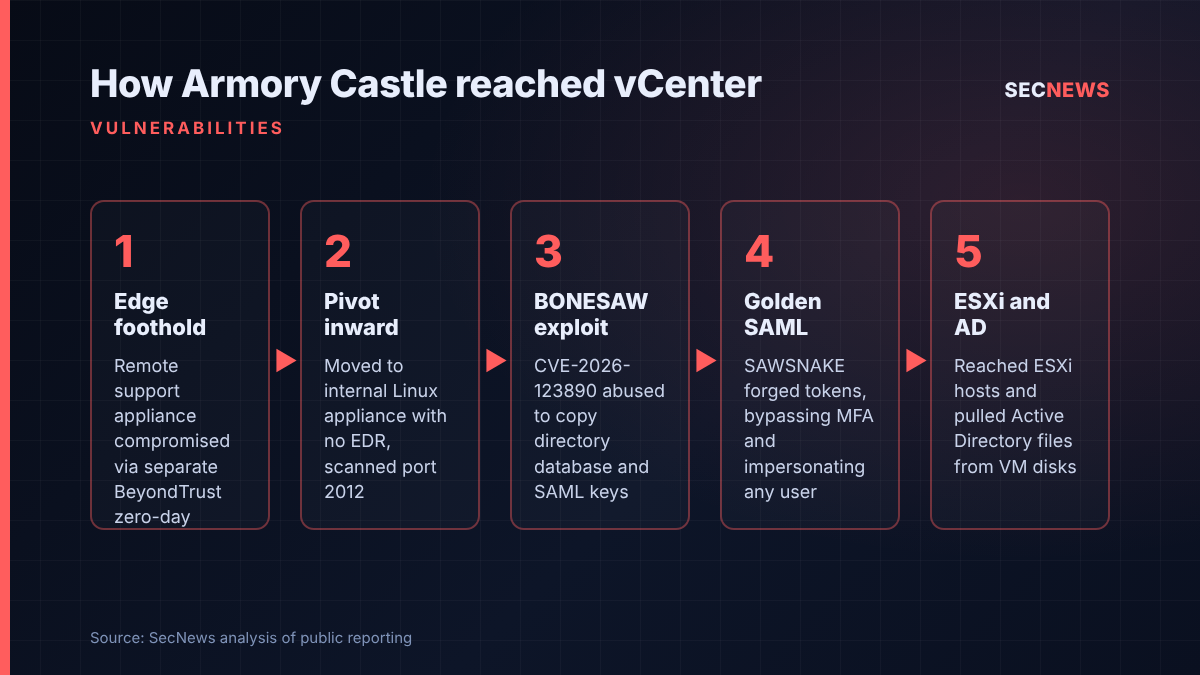
For context, the same group’s way in during at least one intrusion was a separate BeyondTrust Remote Support zero-day, CVE-2026-102764, which Mandiant reported in October. The vCenter bug is a new and distinct vulnerability, used after that initial foothold.
The advisory also fixes four lower-rated issues: three in SDDC Manager (CVE-2026-123891, CVE-2026-123892 and CVE-2026-123893, scored between 6.7 and 8.1) and a flaw in VMware Tools for Windows that skips SAML token signature checks (CVE-2026-123894, 6.7). None of those four is reported as exploited, and ESX hosts themselves are not affected.
The technical picture
According to Mandiant’s analysis, as reported by SecurityOnline and IT-Connect, the weakness lies in the RPC interface that vmdir exposes on TCP port 2012. The flaw leaks a Secure Remote Password (SRP) session key, which an attacker can use to obtain a session as administrator@vsphere.local without ever knowing a password. Mandiant is clear that it differs from CVE-2026-59309, the vmdir LDAP bug patched in July; the group’s tooling worked against a server that already carried that earlier patch.
The intrusion chain Mandiant describes is a textbook example of an attacker living below the endpoint security layer:
- After compromising the remote support appliance, the operators moved to an internal Linux appliance that had no EDR, dropped web shells and scanned for VMware services, including port 2012.
- A custom Go tool, BONESAW, exploited CVE-2026-123890 to copy the directory database, steal SAML signing material and add a new SSO administrator.
- A second utility, SAWSNAKE, forged SAML tokens, a Golden SAML approach that sidesteps MFA and lets the attacker impersonate any user.
- The group briefly enabled SSH on vCenter to grab the appliance’s master key along with database credentials, then disabled it, before moving on to ESXi hosts and pulling Active Directory database files directly from virtual machine disks.
BONESAW carries a build timestamp of 13 July 2026, although Mandiant cautions that Go build metadata can be altered. Mandiant also describes the tool as likely built for wider operations, which suggests the victims it has seen are unlikely to be the only ones.
Why it matters for UK organisations
vCenter is the control plane for a large share of on-premises virtualisation in the UK, from FTSE estates and local authorities to NHS trusts, universities and the managed service providers that run infrastructure for smaller firms. Whoever owns vCenter effectively owns every virtual machine beneath it, including domain controllers, file servers and backup appliances. Espionage crews and ransomware affiliates both prize that access.
Two details should worry UK teams in particular. First, fixed builds exist only for vCenter 9.1, 9.0 and 8.0 (9.1.1.0200, 9.0.2.0200 and 8.0 U3m, the last also used on VMware Cloud Foundation 5.x). vCenter 7.0 left general support in October 2025, a patch for it is available only to customers holding an extended support contract, and Mandiant says BONESAW works against both 7.x and 8.x. Broadcom has not assessed 6.5 or 6.7 and advises treating them as vulnerable.
Second, the attack does not depend on vCenter being exposed to the internet. Mandiant’s chain started at an edge appliance and pivoted inward, which is exactly the kind of route that Cyber Essentials boundary controls do not, on their own, stop.
Expert view
When we test virtualised estates, vCenter is nearly always reachable from far more of the internal network than it should be. Management interfaces tend to sit on a flat server VLAN alongside the very Linux appliances, monitoring boxes and jump hosts that rarely carry EDR. Armory Castle’s playbook relies on precisely that gap: get onto something unmonitored, then attack the management plane from inside.
The detail that stands out to me is the SAML signing material. Patching closes the door, but if the signing key has already been copied, forged tokens may keep working afterwards. Mandiant’s CTO, Charles Carmakal, put it plainly, telling SecurityWeek that organisations should “apply the patches and examine their systems for evidence of compromise.” I would go further: if you ran an affected build with port 2012 reachable from a host you cannot vouch for since early September, treat a compromise assessment as part of the remediation, not an optional extra.
In my experience, the brief SSH toggle is also a useful lesson. Attackers who switch services on and off again are betting that nobody is collecting appliance logs centrally. Most organisations I see still are not.
What to do now
- Patch vCenter today. Move to 9.1.1.0200, 9.0.2.0200 or 8.0 U3m as appropriate (on VCF 5.x, 8.0 U3m via KB 88287). Broadcom warns that 8.0 U3m and 9.0.2.0200 temporarily prevent a move to VCF 9.1.1. This falls squarely under the Cyber Essentials security update management control, which expects critical fixes within 14 days; for an exploited flaw, aim for days.
- Deal with legacy versions. If you run 7.0 without extended support, or 6.x, plan an urgent upgrade and isolate the appliance meanwhile.
- Restrict port 2012 and other vCenter management ports to a small set of dedicated admin hosts using internal firewall rules. This applies the firewall and secure configuration principles inside the network, not just at the boundary.
- Hunt for compromise. Audit SSO accounts for any administrator nobody on your team set up, look through VAMI logs for SSH that was switched on and later off again, and look for unexpected SSH listeners on high ports.
- If you find anything, rotate trust material. Replace the vCenter STS signing certificate and reset all SSO credentials, because forged SAML tokens can outlive the patch. Assume Active Directory may be exposed and plan accordingly.
- Close the visibility gap. Put EDR or equivalent monitoring on internal Linux appliances where possible, and forward vCenter and ESXi logs to your SIEM.
- Patch the rest of VMSA-2026-0009 in SDDC Manager and VMware Tools for Windows during the same window.
Bottom line
CVE-2026-123890 turns network access to vCenter into full administrative control of the virtual estate, and a suspected state-linked group has been using it since at least September. Patch immediately, lock down who can reach the management plane, and assume that any unpatched, reachable vCenter needs a proper compromise check rather than just an update.
Sources
- Broadcom (VMware): VMSA-2026-0009 questions and answers
- SecurityWeek: Newly patched VMware vCenter flaw exploited as zero-day by Chinese APT
- BleepingComputer: VMware patches vCenter zero-day exploited in attacks since September
- SecurityOnline: VMware vCenter zero-day CVE-2026-123890 exploited in the wild
- IT-Connect: Critical VMware vCenter zero-day lets attackers log in as administrator
- Virtualization Review: Broadcom and CISA sound alarms on critical security flaws