Transport for London says around 265,000 Oyster photocard customers had home addresses, dates of birth and account security answers exposed after suspicious activity on its photocard website was detected on 16 November 2026. The site remains offline, the ICO has been notified and affected customers are being contacted.
What happened
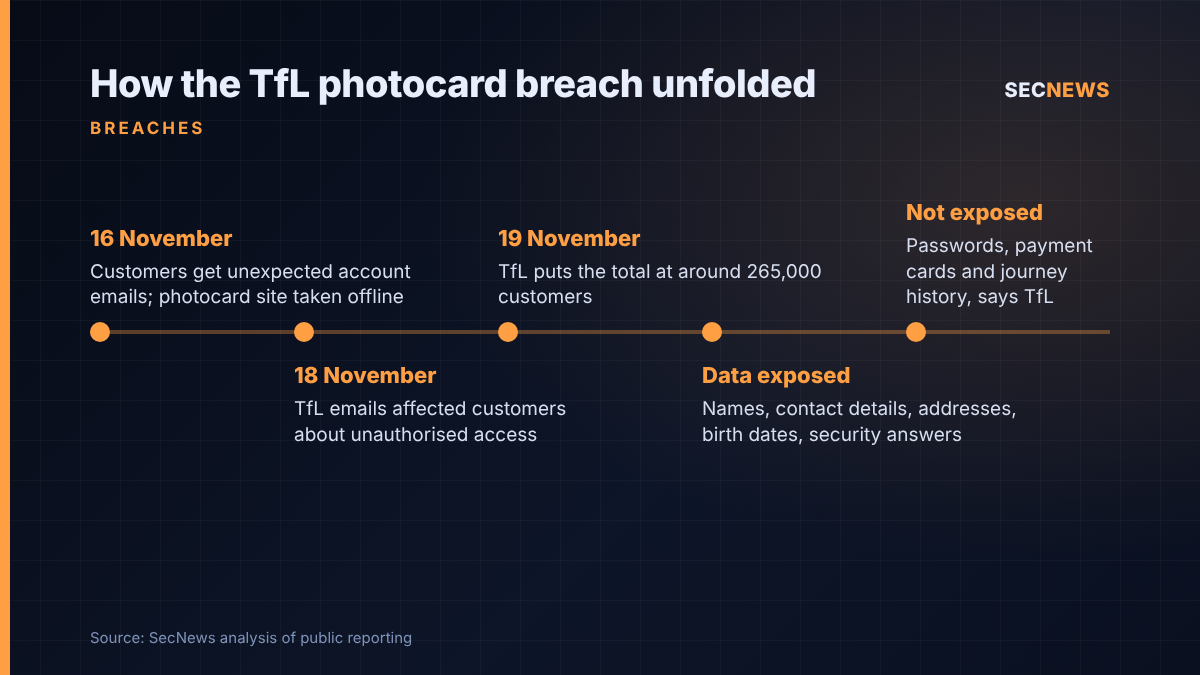
TfL found out something was wrong in an unusual way. On Monday 16 November, existing Oyster photocard holders started receiving emails, sent through TfL’s own systems, asking them to create an account they already had. TfL has since confirmed those messages were a product of the compromise. It pulled the photocard website offline the same day while it investigated.
By Wednesday 18 November, TfL was emailing affected customers to tell them that their web account information had been accessed without authorisation. On Thursday 19 November it put the total at around 265,000 customers, up from an earlier working figure of roughly 250,000, according to BleepingComputer. TfL says the investigation is continuing, so that number could still move.
The accounts affected span a wide range of TfL’s concession schemes: Zip Oyster cards for children and young people, 18+ Student, 18-25 Care Leaver, 60+ London, Apprentice and Veterans photocards. Shashi Verma, TfL’s director of technology strategy and revenue, said the incident had been contained and argued that the speed of the response had “significantly reduced” the number of people caught up in it.
Existing photocards still work for travel, but online applications, renewals and account management are unavailable until the site returns, and TfL has given no date.
The detail
According to TfL, the data exposed for affected customers covers full name, email address, phone number, home address, date of birth and the security question and answer set on the account. TfL’s current assessment is that passwords, bank and payment card details and journey history were not accessed. It also says Zip Oyster cardholders’ own names and birth dates were not compromised, and ITPro reports that customer photographs were not exposed either.
TfL has not said who was behind the activity, how they got in, or whether the attacker abused a flaw in the photocard application, a third-party component or valid credentials. That gap matters. The fact that the attacker could trigger account-creation emails from TfL’s own infrastructure suggests access to application functionality, not simply a leaked database file, but until TfL publishes more, that is inference rather than fact. TfL says it has seen no evidence of misuse so far.
Once the portal is back, customers will be asked to change their password and their security question and answer. Anyone who reused those answers elsewhere should change them there too.
This is TfL’s second significant breach in just over two years. The September 2024 intrusion, which has been linked to the Scattered Spider collective, was first described as affecting about 5,000 customers whose refund bank details may have been seen. TfL later confirmed to The Register that it had emailed more than 7 million customers about that incident, and the BBC reported the database involved could have held records on as many as 10 million people. The ICO chose not to take enforcement action over that earlier breach.
Why it matters for UK organisations
The number is modest by recent standards; the profile of those affected is not. Photocard holders are, by definition, students, care leavers, older Londoners, apprentices, veterans and families with children. Several of those groups are disproportionately targeted by fraudsters, and a care leaver’s home address is not a trivial thing to lose.
The most dangerous field in the haul is the security question and answer. Unlike a password, people rarely change these, and the same handful of prompts (first school, mother’s maiden name, first pet) recur across banks, utilities, telecoms providers and government services. Nathan Davies-Webb of Acumen Cyber told ITPro that this was the most concerning element of the breach. Combined with a verified name, date of birth, address and phone number, a stolen answer gives a social engineer exactly what a call centre agent expects to hear.
There is a second, quieter lesson. Customers first noticed this because legitimate TfL infrastructure was used to send them unexpected mail. Any organisation whose transactional email platform can be driven by an attacker has handed them a trusted sender, and messages sent that way would very likely pass DMARC, SPF and DKIM checks. Email authentication protects the brand from spoofing; it does nothing once the real system is in hostile hands.
For public bodies, this incident will also be watched through a regulatory lens. Having avoided enforcement over the 2024 breach, TfL now reports a second exposure of customer data. How the ICO weighs a repeat incident will interest every council and transport operator running similar concession schemes.
Expert view
In my experience, concession and entitlement portals are some of the least loved applications in a public sector estate. They are often built once by a supplier and left largely untouched for years. When we test them, the recurring themes are weak rate limiting on account and email functions, verbose responses that confirm whether a user exists, and administrative or batch features reachable from the internet that were only ever meant for internal staff. TfL has not said how this intrusion happened, but those are the places I would look first.
I would also question the continued use of security questions at all. They are knowledge-based authentication, and the knowledge is now in someone else’s hands for a quarter of a million people. TfL has asked customers to change them, which is sensible, but the stronger move for any service designer is to retire them in favour of one-time codes or passkeys.
Credit to TfL, though, for pulling the service the same day; that decision usually limits the damage.
What to do now
- If you hold a photocard: ignore any unexpected “create an account” email, treat calls or messages quoting your personal details with suspicion, and change any security answers you reused elsewhere, starting with banks and mobile providers.
- Help desks and contact centres: stop relying on static security questions, date of birth and address as proof of identity. Move to one-time codes sent to a registered device, or call-backs to a verified number.
- Customer-facing web apps: inventory concession, membership and loyalty portals, confirm patch levels (Cyber Essentials: security update management) and review exposed admin and bulk-mail functions (secure configuration).
- Transactional email: alert on unusual send volumes or new templates from application mail relays, and restrict which services can call the mail API (access control).
- Authentication: enforce MFA for every administrator and supplier account with access to customer platforms, and log all privileged activity centrally.
- Breach readiness: pre-draft customer notifications and ICO reports so you can meet the 72-hour window, and rehearse taking a public service offline quickly.
Bottom line
TfL acted fast, but a second customer data breach in just over two years, this time including security answers for vulnerable groups, will draw scrutiny. For everyone else, the takeaway is blunt: security questions are now a liability, and any public portal that holds them deserves a fresh look.
Sources
- BleepingComputer: Transport for London breach exposes 265,000 Oyster card users’ data
- Infosecurity Magazine: TfL Warns 265,000 Photocard Customers May Have Had Personal Data Exposed
- ITV News: 265,000 TfL Oyster photocard customers may have had account details compromised
- ITPro: Oyster photocard breach: TfL takes system offline after 260,000+ customers affected by attack
- IBTimes UK: TfL Oyster Photocard Breach Exposes Names, Home Addresses and Security Answers
- Yahoo News UK: Hackers access details of 265,000 Oyster card customers in TfL cyber breach
- The Register: Transport for London says 2024 breach affected 7M customers, not 5,000