PHP has shipped security releases for every supported branch, fixing 17 vulnerabilities, seven of which the project rates critical. The most talked-about, phpAfterShell, abuses PHP’s default file-based session storage and is not covered by last month’s emergency fixes.
What happened
On Wednesday 18 November the PHP security team gave administrators a day’s notice that a release rated CRITICAL was coming, adding that the worst issues depended on “non-default configuration or uncommon setups”. The fixes landed on Thursday 19 November, a little after 14:00 UTC, as PHP 8.5.13, 8.4.28, 8.3.37 and 8.2.36. PHP 8.6.0, the new feature release, went out the same afternoon and carries the same fixes.
Counts vary depending on who you read. The project’s own advisories cover 17 CVEs, which is the figure heise and UK firm Precursor Security use. BleepingComputer, citing Aikido, reports 18; Precursor says higher tallies include a bundled uriparser library flaw that has no PHP advisory. Either way, seven of the PHP issues carry a CVSS 4.0 score of 9.2, with four more rated high and the rest medium.
The bug drawing most attention is CVE-2026-126714, nicknamed phpAfterShell, which was reported by research firm Depthfirst. It arrives four weeks after the PHP2Shell flaws forced emergency releases in October, and organisations that patched only for those are still exposed: the October builds do not contain this fix. No attacks have been reported against any of the November CVEs, and none is in CISA’s Known Exploited Vulnerabilities catalogue.
The technical picture
phpAfterShell lives in the files session handler, which is what PHP uses unless someone has configured Redis, a database or another store. Session records are written as a key followed by serialised data, with length fields but nothing to mark that a write has finished. If the worker dies partway through, the file can end up holding the opening of the new record stitched to the tail of the old one. Depthfirst showed that carefully chosen lengths make the leftover bytes parse as a separate object, which PHP then rebuilds the next time the application starts the session. Turning that into code execution needs a gadget chain in the application or, as in Depthfirst’s chain, a second PHP bug, but the same trick can also alter login state or CSRF tokens.
The researchers’ route in uses the session upload progress feature, which was switched on by default until this release. A multipart request carrying the progress field causes a session write before any application code runs, so no upload form is required, only a page that later opens the session.
The other critical issues deserve equal attention:
- CVE-2026-129289 is request smuggling in PHP-FPM. Where the web server keeps FastCGI connections open between requests (nginx fastcgi_keep_conn, Apache enablereuse, some HAProxy and LSAPI set-ups) and a script opens php://input without reading all of it, an unauthenticated attacker can get their own PHP executed. Standard configurations that close the connection each time are not affected.
- CVE-2026-115560 is a session serialiser mismatch, first flagged in an informational advisory on 23 October. CSIRT Italia says proof-of-concept code is already online, according to Precursor’s tracker.
- Four use-after-free bugs: CVE-2026-129496 in the timezone cache, plus CVE-2026-129481, CVE-2026-129474 and CVE-2026-129182 in session and error handling. Two of the latter follow on from the October PHP2Shell work, and CVE-2026-129481 is described as an incomplete fix for one of those earlier flaws.
Outside the critical set, CVE-2026-129291 (8.8) allows a compromised FPM worker to attack the master process, which often runs as root.
Why it matters for UK organisations
PHP underpins a large slice of the UK web: WordPress, Drupal and Magento sites, council and charity portals, hosting control panels and many internal tools. Many are run by small agencies or shared hosts, where patch lag builds up.
Three practical problems stand out. First, packaging. Precursor reported that Ubuntu, Red Hat, SUSE and Amazon Linux packages were still pending on Thursday afternoon, while heise noted Debian had already published 8.4.28. Distributions often backport fixes without changing the upstream version number, so a version check alone can mislead you in either direction. Second, legacy branches. PHP 8.1 and earlier receive nothing from the project; BleepingComputer notes that Ondřej Surý, whose package repositories are widely used on Ubuntu and Debian servers, has published patched builds going back to 5.6, but that is a third-party route. Astra also points out that PHP 8.2 itself reaches end of life on 31 December. Third, visibility: Precursor observed that the NCSC’s most recent PHP alert at the time was still the October PHP2Shell one, so do not wait for a national advisory before acting.
Expert view
The “non-default configuration” caveat is doing a lot of work in the PHP announcement, and I would not lean on it. When we test PHP estates, connection reuse between nginx and FPM is a common performance tweak, upload progress has been on everywhere by default, and file-based sessions are the norm on single-server and shared hosting builds. Those are the conditions several of these bugs need.
The October episode is the more useful guide. PHP2Shell was fixed on 21 October and, according to Check Point, was being used against its gateways from 30 October. With proof-of-concept material reportedly public for parts of this batch, I would measure the exploitation window in days.
There is also a quieter operational trap. The fixed releases turn upload progress off by default, which the release notes do not make obvious. Applications that rely on it may break, and an explicit setting in php.ini, an FPM pool or a hosting panel will override the new default and leave the exposure in place.
What to do now
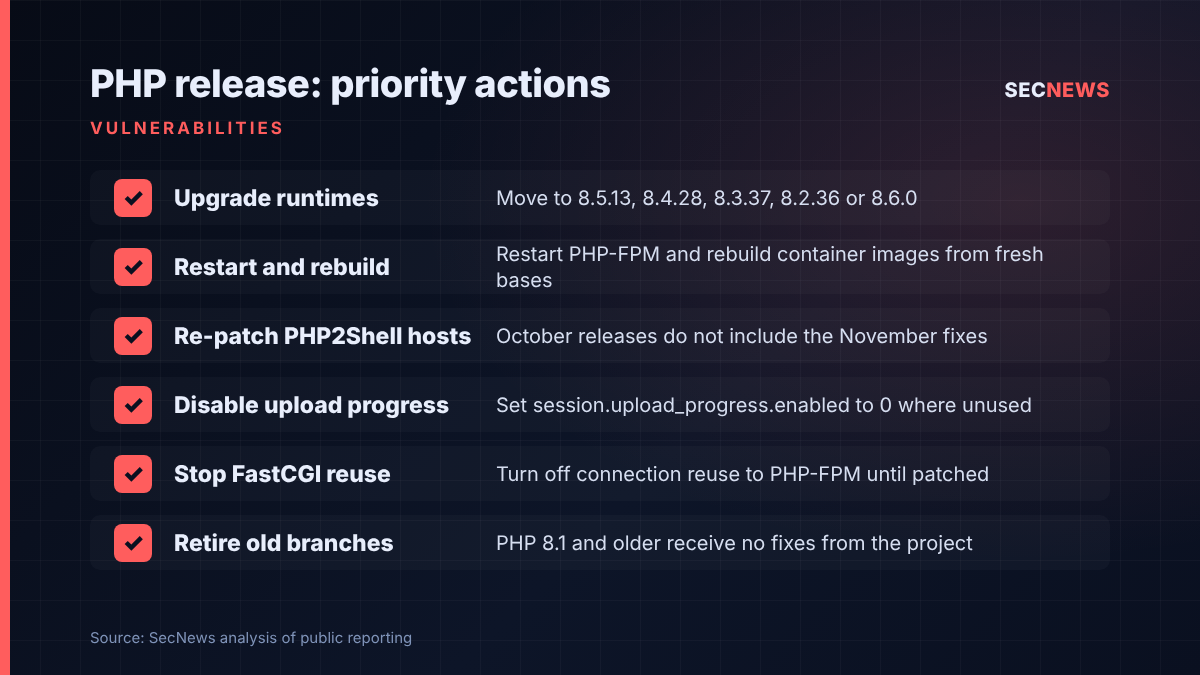
- Patch every PHP runtime to 8.5.13, 8.4.28, 8.3.37, 8.2.36 or 8.6.0. Rebuild container images from a freshly pulled base, then restart PHP-FPM so the new binary is actually serving requests. Under Cyber Essentials, critical fixes like these fall inside the 14-day security update management window.
- Verify, do not assume. Check what the web server is running, not just the command line, and check distribution advisories by CVE number where packages are backported.
- Re-patch anything only fixed for PHP2Shell. October’s releases do not cover this batch.
- If you cannot patch today, set session.upload_progress.enabled = 0 where the feature is unused, search configuration files and hosting panels for explicit “On” values, and disable FastCGI connection reuse between the web server and FPM. These are partial measures only.
- Consider moving sessions to Redis or a database where practical, as the file-write defect does not apply there.
- Keep PHP-FPM and LSAPI listeners off untrusted networks and restrict FPM status pages, in line with Cyber Essentials firewall and secure configuration controls.
- Plan the exit from PHP 8.1 and older, and from 8.2 before year end. Ask hosting providers and web agencies which branch your sites run.
Bottom line
This is not a drop-everything event yet: nothing is known to be exploited and the worst bugs need particular settings. But those settings are common, PHP2Shell showed how quickly attackers follow PHP fixes, and October’s patches do not help. Update every PHP runtime this week, confirm the running version, and check that upload progress is genuinely switched off where you do not need it.
Sources
- PHP: News Archive 2026 (security release notice and 8.2.36 to 8.5.13 releases)
- PHP: ChangeLog for PHP 8.4.28
- BleepingComputer: PHP security updates fix 18 flaws, including critical RCE bugs
- heise online: PHP fixes 17 security flaws; four allow code execution
- The Hacker News: PHP Fixes 7 Critical Flaws, Including Bugs That Could Allow Remote Code Execution
- The Hacker News: phpAfterShell Explained
- Precursor Security: phpAfterShell (CVE-2026-126714): Live PHP RCE Updates
- Astra Security: PHP Critical Security Release, 19 November 2026
- Cycode: PHPAfterShell (CVE-2026-126714)