A month after spotting an intruder on its networks, the European Commission has confirmed that personal data has leaked from its EU Academy platform and has still not said the attack is contained. Insiders now reportedly point to a China-backed actor using the AI-driven ARTEX framework, which turns this into a live example of AI-accelerated intrusion against a major public body.
What happened
On Monday 23 November the European Commission told users of EU Academy, its public online learning platform, that names and email addresses had been taken in the cyber campaign it has been fighting since October. Spokesperson Thomas Regnier said the size of the leak was still being investigated and gave no figure for how many people are affected. The platform was pulled offline on Saturday, and a notice on the site warns users to treat unexpected messages about it with suspicion.
The same day, Euronews reported, citing two people familiar with the matter, that the Commission believes a Chinese state-backed network is responsible. The codename used internally for the attackers is “Panda”, the label the security industry conventionally gives to China-linked groups. The suspicion reportedly rests on how sophisticated the intrusion is and on the attackers’ use of ARTEX, an AI-assisted offensive framework developed in China. Beijing denies sponsoring such hacking, and there is no formal attribution.
This is a distinct incident from earlier ARTEX activity covered here: a named EU institution, a confirmed data leak and an intrusion still running.
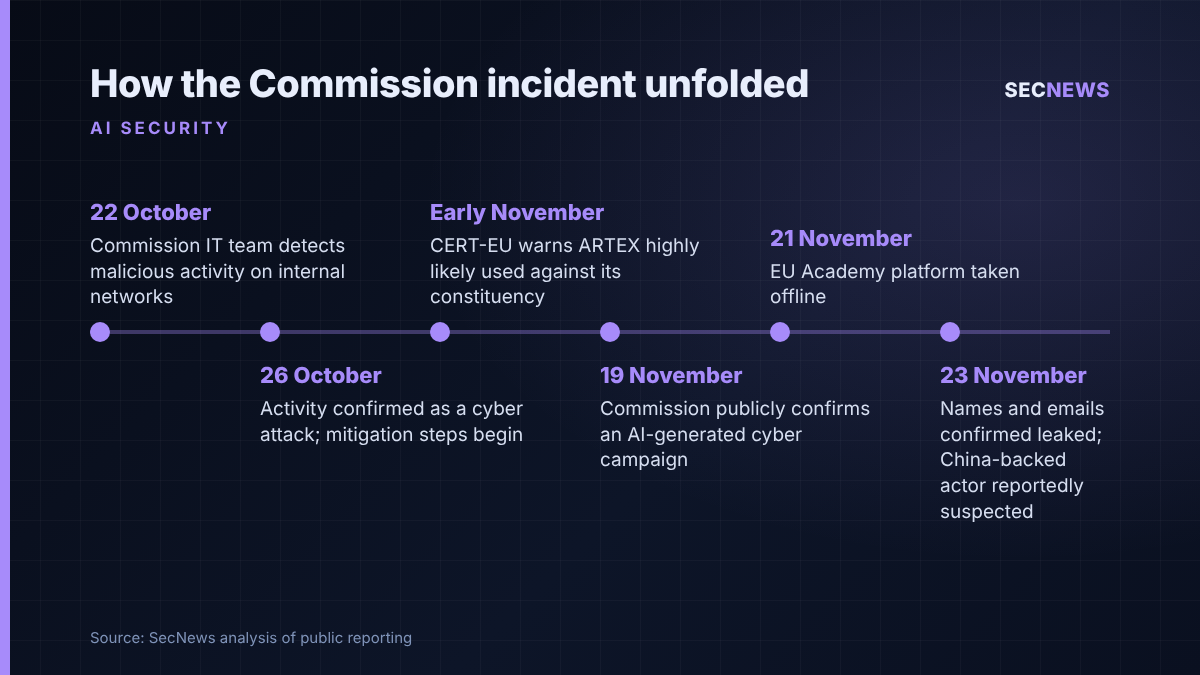
The timeline is worth setting out. The Commission’s IT team detected malicious activity on 22 October and confirmed four days later that it was an attack. Politico reported that precautionary shutdowns hit Sysper, the staff HR and payslip system, and a medical reimbursement service. The Commission only confirmed the incident publicly on 19 November, after press reports. Regnier then called it an “AI-generated cyber campaign” and said he knew of no ransom demand.
The technical picture
ARTEX is not exotic malware. It is an open-source offensive platform, released in July, written in Go with a web console, which acts as a command-and-control hub for several AI agents and plugs into commercial large language models. In effect, reconnaissance, vulnerability discovery and exploit preparation are handed to models running in parallel. CERT-EU warned in early November that it was “highly likely” the tool had been used against bodies in its constituency. It added that public availability would probably make automated attacks faster and more frequent.
Two details in the reporting matter for defenders. First, the current assessment, as Euronews describes it, is that the actor was not after particular systems or people. It seems to have been testing how far it could spread through the Commission’s estate. That breadth-first behaviour fits agent-driven tooling, which will happily try every reachable service rather than quietly pursue one objective. Second, a month on, the Commission still will not say the attacker is out, which suggests multiple footholds or slow eradication across a large, federated estate.
The data now confirmed as leaked is modest: names and email addresses. The real risk is follow-on phishing using contacts from a trusted EU platform, which the Commission has itself warned about.
Why it matters for UK organisations
The UK is outside the EU, but this is close to home in three ways. Many UK businesses, universities and consultancies work with Commission programmes, and their staff may hold EU Academy accounts. They should expect convincing emails that appear to come from EU services.
More importantly, the incident fits closely with the NCSC’s assessment published on 3 November, which looks at AI and cyber intrusion out to 2028. The NCSC judges it highly likely that China, Russia and other states will routinely use AI-enabled tooling for geopolitical ends, increasing both the speed and the scale of attacks on the UK. It also expects large numbers of systems to stay exposed to AI tools that hunt for weaknesses. A large Brussels bureaucracy with sprawling legacy applications is precisely the kind of target that assessment describes.
There is also a governance lesson. The Commission’s main staff union has criticised management for leaving employees to learn about the attack from the press. Officials counter that going public too early would have warned the intruder that containment was under way. UK organisations face the same tension, but with firmer rules. Under UK GDPR a personal data breach generally has to be reported to the ICO within 72 hours of becoming aware of it. The Cyber Security and Resilience Bill is set to tighten incident reporting for regulated sectors and their suppliers.
Expert view
When we test large public-sector estates, the tightly guarded crown jewels are rarely where we get in. The way in is usually the long tail of internet-facing applications: training portals, booking systems, forgotten staging sites. EU Academy sounds like exactly that kind of asset. AI tooling such as ARTEX does not invent new weaknesses. It removes the labour cost of finding the ones that are already there. Shaun Williams of SentinelOne made a similar point to The Record: the significance is that such tools let attackers find and exploit exposed flaws more cheaply and with less skill.
In my experience, the defensive answer is not mainly an AI arms race, although ISACA’s Chris Dimitriadis is right that AI now lets attackers move “at the speed of intent”. The answer is shrinking what is reachable, and seeing quickly when something unusual starts touching it. A breadth-first, agent-led intrusion is noisy and should light up centrally collected logs. A month-long dwell time hints that visibility across peripheral services was patchy.
I would also urge caution over attribution. The China link rests on unnamed sources, tooling and sophistication. ARTEX is open source and the FBI has said criminals use it too. Defenders should plan for the behaviour rather than the flag.
What to do now
- Inventory your internet-facing estate. List every public application, including training, events and partner portals, with a named owner. Retire anything nobody will own. This maps to the Cyber Essentials firewall and secure configuration controls.
- Patch peripheral systems on the same clock as core ones. Apply the Cyber Essentials 14-day rule for high and critical fixes to every exposed asset, not just flagship services.
- Centralise logging for edge applications. Watch for bursts of enumeration, unusual authentication patterns and lateral movement from web tiers. Rapid parallel probing is a hallmark of automated frameworks.
- Brief staff on EU-themed phishing. Anyone with EU Academy or other Commission accounts should treat unexpected messages about those services with suspicion and report them.
- Rehearse eradication, not just detection. Your plan should cover credential resets, host rebuilds and proof that persistence has gone.
- Agree your disclosure position in advance. Document how you will balance operational secrecy with ICO deadlines and communication with staff, so the decision is not made under pressure.
Bottom line
The Commission breach is one of the clearest public cases yet of an AI-assisted intrusion against a major government body. It reached a confirmed data leak and is still not declared contained after a month. Whoever is behind it, the lesson for UK defenders is practical: automated tooling punishes forgotten, exposed systems and weak central visibility. Fix those first.
Sources
- Euronews: Exclusive: China-backed hackers suspected behind ongoing EU Commission cyberattack
- Associated Press via ABC News: European Commission warns EU Academy users of data leak after AI-driven cyberattack
- The Record: European Commission confirms cyberattack, says hackers used AI tool
- Infosecurity Magazine: European Commission Confirms AI-Driven Cyber-Attack Took Systems Offline
- NCSC: Artificial intelligence and cyber intrusion