A new extortion site calling itself Inception has named seven large companies, including AMD, PepsiCo and Cigna Healthcare, as victims within a week of appearing online. Okta says the vishing crew whose targets used to surface on the ShinyHunters leak site has very likely moved across to the new brand, although none of the named firms has confirmed a breach.
What happened
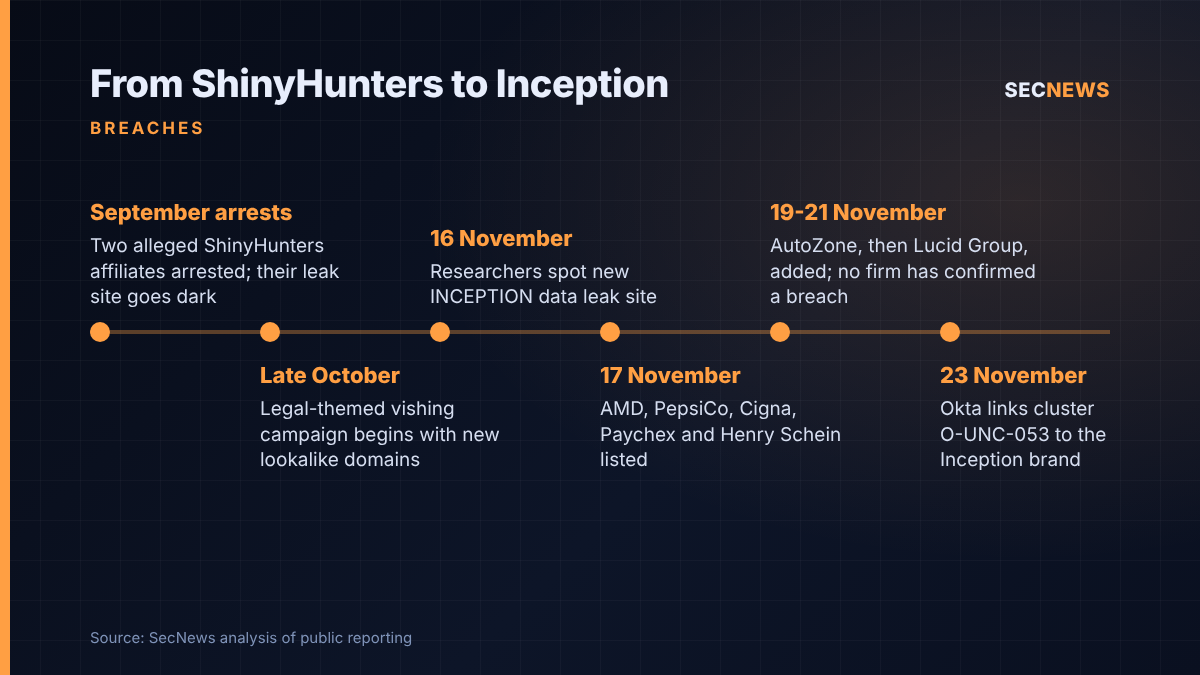
On 23 November 2026, Okta Threat Intelligence published an advisory on a threat cluster it tracks as O-UNC-053. Between March and September this year, organisations targeted by that cluster’s phishing infrastructure kept turning up on the ShinyHunters data leak site. That site went offline after law enforcement arrested two alleged ShinyHunters affiliates in September: Pepijn van der Stap on 15 September and Saif al-Din Khader, known as “Rey”, on 29 September. Throughout October and early November, Okta saw no O-UNC-053 target posted on any leak site, even though the operators were still registering fresh phishing domains.
That gap ended on 16 November, when researchers spotted a new leak site branded INCEPTION. According to The Register, five names went up on 17 November, all marked as leaked: PepsiCo, AMD, Henry Schein, Cigna Healthcare and Paychex. AutoZone followed on 19 November, with the site claiming to have published the retailer’s files. Lucid Group, the electric vehicle maker, was added on Saturday 21 November.
None of the seven companies has confirmed a breach, and none had responded to The Register’s questions at the time of publication. Okta told the outlet it could not validate whether the published data is authentic. At this stage these are extortion claims, not confirmed incidents.
The technical picture
Okta’s link between O-UNC-053 and Inception rests on timing rather than a confession. Several organisations listed on Inception had previously been targeted by O-UNC-053 infrastructure, with the phishing domains registered between six and 19 days before each name appeared on the leak site. Under the old arrangement, the lag between domain registration and a ShinyHunters listing ran from one to 28 days. Okta says the cluster kept the same infrastructure and techniques before and after the switch, and assesses that it has “very likely changed their brand affiliation”. It stops short of saying whether O-UNC-053 runs Inception itself or simply supplies stolen data to another extortion operator.
The intrusion method is old-fashioned social engineering wrapped around modern single sign-on. A caller rings an employee, often posing as support staff, and pushes them to reset their password in a hurry. The victim is steered to a phishing kit that captures the username and password, then asks for whatever MFA factor the organisation uses. While still on the phone, the attacker talks the user into reading out a one-time code or approving a push prompt. With a live SSO session in hand, the crew moves into SaaS applications, pulls out data and later threatens to publish it.
The current campaign has used a legal theme since late October, with domains built from the target’s name plus words such as “legal” or “legaldept”. Okta reports that registrations come mainly through NICENIC, with Cloudflare fronting the sites, and that the operators refresh their theme every four to six weeks. Mallory, summarising work by ReversingLabs, reports that the kit adapts to Okta or NetIQ sign-in pages and that dozens of related domains point to targeting well beyond the seven named firms.
The most useful line in Okta’s write-up is the simplest: the kit cannot get past phishing-resistant authentication such as FIDO2/WebAuthn passkeys or Okta FastPass.
Why it matters for UK organisations
None of the claimed victims is a UK company, but several are multinationals with large British workforces, suppliers and customer bases. If any of these claims prove genuine, UK staff or customer records could be in the haul, and UK data controllers would then face the usual UK GDPR questions about notification to the ICO within 72 hours.
The bigger point is the playbook. Okta’s target list covers technology, healthcare, financial services, insurance, retail, transport, hospitality and legal firms, which describes much of the FTSE 350 and a good slice of the mid-market. The Register notes that many researchers place ShinyHunters within The Com, the loose online network that also takes in Scattered Spider and LAPSUS$. In my view, that shared ecosystem matters more than any single brand name. Arrests take individuals out of circulation, but the techniques, tooling and people move on and reappear under new labels.
The legal theme is also worth noting for UK law firms and in-house legal teams. A call that appears to come from the legal department, combined with a convincing internal-looking domain, is exactly the kind of pretext that busy staff tend not to question.
Expert view
When we run social engineering assessments, the help desk and the end user’s phone remain the softest route into an organisation. Technical controls on the perimeter are often excellent, yet a confident caller with a plausible story can still talk someone into approving a prompt they did not start. Against a live operator on the phone, push prompts and SMS codes protect far less than many boards assume.
What stands out in Okta’s analysis is how predictable the operation is. The crew typically registers lookalike domains on or within a day of a campaign starting, sometimes on the very day a call is placed, and it reuses naming patterns. That makes domain monitoring a useful early warning. In my experience, organisations that watch for new registrations containing their brand name tend to spot this kind of activity days before any data leaves.
I would also urge caution in how these claims are reported internally. A leak site listing is a statement by criminals who benefit from fear. Until a company confirms an incident or credible researchers verify the data, treat it as an indicator worth investigating, not proof of compromise.
What to do now
- Move privileged and high-risk users to phishing-resistant MFA. FIDO2 security keys or passkeys for administrators, finance, HR, legal and IT support first. This maps directly to the Cyber Essentials user access control requirements.
- Harden help-desk identity checks. Require call-backs to known numbers, manager approval or in-person verification before resetting passwords or enrolling new MFA devices.
- Tell staff plainly: IT will never ask you to read out a code or approve a prompt you did not trigger. Make reporting a suspicious call quick and blame-free.
- Monitor for lookalike domains containing your brand plus terms like “legal”, “sso” or “support”, and pursue takedowns quickly.
- Tighten conditional access. Restrict sensitive SaaS applications to managed, EDR-protected devices and challenge or block sign-ins from unusual networks, hosting ASNs and anonymising proxies.
- Review SaaS audit logs for bulk exports, new OAuth grants and sign-ins from unfamiliar infrastructure since late October.
- If you work with any named company, watch for their statements and be alert to follow-on phishing that uses any leaked data.
Bottom line
Inception’s seven claims remain unverified, and the companies have not confirmed breaches. What Okta has shown is that the vishing operation once tied to ShinyHunters survived the autumn arrests and is back at work under a new banner. The defence has not changed: phishing-resistant MFA and a help desk that cannot be talked round.